Department of Oncology, School of Medicine and Life Sciences, University of Jinan‑Shandong Academy of Medical Sciences, Jinan, Shandong 250022, P.R. China.
Department of Radiation Oncology, Shandong Key Laboratory of Radiation Oncology, Shandong Cancer Hospital Affiliated to Shandong University, Shandong Academy of Medical Science, Jinan, Shandong 250117, P.R. China.
Oncol Rep. 2019 Jan;41(1):77-86. doi: 10.3892/or.2018.6803. Epub 2018 Oct 17.
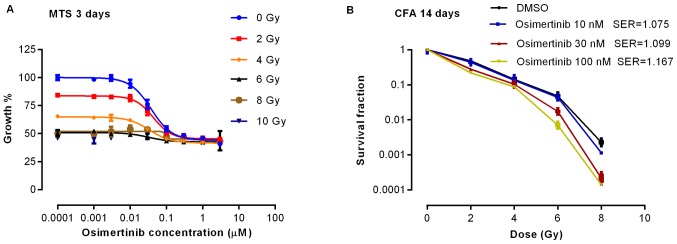
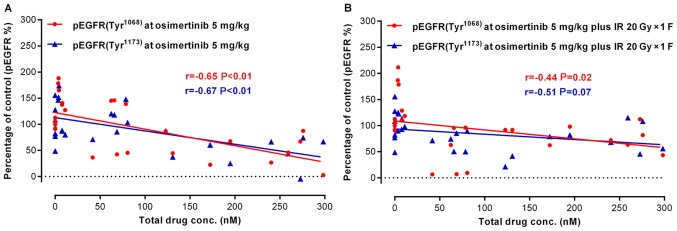
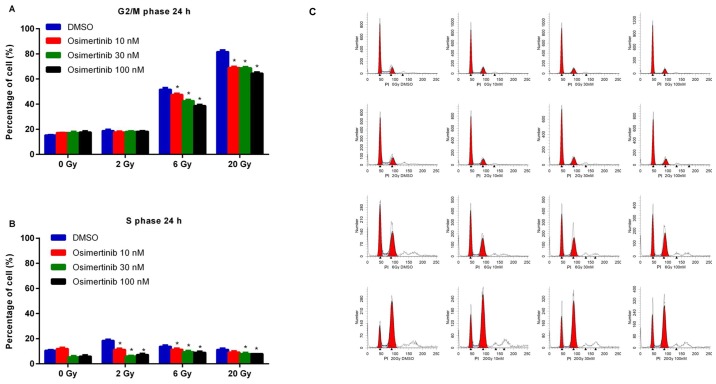
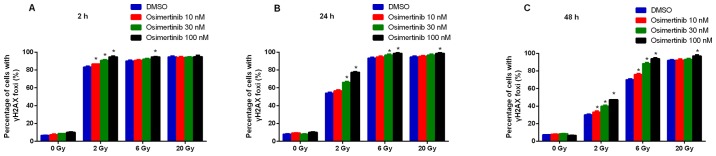
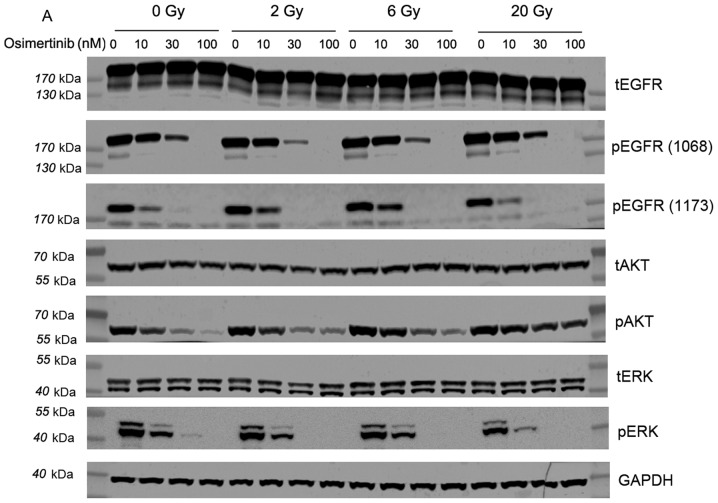
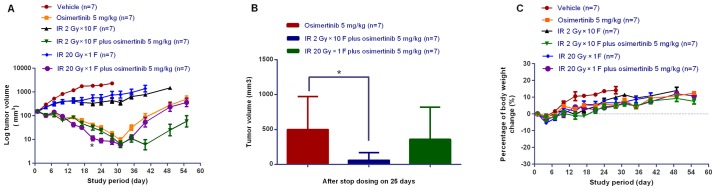
Osimertinib (AZD9291) is a third generation epidermal growth factor receptor (EGFR) tyrosine kinase inhibitor that has demonstrated significant clinical benefits in patients with EGFR‑sensitizing mutations or the T790M mutation. However, the potential therapeutic effect of osimertinib combined with ionizing irradiation (IR) is not well understood. The present study investigated treatment with osimertinib combined with IR in EGFR T790M non‑small cell lung cancer (NCI‑H1975) in vitro and in vivo. The results revealed that osimertinib inhibited proliferation and clonogenic survival following irradiation, decreased G2/M phase arrest in irradiated cells, and delayed DNA damage repair in a concentration‑ and time‑dependent manner. Furthermore, osimertinib alone or in combination with IR, blocked the phosphorylation of EGFR (Tyr1068/Tyr1173), protein kinase B and extracellular signal‑regulated kinase. Osimertinib also enhanced the antitumor activity of IR in tumor‑bearing nude mice. The results of the present study indicated that osimertinib has therapeutic potential as a radiation‑sensitizer in lung cancer cells harboring the EGFR T790M mutation, providing a rationale for clinically combining osimertinib with irradiation in EGFR T790M non‑small cell lung cancer.
奥希替尼(AZD9291)是第三代表皮生长因子受体(EGFR)酪氨酸激酶抑制剂,在具有 EGFR 敏感突变或 T790M 突变的患者中显示出显著的临床获益。然而,奥希替尼联合电离辐射(IR)的潜在治疗效果尚未得到充分了解。本研究探讨了奥希替尼联合 IR 治疗 EGFR T790M 非小细胞肺癌(NCI-H1975)的体内和体外疗效。结果表明,奥希替尼抑制照射后细胞的增殖和集落存活,降低照射细胞的 G2/M 期阻滞,并呈浓度和时间依赖性延迟 DNA 损伤修复。此外,奥希替尼单独或联合 IR 可阻断 EGFR(Tyr1068/Tyr1173)、蛋白激酶 B 和细胞外信号调节激酶的磷酸化。奥希替尼还增强了荷瘤裸鼠中 IR 的抗肿瘤活性。本研究结果表明,奥希替尼具有作为携带 EGFR T790M 突变的肺癌细胞放射增敏剂的治疗潜力,为临床上在 EGFR T790M 非小细胞肺癌中联合奥希替尼与放疗提供了理论依据。