Lima Juliana Beust de, Silveira Anderson Donelli da, Saffi Marco Aurélio Lumertz, Menezes Márcio Garcia, Piardi Diogo Silva, Ramm Leila Denise Cardoso Ramos, Zanini Maurice, Stein Rosane Maria Nery Ricardo
Hospital de Clínicas de Porto Alegre - Universidade Federal do Rio Grande do Sul, Porto Alegre, RS - Brazil.
Arq Bras Cardiol. 2018 Nov;111(5):699-707. doi: 10.5935/abc.20180202. Epub 2018 Oct 18.
Heart failure with preserved ejection fraction (HFpEF) is a multifactorial syndrome characterized by a limited exercising capacity. High-intensity interval training (HIIT) is an emerging strategy for exercise rehabilitation in different settings. In patients with HFpEF, HIIT subacute effects on endothelial function and blood pressure are still unknown.
To evaluate the subacute effect of one HIIT session on endothelial function and blood pressure in patients with HFpEF.
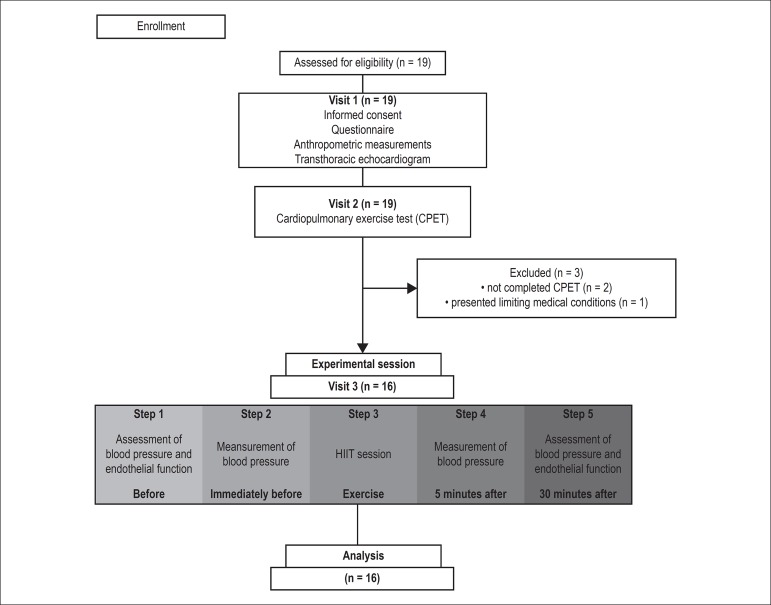
Sixteen patients with HFpEF underwent a 36-minute session of HIIT on a treadmill, alternating four minutes of high-intensity intervals with three minutes of active recovery. Brachial artery diameter, flow-mediated dilation, and blood pressure were assessed immediately before and 30 minutes after the HIIT session. In all analyses, p <0.05 was considered statistically significant.
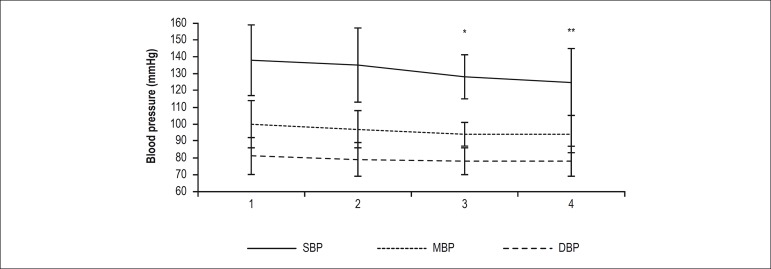
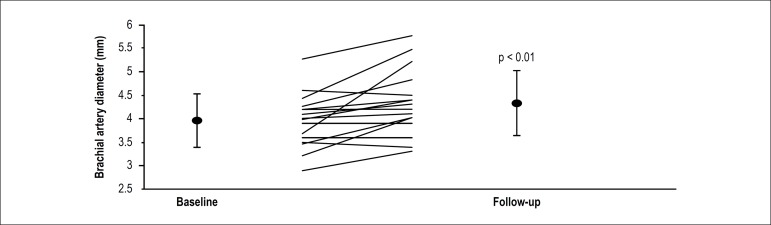
There was an increase in brachial artery diameter (pre-exercise: 3.96 ± 0.57 mm; post-exercise: 4.33 ± 0.69 mm; p < 0.01) and a decrease in systolic blood pressure (pre-exercise: 138 ± 21 mmHg; post-exercise: 125 ± 20 mmHg; p < 0.01). Flow-mediated dilation (pre-exercise: 5.91 ± 5.20%; post-exercise: 3.55 ± 6.59%; p = 0.162) and diastolic blood pressure (pre-exercise: 81 ± 11 mmHg; post-exercise: 77 ± 8 mmHg; p = 1.000) did not change significantly. There were no adverse events throughout the experiment.
One single HIIT session promoted an increase in brachial artery diameter and reduction in systolic blood pressure, but it did not change flow-mediated dilation and diastolic blood pressure.
射血分数保留的心力衰竭(HFpEF)是一种多因素综合征,其特征为运动能力受限。高强度间歇训练(HIIT)是一种在不同环境下进行运动康复的新兴策略。在HFpEF患者中,HIIT对内皮功能和血压的亚急性影响仍不明确。
评估一次HIIT训练对HFpEF患者内皮功能和血压的亚急性影响。
16例HFpEF患者在跑步机上进行了一次36分钟的HIIT训练,4分钟的高强度间歇与3分钟的主动恢复交替进行。在HIIT训练前及训练后30分钟评估肱动脉直径、血流介导的血管舒张功能和血压。在所有分析中,p<0.05被认为具有统计学意义。
肱动脉直径增加(运动前:3.96±0.57mm;运动后:4.33±0.69mm;p<0.01),收缩压降低(运动前:138±21mmHg;运动后:125±20mmHg;p<0.01)。血流介导的血管舒张功能(运动前:5.91±5.20%;运动后:3.55±6.59%;p=0.162)和舒张压(运动前:81±11mmHg;运动后:77±8mmHg;p=1.000)无显著变化。整个实验过程中未发生不良事件。
单次HIIT训练可使肱动脉直径增加,收缩压降低,但对血流介导的血管舒张功能和舒张压无影响。