Fibre and Particle Engineering Research Unit, University of Oulu, P.O. Box 4300, FI-90014 Oulu, Finland.
Department of Bioproducts and Biosystems, Aalto University, P.O. Box 16300, FI-00076 Aalto, Finland.
Molecules. 2018 Oct 25;23(11):2765. doi: 10.3390/molecules23112765.
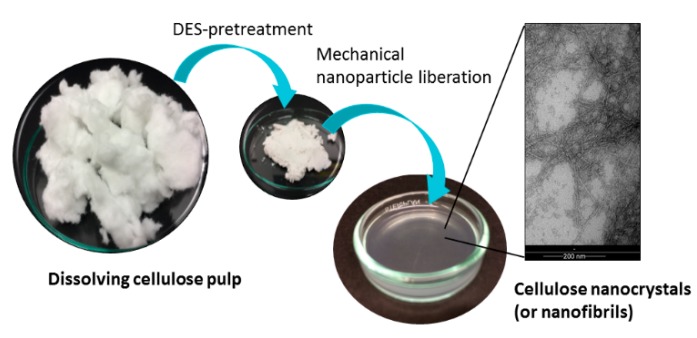
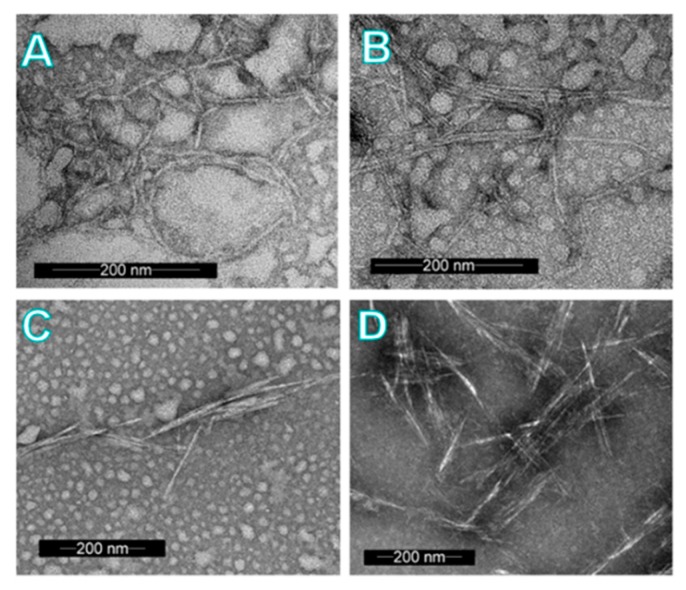
In this experiment, the influence of the morphology and surface characteristics of cellulosic nanoparticles (i.e., cellulose nanocrystals [CNCs] and cellulose nanofibers [CNFs]) on oil-in-water (/) emulsion stabilization was studied using non-modified or functionalized nanoparticles obtained following deep eutectic solvent (DES) pre-treatments. The effect of the oil-to-water ratio (5, 10, and 20 wt.-% (weight percent) of oil), the type of nanoparticle, and the concentration of the particles (0.05⁻0.2 wt.-%) on the oil-droplet size (using laser diffractometry), / emulsion stability (via analytical centrifugation), and stabilization mechanisms (using field emission scanning electron microscopy with the model compound-i.e., polymerized styrene in water emulsions) were examined. All the cellulosic nanoparticles studied decreased the oil droplet size in emulsion (sizes varied from 22.5 µm to 8.9 µm, depending on the nanoparticle used). Efficient / emulsion stabilization against coalescence and an oil droplet-stabilizing web-like structure were obtained only, however, with surface-functionalized CNFs, which had a moderate hydrophilicity level. CNFs without surface functionalization did not prevent either the coalescence or the creaming of emulsions, probably due to the natural hydrophobicity of the nanoparticles and their instability in water. Moderately hydrophilic CNCs, on the other hand, distributed evenly and displayed good interaction with both dispersion phases. The rigid structure of CNCs meant, however, that voluminous web structures were not formed on the surface of oil droplets; they formed in flat, uniform layers instead. Consequently, emulsion stability was lower with CNCs, when compared with surface-functionalized CNFs. Tunable cellulose nanoparticles can be used in several applications such as in enhanced marine oil response.
在这项实验中,研究了纤维素纳米粒子(即纤维素纳米晶[CNC]和纤维素纳米纤维[CNF])的形态和表面特性对水包油(/)乳液稳定性的影响,使用非改性或功能化纳米粒子获得了深共晶溶剂(DES)预处理。考察了油/水比(5、10 和 20 wt.-%(重量百分比)的油)、纳米粒子类型和粒子浓度(0.05⁻0.2 wt.-%)对油滴粒径(激光衍射法)、/乳液稳定性(分析离心法)的影响,以及稳定机制(使用场发射扫描电子显微镜和模型化合物-即水中乳化的聚合苯乙烯)。研究的所有纤维素纳米粒子均降低了乳液中的油滴粒径(粒径大小因使用的纳米粒子而异,范围从 22.5 µm 到 8.9 µm)。然而,只有表面功能化的 CNF 才能有效地稳定/乳液以防聚结,并形成油滴稳定的网状结构,这归因于 CNF 具有适度的亲水性。未经表面功能化的 CNF 既不能防止乳液聚结也不能防止乳液的乳析,这可能是由于纳米粒子的天然疏水性及其在水中的不稳定性。另一方面,具有适度亲水性的 CNC 均匀分布并与两个分散相显示出良好的相互作用。然而,由于 CNC 的刚性结构,在油滴表面上没有形成体积庞大的网状结构,而是形成了平整均匀的层。因此,与表面功能化的 CNF 相比,CNC 形成的乳液稳定性较低。可调谐纤维素纳米粒子可用于多种应用,例如增强海洋油污响应。