Department of Critical Care Medicine, University of Pittsburgh, Pittsburgh, PA, USA.
Children's Hospital of Pittsburgh of UPMC, Pittsburgh, PA, USA.
Pediatr Res. 2019 Mar;85(4):511-517. doi: 10.1038/s41390-018-0215-5. Epub 2018 Oct 26.
Cerebral edema after cardiac arrest (CA) is associated with increased mortality and unfavorable outcome in children and adults. Aquaporin-4 mediates cerebral water movement and its absence in models of ischemia improves outcome. We investigated early and selective pharmacologic inhibition of aquaporin-4 in a clinically relevant asphyxial CA model in immature rats in a threshold CA insult that produces primarily cytotoxic edema in the absence of blood-brain barrier permeability.
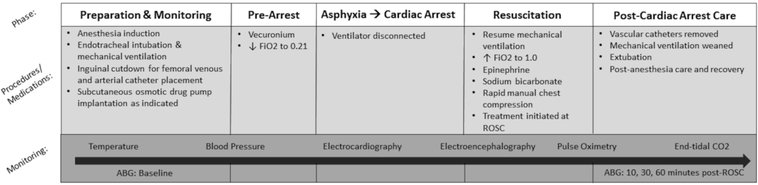
Postnatal day 16-18 Sprague-Dawley rats were studied in our established 9-min asphyxial CA model. Rats were randomized to aquaporin-4 inhibitor (AER-271) vs vehicle treatment, initiated at return of spontaneous circulation. Cerebral edema (% brain water) was the primary outcome with secondary assessments of the Neurologic Deficit Score (NDS), hippocampal neuronal death, and neuroinflammation.
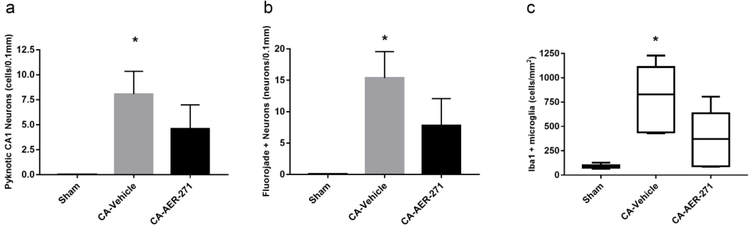
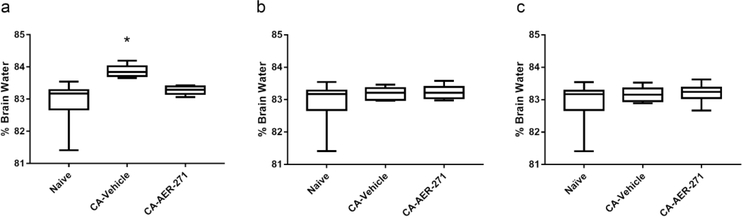
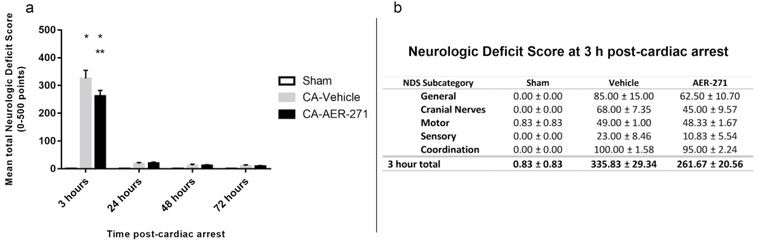
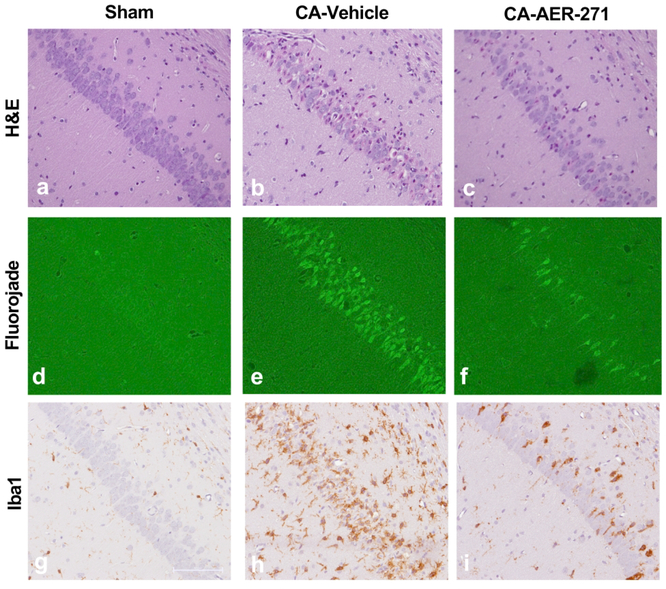
Treatment with AER-271 ameliorated early cerebral edema measured at 3 h after CA vs vehicle treated rats. This treatment also attenuated early NDS. In contrast to rats treated with vehicle after CA, rats treated with AER-271 did not develop significant neuronal death or neuroinflammation as compared to sham.
Early post-resuscitation aquaporin-4 inhibition blocks the development of early cerebral edema, reduces early neurologic deficit, and blunts neuronal death and neuroinflammation post-CA.
心脏骤停(CA)后的脑水肿与儿童和成人死亡率增加及预后不良有关。水通道蛋白-4介导脑内水的运动,其在缺血模型中的缺失可改善预后。我们在一种具有临床相关性的、致不成熟大鼠发生窒息性 CA 的模型中,研究了早期和选择性的水通道蛋白-4 药理学抑制作用,这种模型在没有血脑屏障通透性的情况下,主要产生细胞毒性水肿。
在我们建立的 9 分钟窒息性 CA 模型中,对出生后 16-18 天的 Sprague-Dawley 大鼠进行了研究。大鼠被随机分为水通道蛋白-4 抑制剂(AER-271)组和载体对照组,在自主循环恢复时开始治疗。脑水肿(%脑水)是主要观察终点,同时还评估了神经功能缺损评分(NDS)、海马神经元死亡和神经炎症的次要指标。
与载体治疗的大鼠相比,CA 后用 AER-271 治疗可改善 3 小时后的早期脑水肿。这种治疗还可减轻早期 NDS。与 CA 后用载体治疗的大鼠不同,用 AER-271 治疗的大鼠与假手术组相比,没有发生明显的神经元死亡或神经炎症。
复苏后早期的水通道蛋白-4 抑制可阻止早期脑水肿的发展,减轻早期神经功能缺损,并减轻 CA 后的神经元死亡和神经炎症。