Department of Internal Medicine, pharmacotherapy section, Amsterdam UMC, Vrije Universiteit Amsterdam, Amsterdam, The Netherlands.
RECIPE (Research & Expertise Center In Pharmacotherapy Education), Amsterdam, The Netherlands.
BMC Med Educ. 2018 Oct 26;18(1):244. doi: 10.1186/s12909-018-1352-6.
Student-run clinics (SRCs) are outpatient clinics run and organized by undergraduate medical students. While these clinics offer participating students multiple learning opportunities, little is known about how participation in an SRC contributes to learning and how this learning is influenced.
In this qualitative clarification study, we conducted semi-structured interviews with a purposive sample of 20 students and student-coordinators participating in our learner-centred SRC (LC-SRC), to gain in-depth insight into their experiences and learning. These interviews were analysed using Glaser's approach to grounded theory.
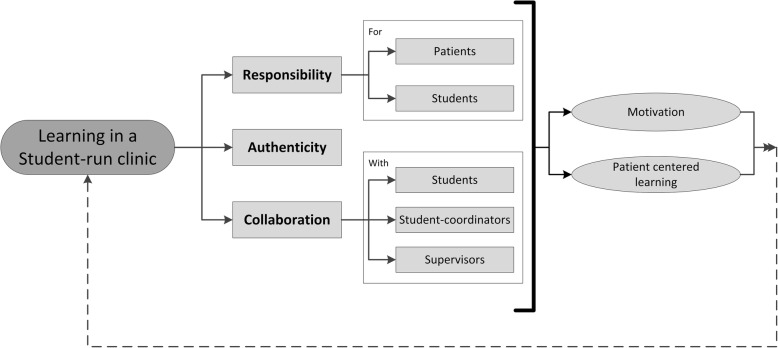
Analysis revealed that responsibility, authenticity, and collaboration described how SRC participation contribute to learning. Responsibility encompassed the responsibility students had for their patients and the responsibility that the student coordinators had for the students. Authenticity reflected the context and tasks in the LC-SRC. Collaboration covered collaboration with other students, with student coordinators, and with clinical supervisors. These three themes are interrelated, and together enhanced motivation and promoted patient-centred learning in both the LC-SRC and the regular curriculum.
Learning in an LC-SRC is highly dependent on students' feelings of responsibility for real authentic tasks and is stimulated by extensive collaboration with fellow students and supervising doctors.
学生经营的诊所(SRC)是由本科生经营和组织的门诊诊所。虽然这些诊所为参与的学生提供了多种学习机会,但对于参与 SRC 如何促进学习以及这种学习如何受到影响,知之甚少。
在这项定性澄清研究中,我们对 20 名参与以学习者为中心的 SRC(LC-SRC)的学生和学生协调员进行了半结构化访谈,深入了解他们的经验和学习情况。这些访谈使用格拉斯的扎根理论方法进行分析。
分析显示,责任、真实性和协作描述了 SRC 参与如何促进学习。责任包括学生对患者的责任和学生协调员对学生的责任。真实性反映了 LC-SRC 中的背景和任务。协作涵盖了与其他学生、学生协调员和临床主管的协作。这三个主题相互关联,共同增强了动机,并促进了 LC-SRC 和常规课程中的以患者为中心的学习。
LC-SRC 中的学习高度依赖于学生对真实任务的责任感,并通过与同学和指导医生的广泛协作得到激发。