Rabbi Mashfiqui, Aung Min Sh, Gay Geri, Reid M Cary, Choudhury Tanzeem
Department of Statistics, Harvard University, Cambridge, MA, United States.
Information Science Department, Cornell University, Ithaca, NY, United States.
J Med Internet Res. 2018 Oct 26;20(10):e10147. doi: 10.2196/10147.
Chronic pain is a globally prevalent condition. It is closely linked with psychological well-being, and it is often concomitant with anxiety, negative affect, and in some cases even depressive disorders. In the case of musculoskeletal chronic pain, frequent physical activity is beneficial. However, reluctance to engage in physical activity is common due to negative psychological associations (eg, fear) between movement and pain. It is known that encouragement, self-efficacy, and positive beliefs are effective to bolster physical activity. However, given that the majority of time is spent away from personnel who can give such encouragement, there is a great need for an automated ubiquitous solution.
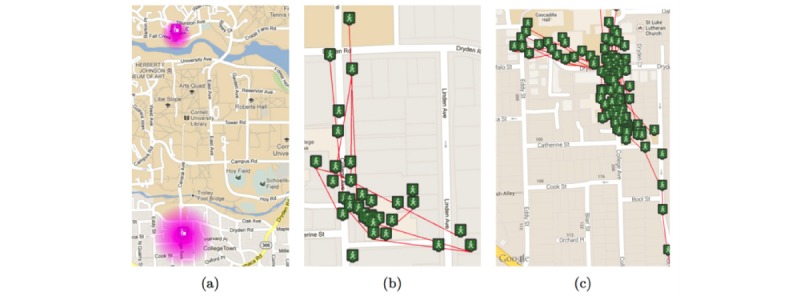
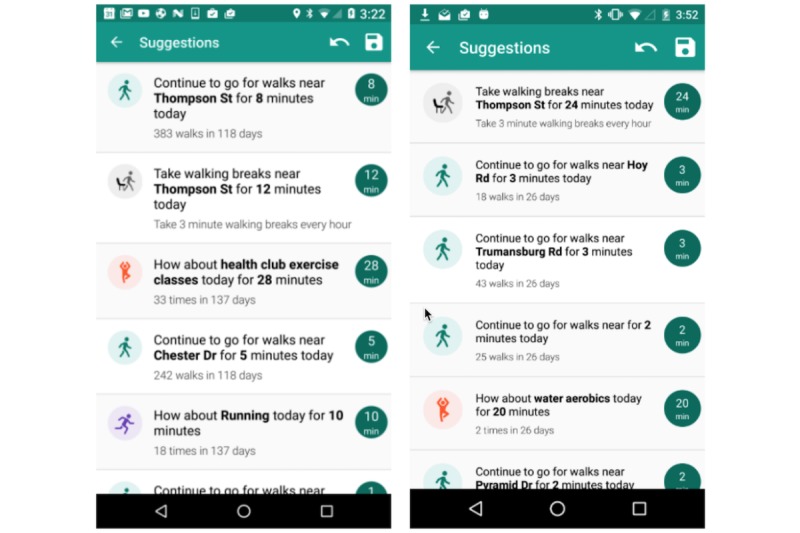
MyBehaviorCBP is a mobile phone app that uses machine learning on sensor-based and self-reported physical activity data to find routine behaviors and automatically generate physical activity recommendations that are similar to existing behaviors. Since the recommendations are based on routine behavior, they are likely to be perceived as familiar and therefore likely to be actualized even in the presence of negative beliefs. In this paper, we report the preliminary efficacy of MyBehaviorCBP based on a pilot trial on individuals with chronic back pain.
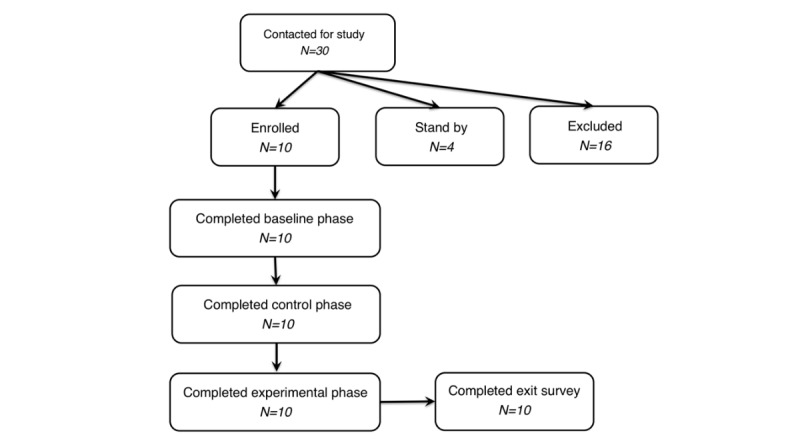
A 5-week pilot study was conducted on people with chronic back pain (N=10). After a week long baseline period with no recommendations, participants received generic recommendations from an expert for 2 weeks, which served as the control condition. Then, in the next 2 weeks, MyBehaviorCBP recommendations were issued. An exit survey was conducted to compare acceptance toward the different forms of recommendations and map out future improvement opportunities.
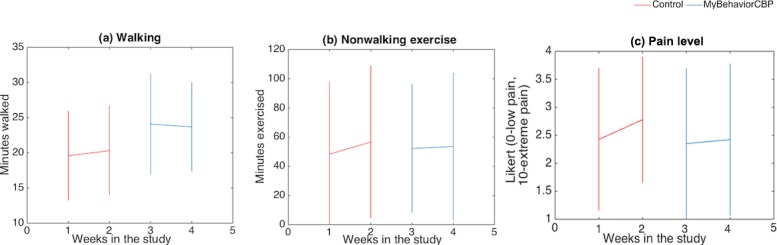
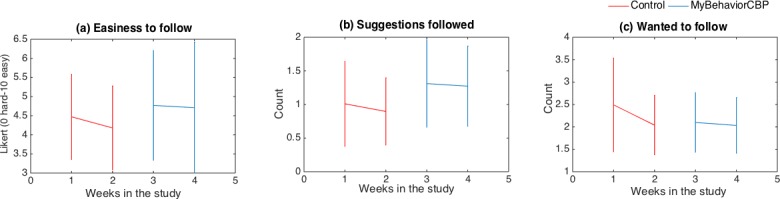
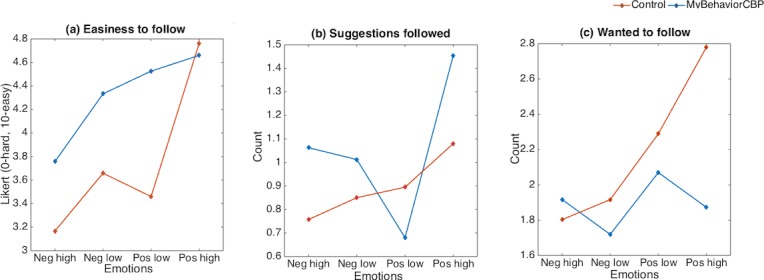
In all, 90% (9/10) of participants felt positive about trying the MyBehaviorCBP recommendations, and no participant found the recommendations unhelpful. Several significant differences were observed in other outcome measures. Participants found MyBehaviorCBP recommendations easier to adopt compared to the control (β=0.42, P<.001) on a 5-point Likert scale. The MyBehaviorCBP recommendations were actualized more (β=0.46, P<.001) with an increase in approximately 5 minutes of further walking per day (β=4.9 minutes, P=.02) compared to the control. For future improvement opportunities, participants wanted push notifications and adaptation for weather, pain level, or weekend/weekday.
In the pilot study, MyBehaviorCBP's automated approach was found to have positive effects. Specifically, the recommendations were actualized more, and perceived to be easier to follow. To the best of our knowledge, this is the first time an automated approach has achieved preliminary success to promote physical activity in a chronic pain context. Further studies are needed to examine MyBehaviorCBP's efficacy on a larger cohort and over a longer period of time.
慢性疼痛是一种全球普遍存在的疾病。它与心理健康密切相关,常伴有焦虑、消极情绪,在某些情况下甚至伴有抑郁症。对于肌肉骨骼慢性疼痛患者,经常进行体育活动有益。然而,由于运动与疼痛之间存在负面心理关联(如恐惧),人们往往不愿进行体育活动。已知鼓励、自我效能感和积极信念有助于促进体育活动。然而,鉴于大多数时间人们远离能给予此类鼓励的人员,因此迫切需要一种自动化的普遍适用解决方案。
MyBehaviorCBP是一款手机应用程序,它利用机器学习对基于传感器和自我报告的体育活动数据进行分析,以找出日常行为模式,并自动生成与现有行为相似的体育活动建议。由于这些建议基于日常行为,即使存在消极信念,它们也可能被视为熟悉的,因此更有可能被付诸实践。在本文中,我们报告了基于对慢性背痛患者进行的一项试点试验得出的MyBehaviorCBP的初步疗效。
对慢性背痛患者(N = 10)进行了为期5周的试点研究。在为期一周的无建议基线期后,参与者接受了专家提供的通用建议,为期2周,此为对照条件。然后,在接下来的2周内,发布了MyBehaviorCBP的建议。进行了一项退出调查,以比较对不同形式建议的接受程度,并规划未来的改进机会。
总体而言,90%(9/10)的参与者对尝试MyBehaviorCBP的建议持积极态度,没有参与者认为这些建议无用。在其他结果指标中观察到了一些显著差异。在5分制李克特量表上,参与者发现与对照相比,MyBehaviorCBP的建议更容易采纳(β = 0.42,P <.001)。与对照相比,MyBehaviorCBP的建议得到了更多的实践(β = 0.46,P <.001),每天额外步行时间增加了约5分钟(β = 4.9分钟,P =.02)。对于未来的改进机会,参与者希望获得推送通知,并能根据天气、疼痛程度或周末/工作日进行调整。
在试点研究中,发现MyBehaviorCBP的自动化方法具有积极效果。具体而言,这些建议得到了更多的实践,并且被认为更容易遵循。据我们所知,这是首次在慢性疼痛背景下,一种自动化方法在促进体育活动方面取得初步成功。需要进一步的研究来检验MyBehaviorCBP在更大样本和更长时间内的疗效。