Respiratory Epidemiology, Occupational Medicine and Public Health, National Heart and Lung Institute, Imperial College London, London, SW3 6LR, UK.
Eur J Clin Microbiol Infect Dis. 2019 Jan;38(1):117-124. doi: 10.1007/s10096-018-3402-8. Epub 2018 Oct 27.
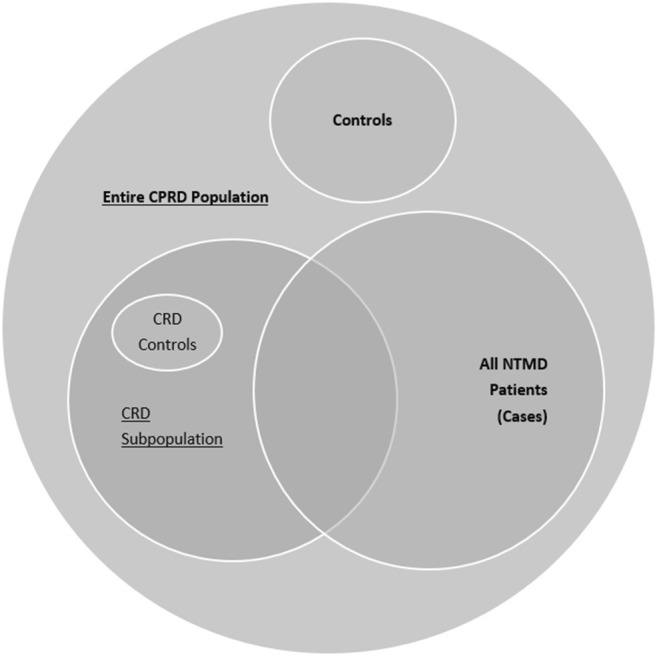
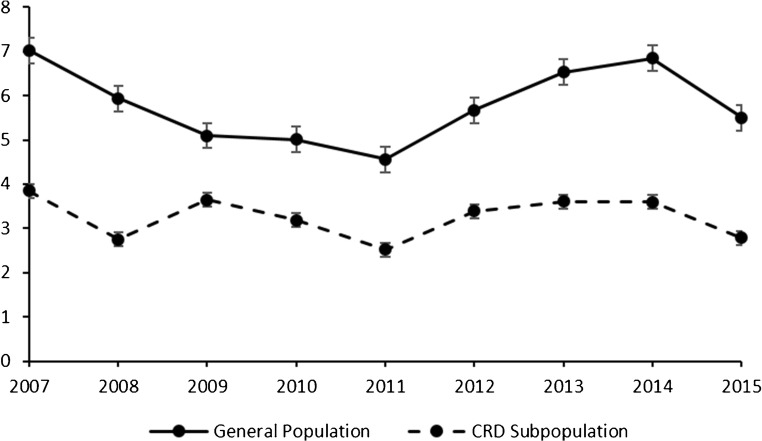
Prior research has identified risk factors associated with developing non-tuberculous mycobacterial disease (NTMD); we identified risk factors and secondary care utilisation of NTMD patients in the UK. This was a matched case-control study using electronic healthcare records from Clinical Practice Research Datalink from 2006 to 2016. NTMD was defined using prescription data and Read codes, based on international guidelines. Risk factors for NTMD were investigated using conditional logistic regression within a representative general population. All-cause secondary care utilisation (combined inpatient, outpatient, emergency visits) was investigated for participants with linked Hospital Episode Statistics (HES), using incidence rate ratio (IRR) from 2007 to 2015. We identified 1225 individuals with NTMD. A subset of individuals (426 patients) were eligible for linkage with HES. In the adjusted model, risk factors most strongly associated with an increased likelihood of NTMD included previous tuberculosis (OR 69.0; 47.7-99.8); bronchiectasis (OR 23.3; 12.4-43.9); lung cancer (OR 14.9; 3.98-55.7); oral corticosteroids (OCS; OR 7.28; 4.94-10.7); immunosuppressive (excluding corticosteroids) medication (OR 3.05; 1.15-8.10); being underweight (odds ratio (OR) 2.92; 95% CI 1.95, 4.36); and rheumatoid arthritis (OR 2.12; 1.05-4.27). NTMD patients had significantly higher rates of all-cause secondary care utilisation than non-NTMD patients (IRR 5.80; 5.14-6.46). Using a representative adult population, we identified prior TB, bronchiectasis, lung cancer, immunosuppressive medication, and OCS as the risk factors associated with the highest odds of developing NTMD in the UK. Patients with NTMD experienced nearly six times more all-cause secondary care events following their NTMD diagnosis than patients without NTMD.
先前的研究已经确定了与非结核分枝杆菌病(NTMD)发展相关的风险因素;我们在英国确定了 NTMD 患者的风险因素和二级保健利用情况。这是一项使用 2006 年至 2016 年临床实践研究数据链接的电子医疗记录进行的匹配病例对照研究。NTMD 是根据国际指南,通过处方数据和 Read 代码来定义的。使用代表性一般人群中的条件逻辑回归研究了 NTMD 的风险因素。对于具有链接医院入院统计数据(HES)的参与者,使用 2007 年至 2015 年的发病率比(IRR)研究了所有原因的二级保健利用情况。我们确定了 1225 名患有 NTMD 的个体。一部分个体(426 名患者)有资格与 HES 进行链接。在调整后的模型中,与 NTMD 发生可能性增加最相关的风险因素包括既往结核病(OR 69.0;47.7-99.8);支气管扩张症(OR 23.3;12.4-43.9);肺癌(OR 14.9;3.98-55.7);口服皮质类固醇(OCS;OR 7.28;4.94-10.7);免疫抑制(不包括皮质类固醇)药物(OR 3.05;1.15-8.10);体重不足(比值比(OR)2.92;95%CI 1.95,4.36);和类风湿性关节炎(OR 2.12;1.05-4.27)。NTMD 患者的全因二级保健利用率明显高于非 NTMD 患者(IRR 5.80;5.14-6.46)。使用代表性的成年人群,我们确定了既往结核病、支气管扩张症、肺癌、免疫抑制药物和 OCS 是与英国 NTMD 发展风险最高相关的风险因素。与没有 NTMD 的患者相比,NTMD 患者在诊断为 NTMD 后发生全因二级保健事件的几率几乎高出六倍。