School of Computer Engineering and Science, Shanghai University, 99 Shangda Road, Baoshan District, Post Code 200444 Shanghai, China.
Comput Intell Neurosci. 2018 Oct 2;2018:6347186. doi: 10.1155/2018/6347186. eCollection 2018.
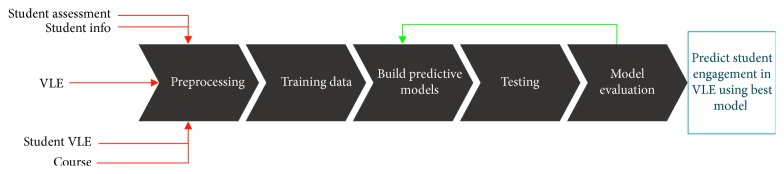
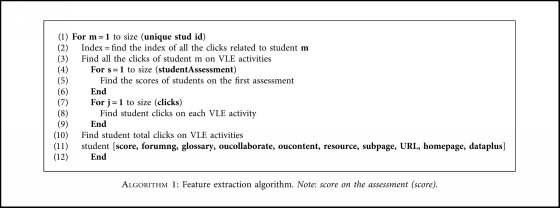
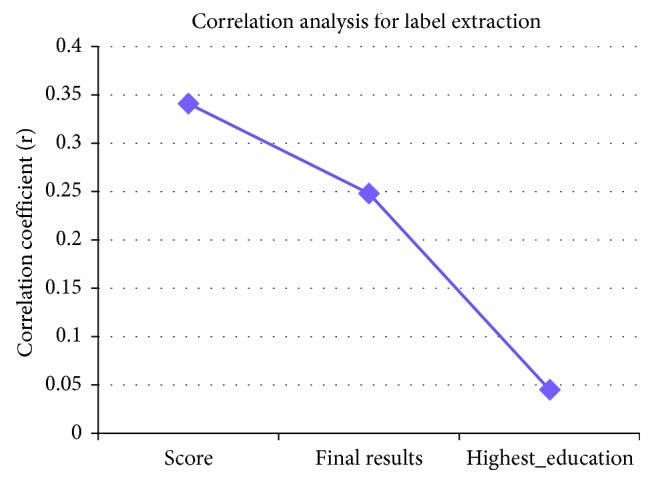
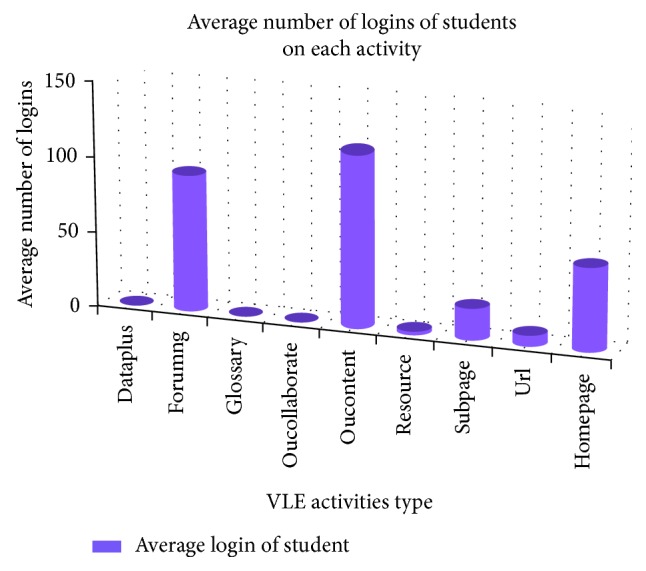
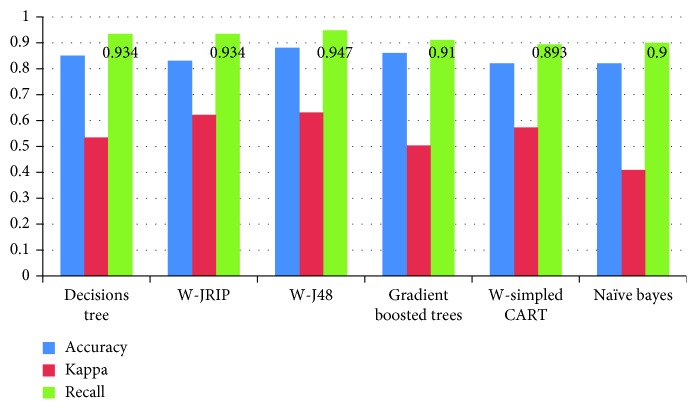
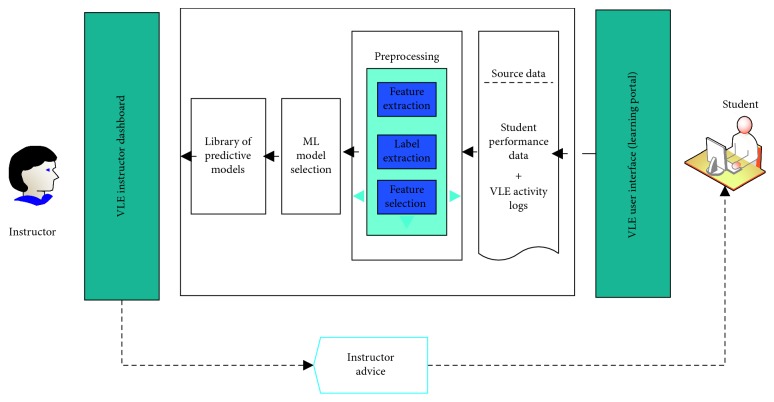
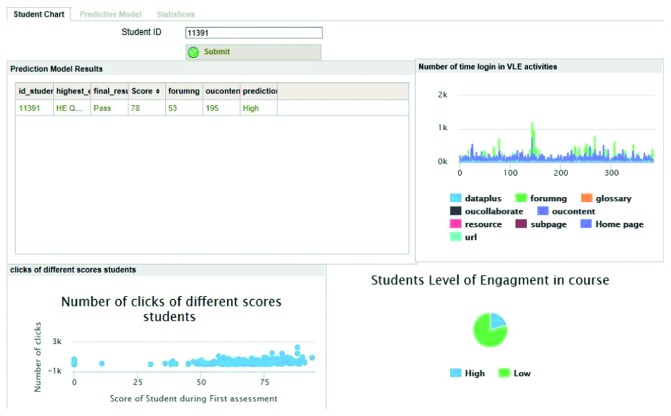
Several challenges are associated with e-learning systems, the most significant of which is the lack of student motivation in various course activities and for various course materials. In this study, we used machine learning (ML) algorithms to identify low-engagement students in a social science course at the Open University (OU) to assess the effect of engagement on student performance. The input variables of the study included , , , and the number of clicks on virtual learning environment (VLE) activities, which included , , , , , , , , during the first course assessment. The output variable was the student level of engagement in the various activities. To predict low-engagement students, we applied several ML algorithms to the dataset. Using these algorithms, trained models were first obtained; then, the accuracy and kappa values of the models were compared. The results demonstrated that the J48, decision tree, JRIP, and gradient-boosted classifiers exhibited better performance in terms of the accuracy, kappa value, and recall compared to the other tested models. Based on these findings, we developed a dashboard to facilitate instructor at the OU. These models can easily be incorporated into VLE systems to help instructors evaluate student engagement during VLE courses with regard to different activities and materials and to provide additional interventions for students in advance of their final exam. Furthermore, this study examined the relationship between student engagement and the course assessment score.
电子学习系统面临着一些挑战,其中最显著的是学生在各种课程活动和课程材料中缺乏动机。在这项研究中,我们使用机器学习 (ML) 算法来识别开放大学 (OU) 社会科学课程中的低参与度学生,以评估参与度对学生表现的影响。研究的输入变量包括性别、年龄、先前的学术成绩和对虚拟学习环境 (VLE) 活动的点击次数,其中包括课程资料、测验、讨论区、课程评估、虚拟导师会议和测验反馈,在第一门课程评估期间。输出变量是学生对各种活动的参与程度。为了预测低参与度的学生,我们将几种机器学习算法应用于数据集。使用这些算法,首先获得了经过训练的模型;然后,比较了模型的准确性和 kappa 值。结果表明,J48、决策树、JRIP 和梯度提升分类器在准确性、kappa 值和召回率方面的表现优于其他测试模型。基于这些发现,我们开发了一个仪表板,以方便 OU 的教师使用。这些模型可以很容易地整合到 VLE 系统中,以帮助教师评估 VLE 课程中学生在不同活动和材料方面的参与度,并在学生期末考试前为他们提供额外的干预措施。此外,本研究还考察了学生参与度与课程评估分数之间的关系。