School of Communication, The Ohio State University, Columbus, OH, USA.
Annenberg School for Communication, University of Pennsylvania, Philadelphia, PA, USA.
Sci Rep. 2018 Oct 30;8(1):16037. doi: 10.1038/s41598-018-33624-3.
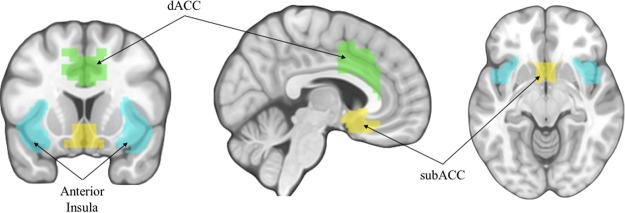
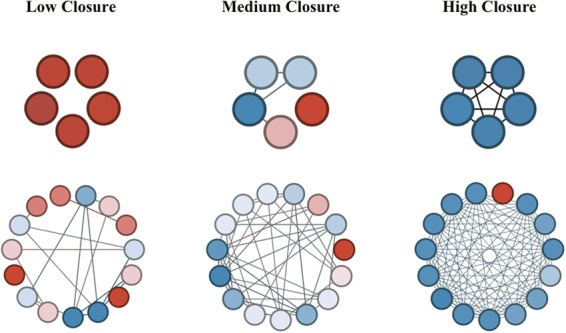
Humans are driven to pursue and preserve social relationships, and these motivations are reinforced through biological systems. In particular, individual differences in the tuning of biological systems that respond to social threats may motivate individuals to seek out differently structured social environments. Drawing on a sample of adolescent males who underwent fMRI brain imaging (n = 74) and contributed Facebook data, we examined whether biological responses to a common scenario - being excluded from an activity with peers - was associated with their social network structure. We find that neural responses during social exclusion in a priori hypothesized "social pain" regions of the brain (dACC, AI, subACC) are associated with the density and transitivity of core friendship networks. These findings suggest that neural reactivity to exclusion may be one factor that underlies network "safety". More broadly, the study shows the potential of linking social cognitive tendencies to social structural properties.
人类有追求和维持社交关系的本能,而这些动机是通过生物系统得到强化的。具体来说,个体在对社交威胁做出反应的生物系统调节方面的差异,可能会促使个体寻求不同结构的社交环境。本研究使用 fMRI 大脑成像技术(n=74)对青少年男性进行了测试,并收集了他们的 Facebook 数据,以此来检验他们对一种常见场景(被同伴排除在某项活动之外)的生物反应是否与他们的社交网络结构有关。我们发现,大脑中与“社交痛苦”相关的预设区域(dACC、AI、subACC)在社会排斥期间的神经反应与核心友谊网络的密度和传递性有关。这些发现表明,对排斥的神经反应可能是网络“安全性”的一个基础因素。更广泛地说,该研究表明了将社交认知倾向与社交结构特征联系起来的潜力。