Schmidt Gordon, Müller Marcus, Veit Peter, Metzner Sebastian, Bertram Frank, Hartmann Jana, Zhou Hao, Wehmann Hergo-Heinrich, Waag Andreas, Christen Jürgen
Institute of Physics, Otto-von-Guericke-University Magdeburg, Magdeburg, Germany.
Institute of Semiconductor Technology and Laboratory for Emerging Nanometrology LENA, Technische Universität Braunschweig, Braunschweig, Germany.
Sci Rep. 2018 Oct 30;8(1):16026. doi: 10.1038/s41598-018-34382-y.
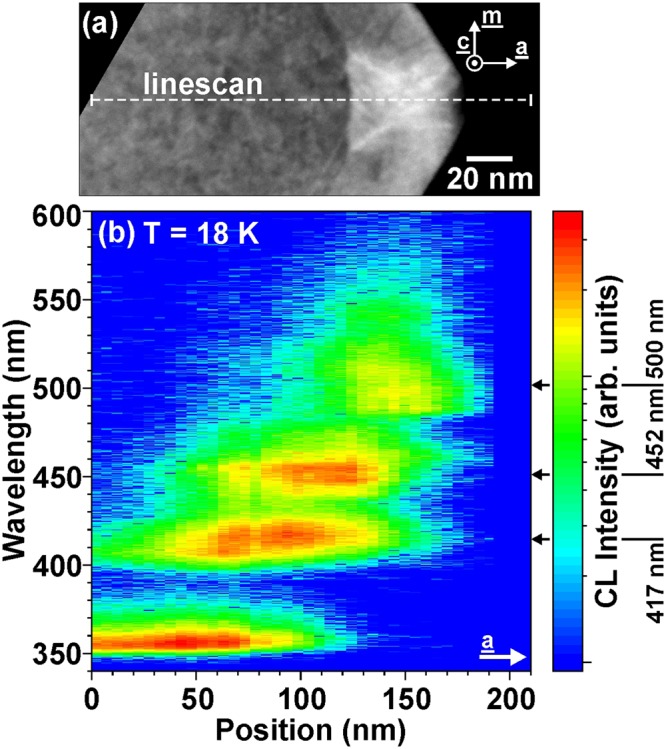
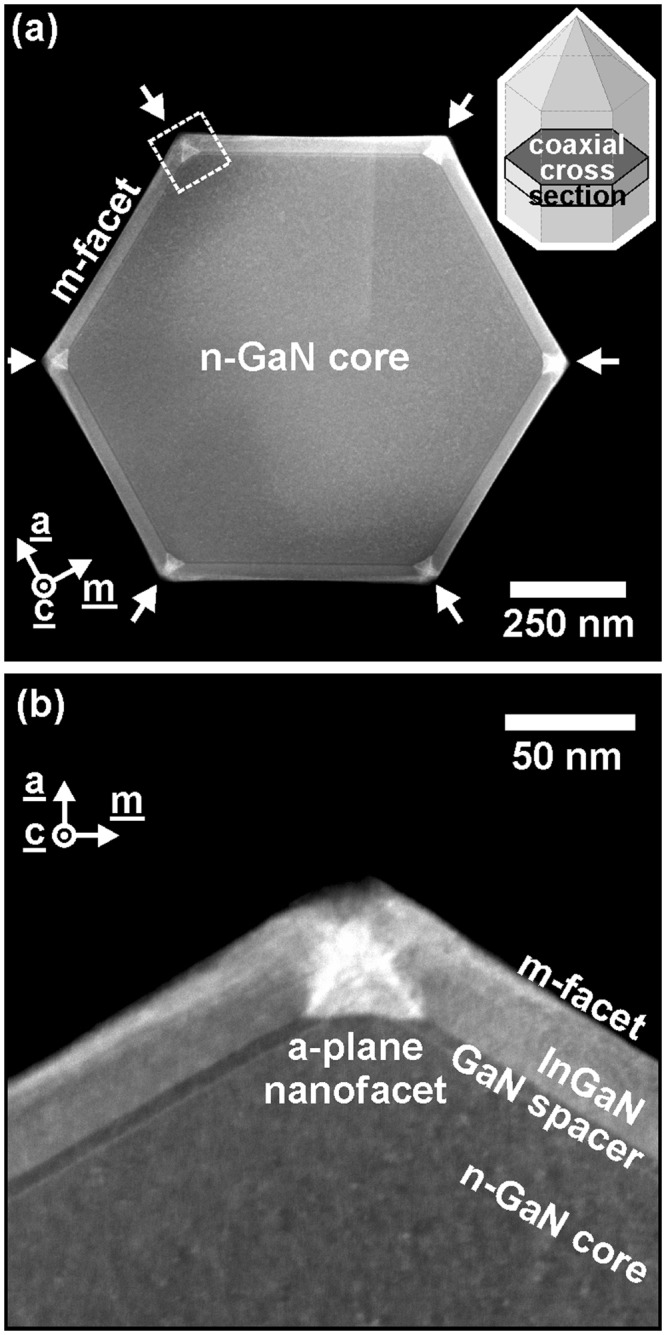
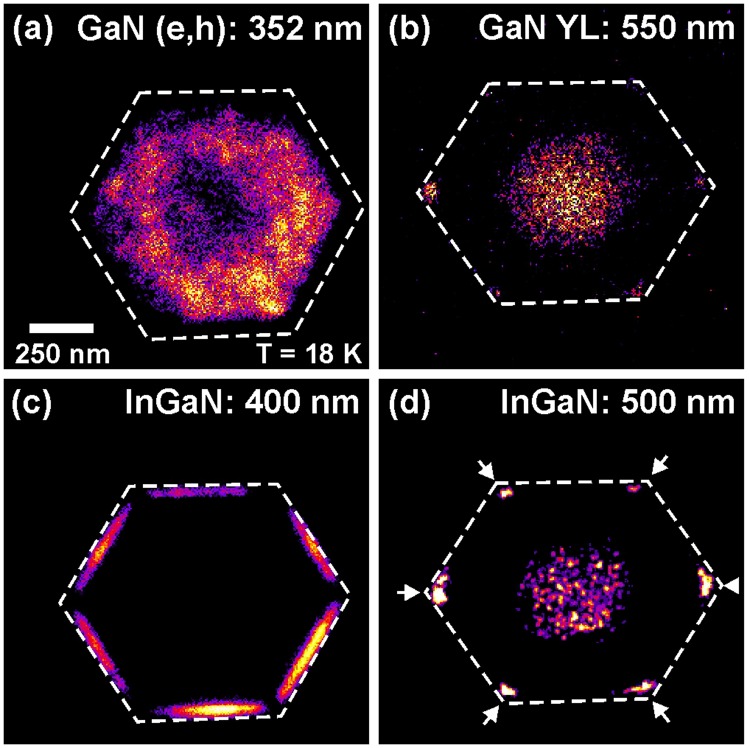
Higher indium incorporation in self-organized triangular nanoprisms at the edges of InGaN/GaN core-shell nanorods is directly evidenced by spectral cathodoluminescence microscopy in a scanning transmission electron microscope. The nanoprisms are terminated by three 46 nm wide a-plane nanofacets with sharp interfaces forming a well-defined equilateral triangular base in the basal plane. Redshifted InGaN luminescence and brighter Z-contrast are resolved for these structures compared to the InGaN layers on the nanorod sidewalls, which is attributed to at least 4 % higher indium content. Detailed analysis of the inner optical and structural properties reveals luminescence contributions from 417 nm up to 500 nm peak wavelength proving the increasing indium concentration inside the nanoprism towards the nanorod surface.
扫描透射电子显微镜中的光谱阴极发光显微镜直接证明了在InGaN/GaN核壳纳米棒边缘的自组织三角形纳米棱镜中铟的掺入量更高。纳米棱镜由三个46纳米宽的a面纳米小面终止,这些小面具有尖锐的界面,在基面中形成定义明确的等边三角形基底。与纳米棒侧壁上的InGaN层相比,这些结构的InGaN发光发生红移且Z对比度更高,这归因于铟含量至少高4%。对内部光学和结构特性的详细分析揭示了从417纳米到500纳米峰值波长的发光贡献,证明了纳米棱镜内部朝向纳米棒表面的铟浓度不断增加。