Department of Epidemiology and Biostatistics, University of Arizona, Tucson, Arizona.
Trauma Research Program, Chandler Regional Medical Center, Chandler, Arizona.
J Am Geriatr Soc. 2018 Dec;66(12):2314-2320. doi: 10.1111/jgs.15613. Epub 2018 Oct 30.
To investigate associations between sarcopenia, obesity, and sarcopenic obesity and incidence of falls in a racially and ethnically diverse cohort of healthy postmenopausal women.
Prospective cohort study.
Three Women's Health Initiative (WHI) clinical centers (Tucson-Phoenix, AZ; Pittsburgh, PA; Birmingham, AL).
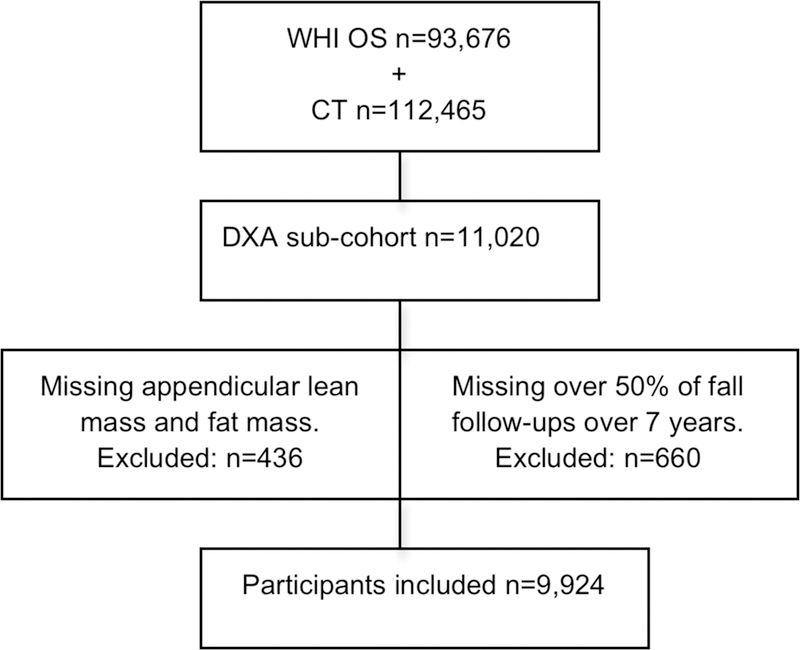
Postmenopausal women aged 50 to 79 enrolled in the WHI who underwent bone and body composition scans using dual-energy x-ray absorptiometry at baseline (N = 11,020).
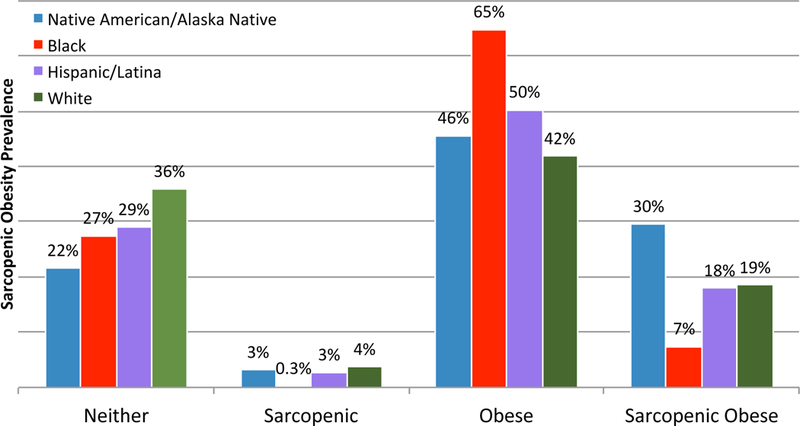
Sarcopenia was defined as the lowest 20 percentile of appendicular lean mass, correcting for height and body fat. Obesity was defined as a body fat percentage greater than 42%. Sarcopenic obesity was defined as co-occurrence of sarcopenia and obesity. The fall outcome was defined as falling 2 or more times in any year during 7 years of follow-up. The risk of falls associated with sarcopenic obesity were analyzed using log binomial regression models stratified according to age and race/ethnicity.
Sarcopenic obesity was associated with greater risk of falls in women aged 50 to 64 (relative risk (RR) = 1.35, 95% confidence interval (CI)=1.17-1.56) and 65 to 79 (RR = 1.21, 95% CI=1.05-1.39). Sarcopenic obesity related fall risk was higher in Hispanic women (RR = 2.40, 95% CI=1.56-3.67) than non-Hispanic white women (RR = 1.24, 95% CI=1.11-1.39).
In a multiethnic cohort of postmenopausal women, sarcopenic obesity-related fall risk was high in women younger than 65 and those age 65 and older. Sarcopenic obesity posed the highest risk for falls in Hispanic women. The findings support identification of causal factors and health disparities in sarcopenic obesity to customize fall prevention strategies and ameliorate this significant public health burden. J Am Geriatr Soc 66:2314-2320, 2018.
在一个种族和民族多样化的健康绝经后女性队列中,研究肌少症、肥胖症和肌少症性肥胖与跌倒发生率之间的关联。
前瞻性队列研究。
三个妇女健康倡议(WHI)临床中心(亚利桑那州图森-凤凰城;宾夕法尼亚州匹兹堡;阿拉巴马州伯明翰)。
参加 WHI 的年龄在 50 至 79 岁之间的绝经后女性,在基线时接受了使用双能 X 射线吸收法进行的骨和身体成分扫描(N=11020)。
肌少症定义为四肢瘦体重的最低 20 百分位,根据身高和体脂肪进行校正。肥胖定义为体脂肪百分比大于 42%。肌少症性肥胖定义为肌少症和肥胖同时发生。跌倒结局定义为在 7 年随访期间的任何一年中跌倒 2 次或以上。使用对数二项式回归模型分析与肌少症性肥胖相关的跌倒风险,根据年龄和种族/民族进行分层。
在 50 至 64 岁(相对风险(RR)=1.35,95%置信区间(CI)=1.17-1.56)和 65 至 79 岁(RR=1.21,95%CI=1.05-1.39)的女性中,肌少症性肥胖与跌倒风险增加相关。与非西班牙裔白人女性(RR=1.24,95%CI=1.11-1.39)相比,西班牙裔女性(RR=2.40,95%CI=1.56-3.67)的肌少症性肥胖相关跌倒风险更高。
在一个多民族的绝经后女性队列中,肌少症性肥胖与跌倒风险相关的风险在 65 岁以下和 65 岁及以上的女性中较高。肌少症性肥胖对西班牙裔女性的跌倒风险最大。这些发现支持确定肌少症性肥胖的因果因素和健康差异,以定制跌倒预防策略并改善这一重大公共卫生负担。美国老年医学会 66:2314-2320, 2018。