
空气传播的信号能使邻近的植物在受到触碰时同步防御。
Airborne signals synchronize the defenses of neighboring plants in response to touch.
机构信息
Department of Crop Production Ecology, Swedish University of Agricultural Sciences, Uppsala, Sweden.
Faculty of Agriculture, University of Banja Luka, Banja Luka, Bosnia and Herzegovina.
出版信息
J Exp Bot. 2019 Jan 7;70(2):691-700. doi: 10.1093/jxb/ery375.
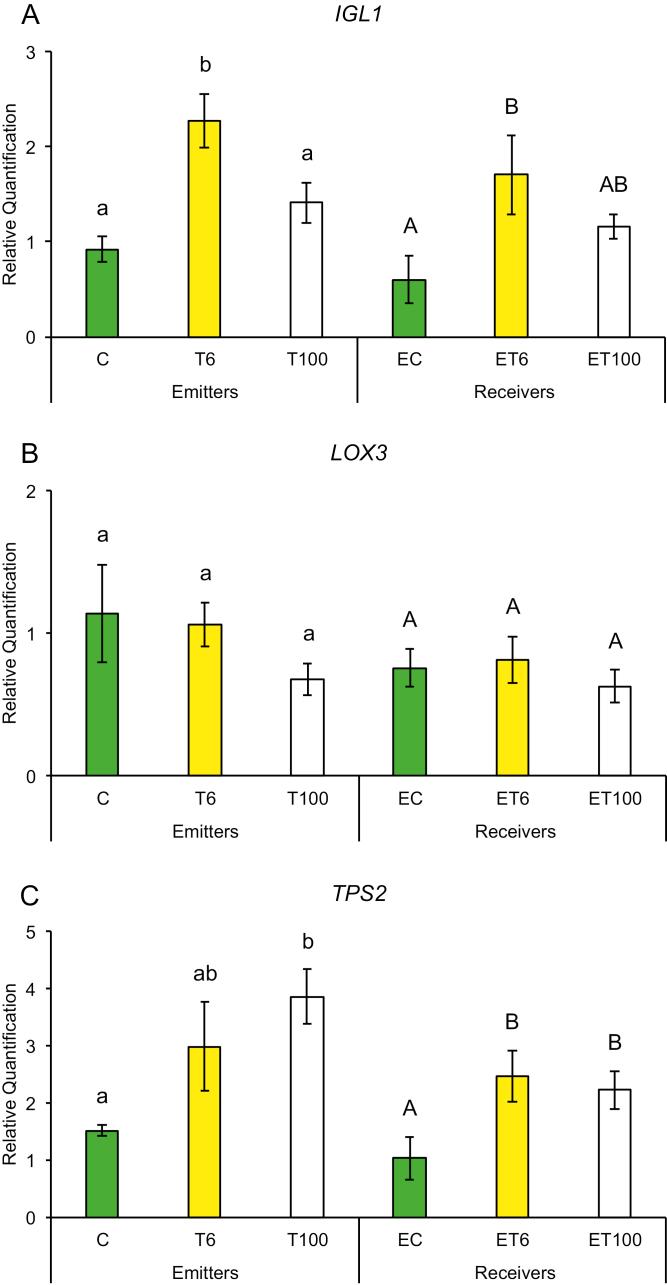
Plants activate defense-related pathways in response to subtle abiotic or biotic disturbances, changing their volatile profile rapidly. How such perturbations reach and potentially affect neighboring plants is less understood. We evaluated whether brief and light touching had a cascade effect on the profile of volatiles and gene expression of the focal plant and a neighboring untouched plant. Within minutes after contact, Zea mays showed an up-regulation of certain defense genes and increased the emission of specific volatiles that primed neighboring plants, making them less attractive for aphids. Exposure to volatiles from touched plants activated many of the same defense-related genes in non-touched neighboring plants, demonstrating a transcriptional mirroring effect for expression of genes up-regulated by brief contact. Perception of so-far-overlooked touch-induced volatile organic compounds was of ecological significance as these volatiles are directly involved in plant-plant communication as an effective trigger for rapid defense synchronization among nearby plants. Our findings shed new light on mechanisms of plant responses to mechanical contact at the molecular level and on the ecological role of induced volatiles as airborne signals in plant-plant interactions.
植物会针对细微的非生物或生物干扰激活与防御相关的途径,从而迅速改变其挥发性成分。然而,对于这些干扰如何到达并潜在地影响周围的植物,我们的了解还比较有限。本研究旨在评估短暂而轻微的触碰是否会对焦点植物及其相邻未触碰植物的挥发性成分和基因表达产生级联效应。在接触后的几分钟内,玉米表现出某些防御基因的上调,并增加了特定挥发性物质的排放,这些物质会使相邻植物预先受到刺激,从而降低它们对蚜虫的吸引力。暴露于触碰植物释放的挥发性物质会激活相邻未触碰植物中许多相同的与防御相关的基因,证明了短暂接触引起的基因上调存在转录镜像效应。对迄今为止被忽视的触碰诱导挥发性有机化合物的感知具有生态意义,因为这些挥发性物质直接参与植物间的通讯,作为触发附近植物快速防御同步的有效信号。本研究结果为植物对机械接触的分子水平响应机制以及诱导挥发性物质作为植物-植物相互作用中的空气传播信号的生态作用提供了新的见解。


 Zotero 插件