Department of Ecology, Swedish University of Agricultural Sciences, Uppsala, Sweden.
Department of Crop Production Ecology, Swedish University of Agricultural Sciences, Uppsala, Sweden.
Plant Cell Environ. 2021 Apr;44(4):1030-1043. doi: 10.1111/pce.13910. Epub 2020 Oct 26.
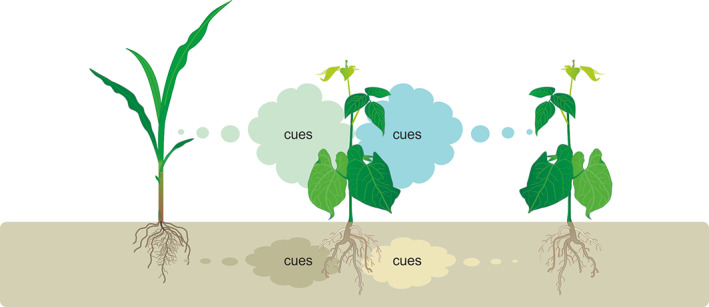
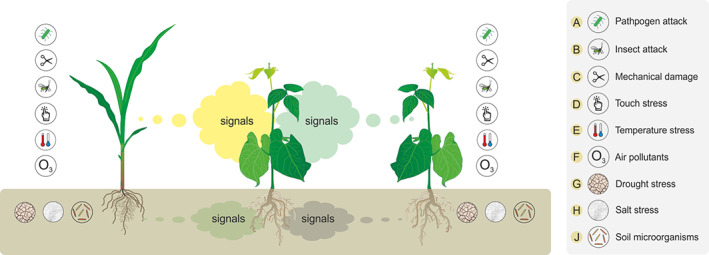
Volatile organic compounds are important mediators of mutualistic interactions between plants and their physical and biological surroundings. Volatiles rapidly indicate competition or potential threat before these can take place, and they regulate and coordinate adaptation responses in neighbouring plants, fine-tuning them to match the exact stress encountered. Ecological specificity and context-dependency of plant-plant communication mediated by volatiles represent important factors that determine plant performance in specific environments. In this review, we synthesise the recent progress made in understanding the role of plant volatiles as mediators of plant interactions at the individual and community levels, highlighting the complexity of the plant receiver response to diverse volatile cues and signals and addressing how specific responses shape plant growth and survival. Finally, we outline the knowledge gaps and provide directions for future research. The complex dialogue between the emitter and receiver based on either volatile cues or signals determines the outcome of information exchange, which shapes the communication pattern between individuals at the community level and determines their ecological implications at other trophic levels.
挥发性有机化合物是植物与其物理和生物环境之间互利共生相互作用的重要调节者。挥发物在竞争或潜在威胁发生之前迅速表明,它们调节和协调邻近植物的适应反应,使它们精确地适应所遇到的压力。挥发性介导的植物-植物通讯的生态特异性和上下文相关性是决定植物在特定环境中表现的重要因素。在这篇综述中,我们综合了近年来在理解植物挥发物作为个体和群落水平植物相互作用的调节剂的作用方面取得的进展,强调了植物对不同挥发性线索和信号的受体反应的复杂性,并探讨了特定反应如何塑造植物的生长和存活。最后,我们概述了知识差距,并为未来的研究提供了方向。基于挥发性线索或信号的发射器和接收器之间的复杂对话决定了信息交换的结果,从而塑造了个体在群落水平上的交流模式,并决定了它们在其他营养水平上的生态意义。