Mariani Angelica, Bonfio Claudia, Johnson Christopher M, Sutherland John D
MRC Laboratory of Molecular Biology , Francis Crick Avenue, Cambridge Biomedical Campus , Cambridge CB2 0QH , U.K.
Biochemistry. 2018 Nov 13;57(45):6382-6386. doi: 10.1021/acs.biochem.8b01080. Epub 2018 Nov 5.
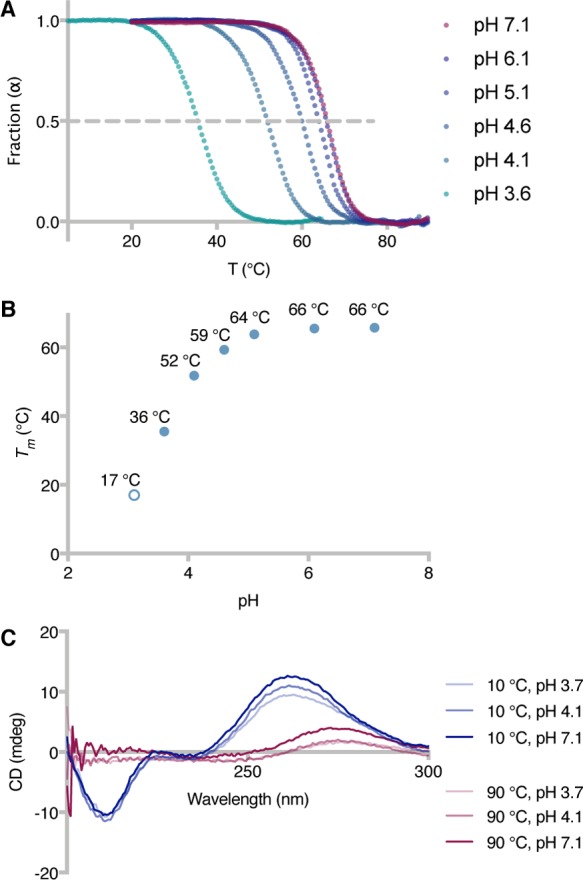
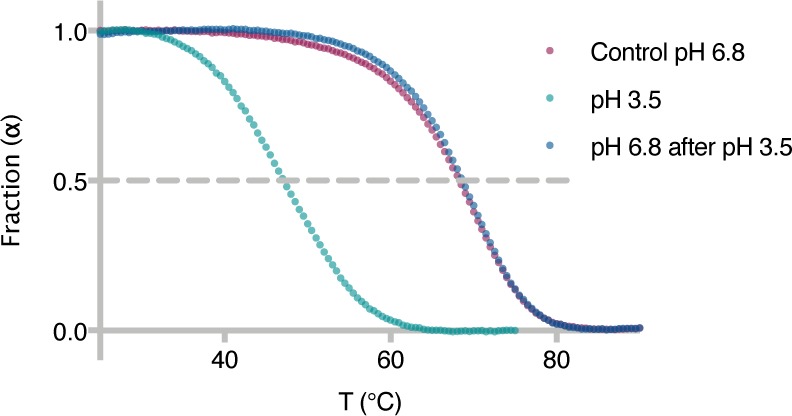
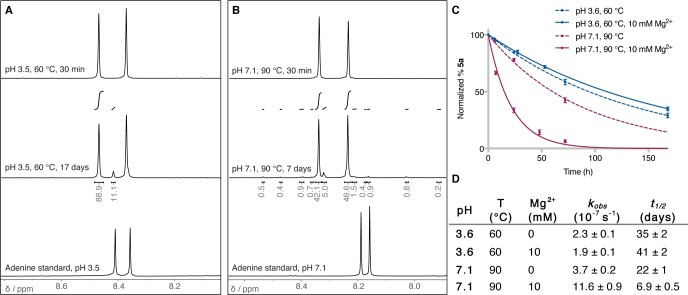
Replication of nucleic acids in the absence of genetically encoded enzymes represents a critical process for the emergence of cellular life. Repeated separation of complementary RNA strands is required to achieve multiple cycles of chemical replication, yet thermal denaturation under plausible prebiotic conditions is impaired by the high temperatures required to separate long RNA strands and by concurrent degradation pathways, the latter accelerated by divalent metal ions. Here we show how the melting temperature of oligoribonucleotide duplexes can be tuned by changes in pH, enabling the separation of RNA strands at moderate temperatures. At the same time, the risk of phosphodiester bond cleavage is reduced under the acid denaturation conditions herein described, both in the presence and in the absence of divalent metal ions. Through a combination of ultraviolet and circular dichroism thermal studies and gel electrophoresis, we demonstrate the relevance of geological pH oscillations in the context of the RNA strand separation problem. Our results reveal new insights in the field of prebiotic chemistry, supporting plausible geochemical scenarios in which non-enzymatic RNA replication might have taken place.
在缺乏基因编码酶的情况下核酸复制是细胞生命出现的关键过程。为实现多个化学复制循环,需要反复分离互补RNA链,但在合理的前生物条件下,长RNA链分离所需的高温以及同时存在的降解途径会阻碍热变性,后者会因二价金属离子而加速。在这里,我们展示了如何通过改变pH值来调节寡核糖核苷酸双链体的解链温度,从而在中等温度下实现RNA链的分离。同时,在本文所述的酸变性条件下,无论有无二价金属离子,磷酸二酯键断裂的风险都会降低。通过紫外和圆二色性热研究以及凝胶电泳相结合的方法,我们证明了地质pH值振荡在RNA链分离问题中的相关性。我们的结果揭示了前生物化学领域的新见解,支持了可能发生非酶促RNA复制的地球化学情景。