Cavendish Astrophysics, University of Cambridge, JJ Thomson Avenue, Cambridge CB3 0HE, UK.
MRC Laboratory of Molecular Biology, Francis Crick Avenue, Cambridge CB2 0QH, UK.
Sci Adv. 2018 Aug 1;4(8):eaar3302. doi: 10.1126/sciadv.aar3302. eCollection 2018 Aug.
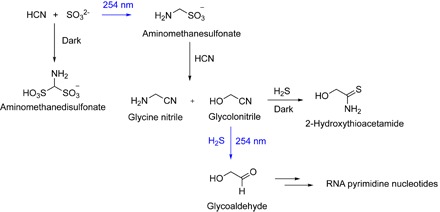
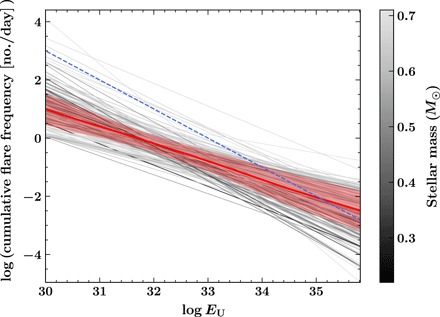
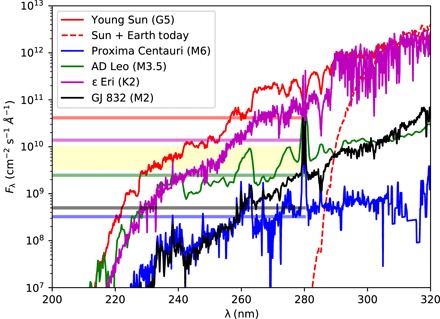
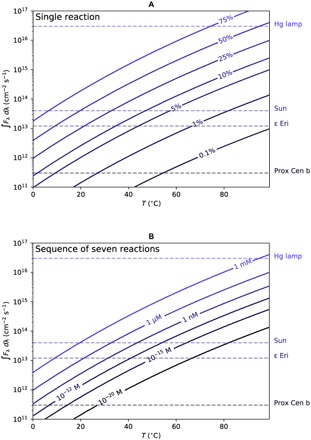
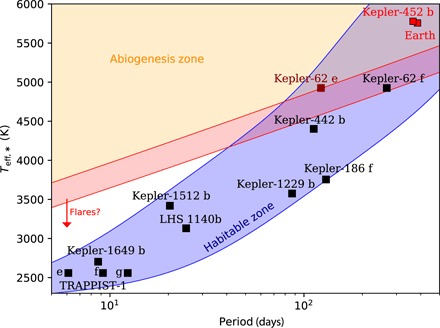
Given that the macromolecular building blocks of life were likely produced photochemically in the presence of ultraviolet (UV) light, we identify some general constraints on which stars produce sufficient UV for this photochemistry. We estimate how much light is needed for the UV photochemistry by experimentally measuring the rate constant for the UV chemistry ("light chemistry", needed for prebiotic synthesis) versus the rate constants for the bimolecular reactions that happen in the absence of the UV light ("dark chemistry"). We make these measurements for representative photochemical reactions involving and HS. By balancing the rates for the light and dark chemistry, we delineate the "abiogenesis zones" around stars of different stellar types based on whether their UV fluxes are sufficient for building up this macromolecular prebiotic inventory. We find that the light chemistry is rapid enough to build up the prebiotic inventory for stars hotter than K5 (4400 K). We show how the abiogenesis zone overlaps with the liquid water habitable zone. Stars cooler than K5 may also drive the formation of these building blocks if they are very active. The HS light chemistry is too slow to work even for early Earth.
鉴于生命的大分子构建块很可能是在存在紫外线 (UV) 光的情况下通过光化学产生的,我们确定了一些限制哪些恒星产生足够的 UV 光用于这种光化学的一般约束条件。我们通过实验测量光化学(用于前生物合成)的速率常数与在没有 UV 光的情况下发生的双分子反应(“暗化学”)的速率常数,来估计光化学所需的光量。我们对涉及和 HS 的有代表性的光化学反应进行了这些测量。通过平衡光化学和暗化学的速率,我们根据恒星的 UV 通量是否足以积累这种大分子前生物库存,来描绘不同恒星类型周围的“生物发生区”。我们发现,对于比 K5(4400 K)更热的恒星,光化学足够快,可以积累前生物库存。我们展示了生物发生区如何与液态水可居住区重叠。如果这些恒星非常活跃,比 K5 更冷的恒星也可能驱动这些构建块的形成。即使对于早期地球来说,HS 的光化学也太慢了。