Chaves Maria Moura Santana, Mendes Matheus de Souza, Schwermann Maximilian Pinho, Queiroz Raquel, Coelho Regina Freitas, Salmito Francisco Thiago Santos, Meneses Gdayllon Cavalcante, Martins Alice Maria Costa, Moreira Ana Cristina de Oliveira Monteiro, Libório Alexandre Braga
Medical Sciences Postgraduate Program, Universidade de Fortaleza⁻UNIFOR, Fortaleza 60811-905, Ceara, Brazil.
Medical Course, Universidade de Fortaleza-UNIFOR, Fortaleza 60811-905, Ceara, Brazil.
J Clin Med. 2018 Oct 31;7(11):401. doi: 10.3390/jcm7110401.
Glomerulopathy is a group of diseases that affect mainly young adults between the ages of 20 and 40 years. Recently, it has been demonstrated that syndecan-1, a biomarker of endothelial glycocalyx damage, is increased in nephrotic patients with near-normal renal function and it is important to endothelial dysfunction in these patients. Angiopoietin-2 (AGPT2) is an endothelial growth factor that promotes cell derangement. Here we evaluated AGPT2 levels in patients with nephrotic syndrome, near-normal renal function and the possible interaction of AGPT2 with endothelial glycocalyx derangement.
This was a cross-sectional study performed from January through November 2017. Adult patients (age > 18 years) with nephrotic syndrome and without immunosuppression were included. Blood samples were drawn after a 12 h fast for later measurement of syndecan-1 and AGPT2. Mediation analyses were performed to assess the hypothesized associations of nephrotic syndrome features and AGPT2 with syndecan-1.
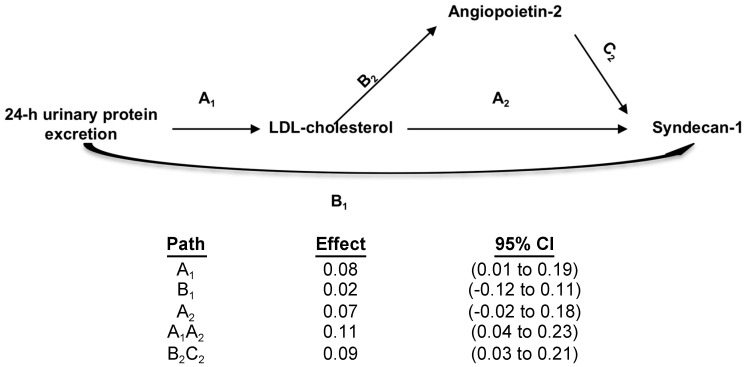
We included 65 patients, 37 (56.9%) of them female, with primary glomerular disease. Syndecan-1 in nephrotic patients was higher than in control individuals (102.8 ± 36.2 vs. 28.2 ± 9.8 ng/mL, < 0.001). Correlation of syndecan-1 with the main features of nephrotic syndrome after adjustment for age and estmmated glomerular filtration rate (eGFR) demonstrated that syndecan-1 was significantly associated with 24-h urinary protein excretion, total cholesterol, LDL (low density lipoprotein)-cholesterol, HDL (high-density lipoprotein)-cholesterol, and triglycerides. Angiopoietin-2 was independently associated with serum albumin, 24 h urinary protein excretion, total cholesterol, and LDL-cholesterol, in addition to being strongly associated with syndecan-1 (0.461, < 0.001). The results of the mediation analyses showed that the direct association between LDL-cholesterol and syndecan-1 was no longer significant after AGPT-2 was included in the mediation analysis. AGPT2 explained 56% of the total observed association between LDL-cholesterol and syndecan-1.
The association between LDL-cholesterol and glycocalyx derangement in nephrotic patients is possibly mediated by AGPT2.
肾小球病是一组主要影响20至40岁年轻人的疾病。最近有研究表明,内皮糖萼损伤的生物标志物syndecan-1在肾功能接近正常的肾病患者中升高,且对这些患者的内皮功能障碍很重要。血管生成素-2(AGPT2)是一种促进细胞紊乱的内皮生长因子。在此,我们评估了肾病综合征、肾功能接近正常患者的AGPT2水平,以及AGPT2与内皮糖萼紊乱之间可能的相互作用。
这是一项于2017年1月至11月进行的横断面研究。纳入患有肾病综合征且未接受免疫抑制的成年患者(年龄>18岁)。禁食12小时后采集血样,用于后续syndecan-1和AGPT2的检测。进行中介分析以评估肾病综合征特征和AGPT2与syndecan-1之间的假设关联。
我们纳入了65例患者,其中37例(56.9%)为女性,患有原发性肾小球疾病。肾病患者的syndecan-1高于对照组个体(102.8±36.2 vs. 28.2±9.8 ng/mL,P<0.001)。在调整年龄和估计肾小球滤过率(eGFR)后,syndecan-1与肾病综合征的主要特征的相关性表明,syndecan-1与24小时尿蛋白排泄、总胆固醇、低密度脂蛋白胆固醇、高密度脂蛋白胆固醇和甘油三酯显著相关。血管生成素-2除了与syndecan-1密切相关(0.461,P<0.001)外,还与血清白蛋白、24小时尿蛋白排泄、总胆固醇和低密度脂蛋白胆固醇独立相关。中介分析结果表明,在中介分析中纳入AGPT-2后,低密度脂蛋白胆固醇与syndecan-1之间的直接关联不再显著。AGPT2解释了低密度脂蛋白胆固醇与syndecan-1之间总观察关联的56%。
肾病患者中低密度脂蛋白胆固醇与糖萼紊乱之间的关联可能由AGPT2介导。