Castro Rebeca, Guerrero-Legarreta Isabel, Bórquez Rodrigo
Chemical Engineering Department, Universidad de Concepción, Concepción, Chile.
Biotechnological Department, Universidad Autónoma Metropolitana, México City, Mexico.
Biotechnol Rep (Amst). 2018 Oct 15;20:e00287. doi: 10.1016/j.btre.2018.e00287. eCollection 2018 Dec.
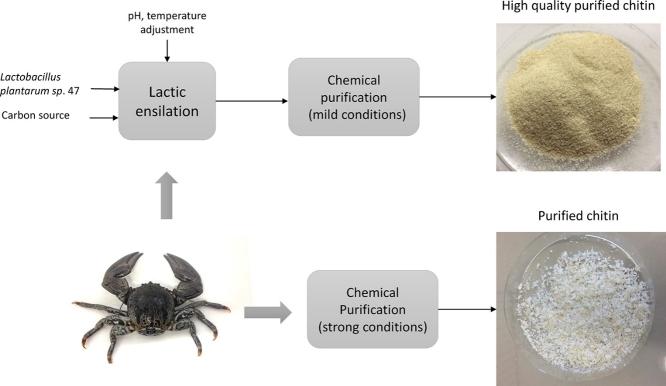
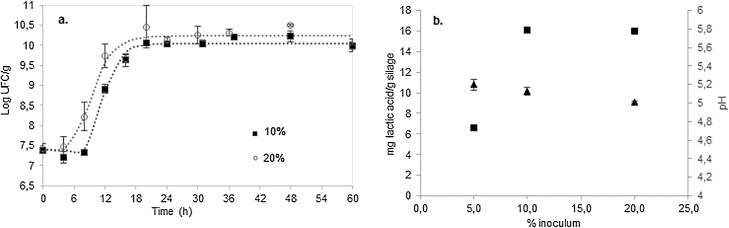
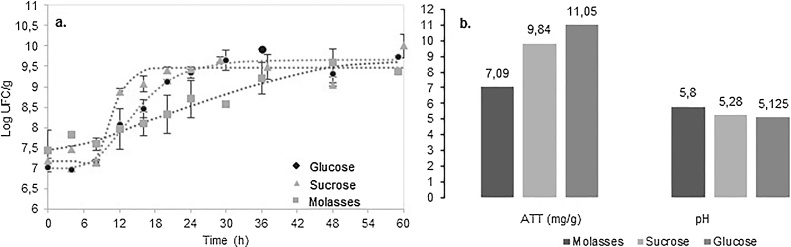
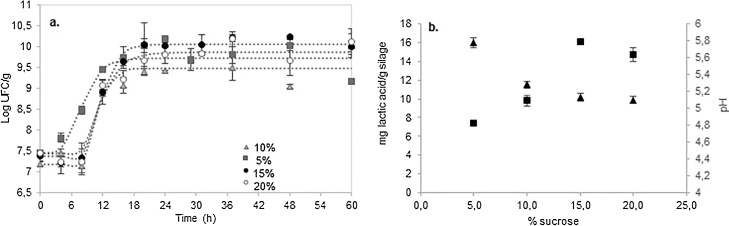
Chitin extraction from , a crab species proliferating in Chile and Peru seashores, was carried out applying preliminary lactic ensilation. For this purpose, sp. 47 isolated from Coho salmon was inoculated in crab biomass. Previously, fermentation parameters (carbon source, inoculum concentration and incubation temperature) to obtain peak lactic acid production and bacterial growth were studied. The optimal fermentation conditions were 10% inoculum, 15% sucrose and 85% crab biomass, producing 17 mg lactic acid/ g silage. Extracted and purified chitin, after 60 h fermentation, showed 99.6 and 95.3% demineralization and deproteinization, respectively, using low concentrated acids and bases. As a means of comparison, chitin was also extracted by chemical hydrolysis using high concentrated acids and bases, giving a lower yield and lower quality product.
从一种在智利和秘鲁海岸大量繁殖的螃蟹物种中提取几丁质,采用了初步乳酸发酵法。为此,将从银大麻哈鱼中分离出的47号菌株接种到螃蟹生物量中。此前,研究了获得乳酸产量峰值和细菌生长的发酵参数(碳源、接种物浓度和培养温度)。最佳发酵条件为接种物10%、蔗糖15%和螃蟹生物量85%,每克青贮饲料产生17毫克乳酸。经过60小时发酵后,使用低浓度的酸和碱提取并纯化的几丁质分别显示出99.6%的脱矿质率和95.3%的脱蛋白率。作为比较手段,还使用高浓度的酸和碱通过化学水解法提取几丁质,得到的产品产量较低且质量较差。