Department of Biology, Edge Hill University, Lancashire, United Kingdom.
Department of Renewable Resources, University of Alberta, Edmonton, Canada.
PLoS One. 2018 Nov 2;13(11):e0206931. doi: 10.1371/journal.pone.0206931. eCollection 2018.
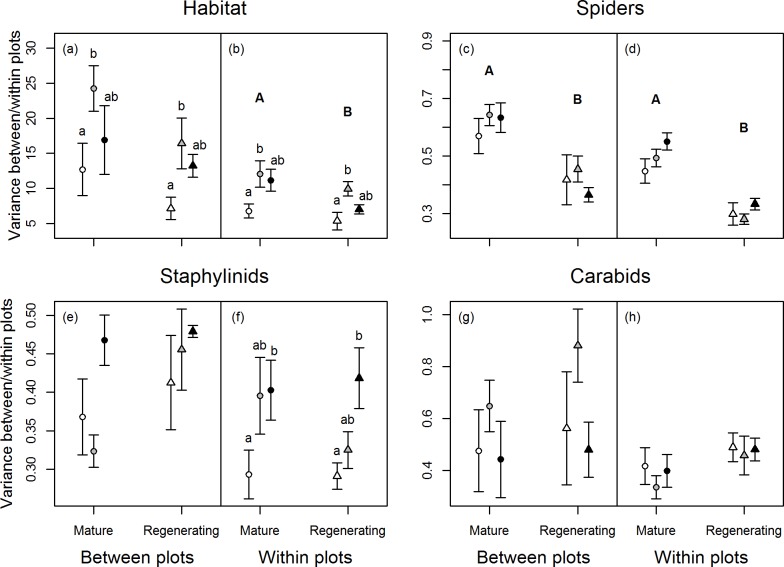
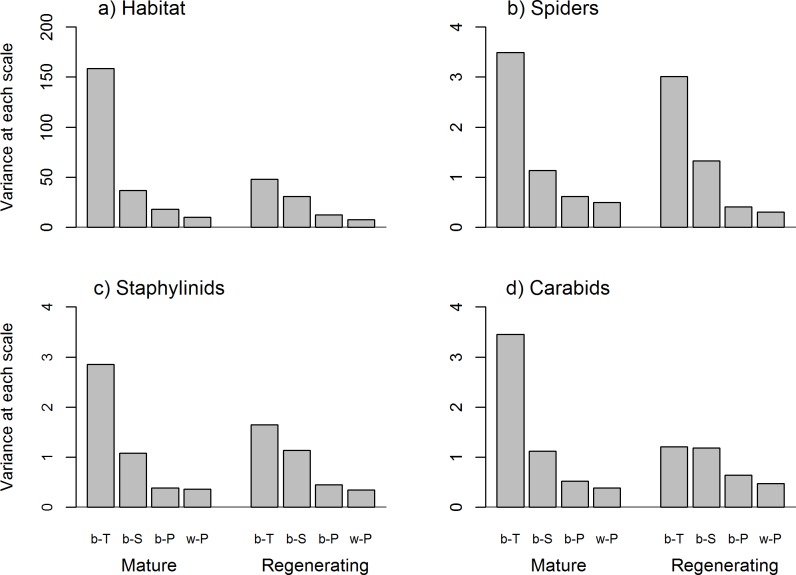
Clear-cutting alters natural ecosystem processes by reducing landscape heterogeneity. It is the dominant harvesting technique across the boreal zone, yet understanding of how environmental heterogeneity and beta diversity are structured in forest ecosystems and post-clear cut is lacking. We use ground-dwelling arthropods as models to determine how natural succession (progression from deciduous to mixed to coniferous cover types) and clear-cutting change boreal forests, exploring the role of environmental heterogeneity in shaping beta diversity across multiple spatial scales (between-cover types and between-stands of the same cover type (1600 to 8500 m), between-plots (100 to 400 m) and within-plots (20 to 40 m)). We characterise environmental heterogeneity as variability in combined structural, vegetational and soil parameters, and beta diversity, as variability in assemblage composition. Clear-cutting homogenised forest environments across all spatial scales, reducing total environmental heterogeneity by 35%. Arthropod beta diversity reflected these changes at larger scales suggesting that environmental heterogeneity is useful in explaining beta diversity both between-cover types and between-stands of the same cover type. However, at smaller scales, within- and between-plots spider beta diversity reflected the lower environmental heterogeneity in regenerating stands, whereas staphylinid and carabids assemblages were not homogenised 12 years post-harvest. Differences in environmental heterogeneity and staphylinid beta diversity between cover types were also important at small scales. In regenerating stands, we detected a subtle yet notable effect of pre-felling cover type on environmental heterogeneity and arthropods, where pre-felling cover type accounted for a significant amount of variance in beta diversity, indicating that biological legacies (e.g. soil pH reflecting pre-harvest conditions) may have a role in driving beta diversity even 12 years post-harvest. This study highlights the importance of understanding site history when predicting impacts of change in forest ecosystems. Further, to understand drivers of beta diversity we must identify biological legacies shaping community structure.
皆伐通过减少景观异质性来改变自然生态系统过程。它是北方地区主要的采伐技术,但对于环境异质性和β多样性在森林生态系统和皆伐后的结构如何,人们的了解还很缺乏。我们使用地面栖息的节肢动物作为模型,来确定自然演替(从落叶林到混交林再到针叶林覆盖类型的转变)和皆伐如何改变北方森林,探索环境异质性在塑造多个空间尺度(覆盖类型之间和同一覆盖类型的林分之间(1600 到 8500 米)、样地之间(100 到 400 米)和样地内(20 到 40 米))的β多样性中的作用。我们将环境异质性描述为组合结构、植被和土壤参数的变异性,而β多样性则描述为组合组成的变异性。皆伐使所有空间尺度的森林环境同质化,使总环境异质性降低了 35%。节肢动物β多样性在较大的尺度上反映了这些变化,表明环境异质性在解释覆盖类型之间和同一覆盖类型的林分之间的β多样性方面是有用的。然而,在较小的尺度上,样地内和样地间蜘蛛β多样性反映了再生林分中较低的环境异质性,而 12 年后,隐翅虫和步甲科的组合并没有同质化。在较小的尺度上,覆盖类型之间的环境异质性和隐翅虫β多样性的差异也很重要。在再生林分中,我们检测到预伐前的覆盖类型对环境异质性和节肢动物有一个微妙但显著的影响,预伐前的覆盖类型解释了β多样性的很大一部分方差,这表明生物遗留物(例如,反映采伐前条件的土壤 pH)可能在采伐后 12 年甚至在驱动β多样性方面发挥作用。本研究强调了在预测森林生态系统变化影响时,了解地点历史的重要性。此外,为了了解β多样性的驱动因素,我们必须确定塑造群落结构的生物遗留物。