• 文献检索
  • 文档翻译
  • 深度研究
  • 学术资讯
  • Suppr Zotero 插件Zotero 插件
  • 邀请有礼
  • 套餐&价格
  • 历史记录
应用&插件
Suppr Zotero 插件Zotero 插件浏览器插件Mac 客户端Windows 客户端微信小程序
定价
高级版会员购买积分包购买API积分包
服务
文献检索文档翻译深度研究API 文档MCP 服务
关于我们
关于 Suppr公司介绍联系我们用户协议隐私条款
关注我们

Suppr 超能文献

核心技术专利:CN118964589B侵权必究
粤ICP备2023148730 号-1Suppr @ 2026

文献检索

告别复杂PubMed语法,用中文像聊天一样搜索,搜遍4000万医学文献。AI智能推荐,让科研检索更轻松。

立即免费搜索

文件翻译

保留排版,准确专业,支持PDF/Word/PPT等文件格式,支持 12+语言互译。

免费翻译文档

深度研究

AI帮你快速写综述,25分钟生成高质量综述,智能提取关键信息,辅助科研写作。

立即免费体验

锂与肾毒性:临床管理和风险分层方法的文献综述。

Lithium and nephrotoxicity: a literature review of approaches to clinical management and risk stratification.

机构信息

Department of Renal Medicine, University Hospital Geelong, Rotary House, 325 Ryrie St, Geelong, VIC, Australia.

IMPACT Strategic Research Centre, School of Medicine, Barwon Health, Deakin University, 75 Pigdons Road, Geelong, Australia.

出版信息

BMC Nephrol. 2018 Nov 3;19(1):305. doi: 10.1186/s12882-018-1101-4.

DOI:10.1186/s12882-018-1101-4
PMID:30390660
原文链接:https://pmc.ncbi.nlm.nih.gov/articles/PMC6215627/
Abstract

BACKGROUND

Despite lithium being the most efficacious treatment for bipolar disorder, its use has been decreasing at least in part due to concerns about its potential to cause significant nephrotoxicity. Whilst the ability of lithium to cause nephrogenic diabetes insipidus is well established, its ability to cause chronic kidney disease is a much more vexing issue, with various studies suggesting both positive and negative causality. Despite these differences, the weight of evidence suggests that lithium has the potential to cause end stage kidney disease, albeit over a prolonged period.

METHODS

A search strategy for this review was developed to identify appropriate studies, sourced from the electronic databases EMBASE, PubMed (NLM) and MEDLINE. Search terms included lithium with the AND operator to combine with nephrotoxicity or nephropathy or chronic kidney disease or nephrogenic diabetes insipidus or renal and pathophysiology.

RESULTS

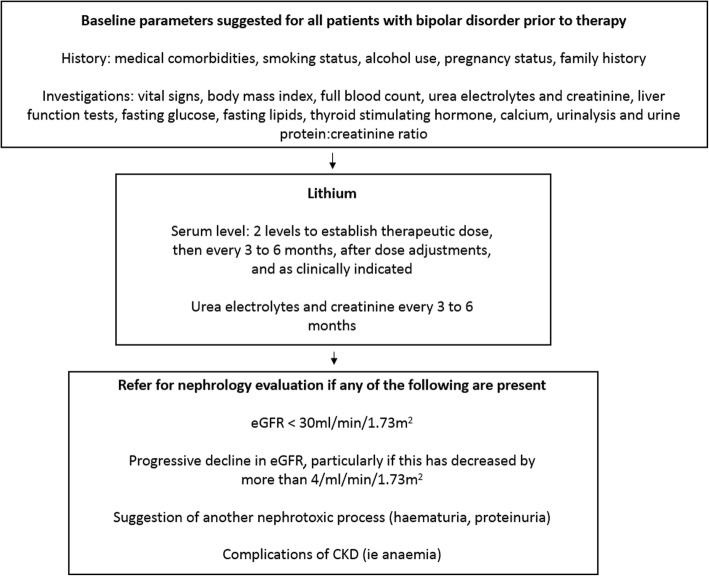
The risks for the development of lithium induced nephropathy are less well defined but appear to include the length of duration of therapy as well as increasing age, as well as episodes of over dosage/elevated lithium levels. Whilst guidelines exist for the routine monitoring of lithium levels and renal function, it remains unclear when nephrological evaluation should occur, as well as when cessation of lithium therapy is appropriate balancing the significant attendant mental health risks as well as the potential for progression to occur despite cessation of therapy against the risks and morbidity of bipolar disorder itself.

CONCLUSION

This paper will elucidate on the current evidence pertaining to the topic of the clinical management of lithium induced nephrotoxicity and provide a guide for clinicians who are faced with the long-term management of these patients.

摘要

背景

尽管锂是治疗双相情感障碍最有效的药物,但由于担心其可能导致严重的肾毒性,其使用至少在一定程度上有所减少。虽然锂引起肾性尿崩症的能力已得到充分证实,但它引起慢性肾脏病的能力则是一个更加棘手的问题,各种研究表明存在正反两方面的因果关系。尽管存在这些差异,但大量证据表明,锂有可能导致终末期肾病,尽管这需要一个漫长的过程。

方法

为了确定适当的研究,我们制定了搜索策略,从电子数据库 EMBASE、PubMed(NLM)和 MEDLINE 中获取相关信息。搜索词包括锂,用 AND 运算符将其与肾毒性、肾病、慢性肾脏病、肾性尿崩症或肾脏和病理生理学相结合。

结果

锂诱导的肾病的发展风险不太明确,但似乎包括治疗时间的长短、年龄的增长、以及过量/升高的锂水平发作。虽然存在常规监测锂水平和肾功能的指南,但仍不清楚何时应进行肾病学评估,以及何时停止锂治疗更为合适,既要权衡停止治疗后可能出现的严重精神健康风险,又要权衡继续治疗与双相情感障碍本身的风险和发病率之间的平衡。

结论

本文将阐明关于锂诱导的肾毒性临床管理的当前证据,并为面临这些患者长期管理的临床医生提供指导。
https://cdn.ncbi.nlm.nih.gov/pmc/blobs/985b/6215627/a93d8011170c/12882_2018_1101_Fig1_HTML.jpg

相似文献

1
Lithium and nephrotoxicity: a literature review of approaches to clinical management and risk stratification.锂与肾毒性:临床管理和风险分层方法的文献综述。
BMC Nephrol. 2018 Nov 3;19(1):305. doi: 10.1186/s12882-018-1101-4.
2
Lithium and nephrotoxicity: Unravelling the complex pathophysiological threads of the lightest metal.锂与肾毒性:解析最轻金属的复杂病理生理线索
Nephrology (Carlton). 2018 Oct;23(10):897-903. doi: 10.1111/nep.13263.
3
[Chronic renal complications induced by lithium].[锂诱导的慢性肾脏并发症]
Encephale. 2009 Dec;35(6):605-10. doi: 10.1016/j.encep.2008.12.007.
4
Prediction of individuals at high risk of chronic kidney disease during treatment with lithium for bipolar disorder.预测双相情感障碍锂治疗个体的慢性肾脏病高危风险。
BMC Med. 2021 Apr 28;19(1):99. doi: 10.1186/s12916-021-01964-z.
5
Lithium nephrotoxicity.锂肾毒性。
Rev Assoc Med Bras (1992). 2010 Sep-Oct;56(5):600-6. doi: 10.1590/s0104-42302010000500025.
6
Persistent nephrogenic diabetes insipidus following lithium therapy.锂治疗后持续性肾性尿崩症
Scott Med J. 1997 Feb;42(1):16-7. doi: 10.1177/003693309704200106.
7
[Renal complications of lithium use: to cease or to continue?].[锂使用的肾脏并发症:停药还是继续用药?]
Ned Tijdschr Geneeskd. 2018 May 29;162:D2683.
8
Lithium-induced nephropathies.锂诱导的肾病。
Psychopharmacol Bull. 2007;40(2):134-49.
9
Use of Lithium and Anticonvulsants and the Rate of Chronic Kidney Disease: A Nationwide Population-Based Study.锂和抗惊厥药物的使用与慢性肾脏病的发生率:一项全国范围内基于人群的研究。
JAMA Psychiatry. 2015 Dec;72(12):1182-91. doi: 10.1001/jamapsychiatry.2015.1834.
10
Lithium in the Kidney: Friend and Foe?肾脏中的锂:是友还是敌?
J Am Soc Nephrol. 2016 Jun;27(6):1587-95. doi: 10.1681/ASN.2015080907. Epub 2015 Nov 17.

引用本文的文献

1
Sodium-Glucose Cotransporter 2 Inhibitors for Lithium-Associated Kidney Dysfunction in Mood Disorders: A Real-World Historical Cohort Study.钠-葡萄糖协同转运蛋白2抑制剂治疗情绪障碍中锂相关的肾功能障碍:一项真实世界历史队列研究
medRxiv. 2025 Sep 3:2025.09.02.25334914. doi: 10.1101/2025.09.02.25334914.
2
Partial central diabetes insipidus during lithium use: A case report and literature review.锂使用过程中出现的部分性中枢性尿崩症:一例报告及文献综述
PCN Rep. 2025 Aug 13;4(3):e70182. doi: 10.1002/pcn5.70182. eCollection 2025 Sep.
3
Comprehensive Review on Association of Bipolar Disorder and Substance Abuse: Dual Diagnosis and Treatment Approaches.

本文引用的文献

1
Canadian Network for Mood and Anxiety Treatments (CANMAT) and International Society for Bipolar Disorders (ISBD) 2018 guidelines for the management of patients with bipolar disorder.加拿大心境与焦虑治疗网络(CANMAT)和国际双相障碍学会(ISBD)2018 年双相障碍患者管理指南。
Bipolar Disord. 2018 Mar;20(2):97-170. doi: 10.1111/bdi.12609. Epub 2018 Mar 14.
2
Recalibrating the risks and benefits of lithium therapy.重新评估锂治疗的风险和获益。
Br J Psychiatry. 2017 Jul;211(1):1-2. doi: 10.1192/bjp.bp.116.193789.
3
Long-term lithium treatment in bipolar disorder: effects on glomerular filtration rate and other metabolic parameters.
双相情感障碍与物质滥用关联的综合综述:双重诊断与治疗方法
Cureus. 2025 Jun 19;17(6):e86363. doi: 10.7759/cureus.86363. eCollection 2025 Jun.
4
Lithium-Induced Hyperparathyroidism in a Patient With Bipolar Disorder: The Importance of Monitoring Complications in Patients Undergoing Chronic Lithium Therapy.一名双相情感障碍患者的锂诱导性甲状旁腺功能亢进:监测接受慢性锂治疗患者并发症的重要性。
Cureus. 2025 Mar 4;17(3):e80030. doi: 10.7759/cureus.80030. eCollection 2025 Mar.
5
Prospects for lithium treated patients with severe renal impairment.锂治疗严重肾功能损害患者的前景。
Int J Bipolar Disord. 2025 Feb 14;13(1):5. doi: 10.1186/s40345-025-00372-z.
6
Various endurance training intensities improve GFR and Up-regulate AQP2/GSK3β in lithium-induced nephropathic rats.不同强度的耐力训练可改善锂诱导的肾病大鼠的肾小球滤过率(GFR)并上调水通道蛋白2(AQP2)/糖原合成酶激酶3β(GSK3β)。
BMC Nephrol. 2025 Feb 6;26(1):60. doi: 10.1186/s12882-025-03997-5.
7
Endoxifen in Bipolar Disorder With Hyperammonemia and Renal Impairment: A Case Report.恩杂他胺治疗伴有高氨血症和肾功能损害的双相情感障碍:一例报告
Cureus. 2025 Jan 3;17(1):e76839. doi: 10.7759/cureus.76839. eCollection 2025 Jan.
8
Central and nephrogenic diabetes insipidus: updates on diagnosis and management.中枢性和肾性尿崩症:诊断与管理的最新进展
Front Endocrinol (Lausanne). 2025 Jan 8;15:1479764. doi: 10.3389/fendo.2024.1479764. eCollection 2024.
9
Influence of Ageing on the Pharmacodynamics and Pharmacokinetics of Chronically Administered Medicines in Geriatric Patients: A Review.衰老对老年患者长期用药药效学和药代动力学的影响:综述
Clin Pharmacokinet. 2025 Mar;64(3):335-367. doi: 10.1007/s40262-024-01466-0. Epub 2025 Jan 11.
10
Do Exercise and Magnesium Sulfate Improve Infertility Caused by Lithium Carbonate in Male Rats?运动和硫酸镁能改善雄性大鼠碳酸锂所致的不育吗?
Adv Biomed Res. 2024 Nov 30;13:110. doi: 10.4103/abr.abr_216_23. eCollection 2024.
双相情感障碍的长期锂盐治疗:对肾小球滤过率及其他代谢参数的影响。
Int J Bipolar Disord. 2017 Dec;5(1):27. doi: 10.1186/s40345-017-0096-2. Epub 2017 Aug 1.
4
An observational study of 110 elderly lithium-treated patients followed up for 6 years with particular reference to renal function.一项对110名接受锂治疗的老年患者进行的观察性研究,随访6年,特别关注肾功能。
Int J Bipolar Disord. 2017 Dec;5(1):19. doi: 10.1186/s40345-017-0089-1. Epub 2017 Jul 9.
5
AJKD Atlas of Renal Pathology: Lithium Nephrotoxicity.《美国肾脏病学会杂志》肾脏病理学图谱:锂中毒性肾病
Am J Kidney Dis. 2017 Jan;69(1):e1-e2. doi: 10.1053/j.ajkd.2016.11.005.
6
Lithium side effects and toxicity: prevalence and management strategies.锂的副作用与毒性:发生率及管理策略
Int J Bipolar Disord. 2016 Dec;4(1):27. doi: 10.1186/s40345-016-0068-y. Epub 2016 Dec 17.
7
Reconsidering risk factors for renal dysfunction in lithium-treated patients.重新审视锂治疗患者肾功能不全的危险因素。
Evid Based Ment Health. 2016 Nov;19(4):e22. doi: 10.1136/eb-2016-102377. Epub 2016 Aug 31.
8
Renal replacement therapy associated with lithium nephrotoxicity in New Zealand.新西兰与锂肾毒性相关的肾脏替代治疗
N Z Med J. 2015 Nov 20;128(1425):77-83.
9
Prevention of lithium-associated renal failure: recent evidence.锂相关性肾衰竭的预防:最新证据
Lancet Psychiatry. 2015 Dec;2(12):1045-7. doi: 10.1016/S2215-0366(15)00498-8.
10
Use of Lithium and Anticonvulsants and the Rate of Chronic Kidney Disease: A Nationwide Population-Based Study.锂和抗惊厥药物的使用与慢性肾脏病的发生率:一项全国范围内基于人群的研究。
JAMA Psychiatry. 2015 Dec;72(12):1182-91. doi: 10.1001/jamapsychiatry.2015.1834.