Institute of Genomic Medicine and Rare Disorders, Semmelweis University, H 1083 Tömő u, Budapest, 25-29, Hungary.
Department of Health Policy and Health Economics, Institute of Economics, Faculty of Social Sciences, Eötvös Loránd University, Pázmány Péter sétány 1/A 1117, Budapest, 361, Hungary.
Orphanet J Rare Dis. 2018 Nov 6;13(1):184. doi: 10.1186/s13023-018-0927-y.
Funding of orphan medicinal products (OMPs) is an increasing challenge in the European Union (EU).
To identify the different methods for public funding of OMPs in order to map the availability for rare disease patients, as well as to compare the public expenditures on OMPs in 8 EU member states.
Information on the reimbursement status of 83 OMPs was collected in 8 countries by distinguishing standard and special reimbursements. In two consecutive years, the total public expenditures on OMPs were calculated by using annual EUR exchange rates. Annual total public expenditures were calculated per capita, and as a proportion of GDP, total public pharmaceutical and healthcare budgets. Differences between countries were compared by calculating the deviations from the average spending of countries.
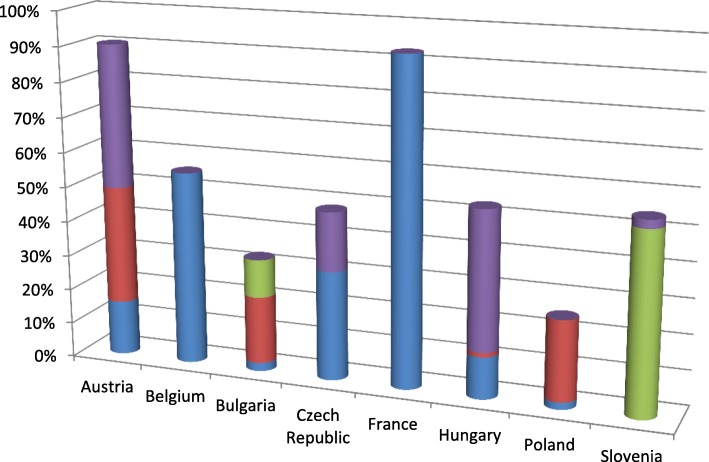
In 2015 29.4-92.8% of the 83 OMPs were available with any kind of public reimbursement in participant countries including special reimbursement on an individual basis. In Austria, Belgium and France more OMPs were accessible for patients with public reimbursement than in Bulgaria, Czech Republic, Hungary and Poland. Standard reimbursement through retail pharmacies and/or hospitals was applied from 0 to 41% of OMPs. The average annual total public expenditure ranged between 1.4-23.5 €/capita in 2013 and 2014. Higher income countries spent more OMPs in absolute terms. Participant countries spent 0.018-0.066% of their GDPs on funding OMPs. Average expenditures on OMPs were ranged between 2.25-6.51% of the public pharmaceutical budget, and 0.44-0.96% of public healthcare expenditures.
Standard and special reimbursement techniques play different roles in participant countries. The number of accessible OMPs indicated an equity gap between Eastern and Western Europe. The spending on OMPs as a proportion of GDP, public pharmaceutical and healthcare expenditure was not higher in lower income countries, which indicates substantial differences in patient access to OMPs in favour of higher-income countries. Equity in access for patients with rare diseases is an important policy objective in each member state of the EU; however, equity in access should be harmonized at the European level.
在欧盟(EU),孤儿药(OMP)的资金供应是一个日益严峻的挑战。
确定公共资金供应 OMP 的不同方法,以便为罕见病患者提供可用性,并比较 8 个欧盟成员国的 OMP 公共支出。
通过区分标准和特殊报销,在 8 个国家收集了 83 种 OMP 的报销状况信息。在连续两年中,使用年度欧元汇率计算 OMP 的公共总支出。按人均计算年度公共总支出,并按 GDP 计算公共制药和医疗保健总预算的比例。通过计算各国支出平均值的偏差来比较国家之间的差异。
2015 年,在参与国,29.4-92.8%的 83 种 OMP 可通过任何形式的公共报销获得,包括针对个别患者的特殊报销。在奥地利、比利时和法国,通过公共报销获得 OMP 的患者比保加利亚、捷克共和国、匈牙利和波兰更多。通过零售药店和/或医院进行的标准报销适用于 0-41%的 OMP。2013 年和 2014 年,平均年公共总支出为每人 1.4-23.5 欧元。高收入国家在绝对支出上花费更多的 OMP。参与国将其 GDP 的 0.018-0.066%用于资助 OMP。OMP 的平均支出占公共制药预算的 2.25-6.51%,占公共医疗支出的 0.44-0.96%。
标准和特殊报销技术在参与国发挥不同的作用。可获得的 OMP 数量表明东欧和西欧之间存在公平差距。作为 GDP 的一部分,公共制药和医疗保健支出的 OMP 支出比例在低收入国家并不高,这表明在高收入国家,患者获得 OMP 的机会存在实质性差异。在每个欧盟成员国中,为罕见病患者提供公平的治疗机会是一个重要的政策目标;然而,公平的机会应该在欧洲层面上协调一致。