Department of Psychology, The University of Texas at Austin, Austin, USA.
Department of Cognitive Science, University of California, San Diego, La Jolla, USA.
Sci Rep. 2018 Nov 5;8(1):16326. doi: 10.1038/s41598-018-34756-2.
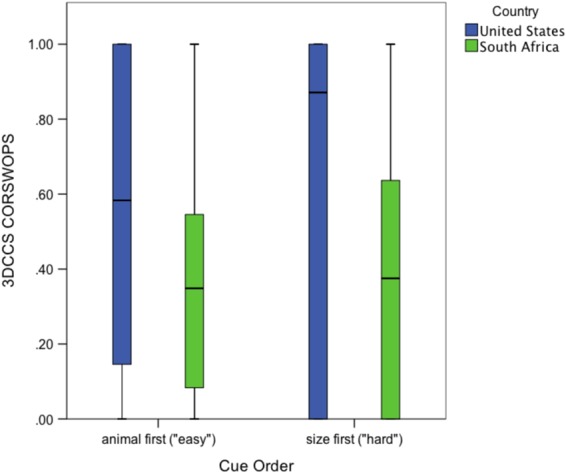
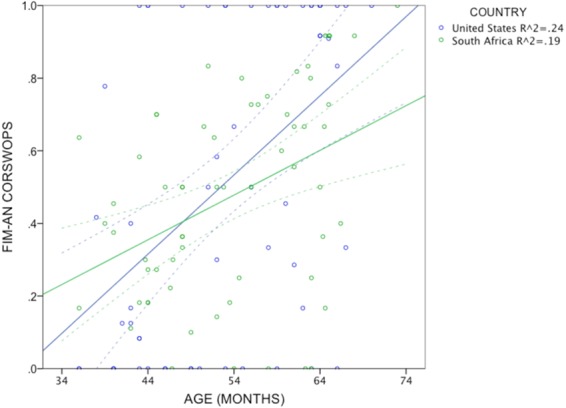
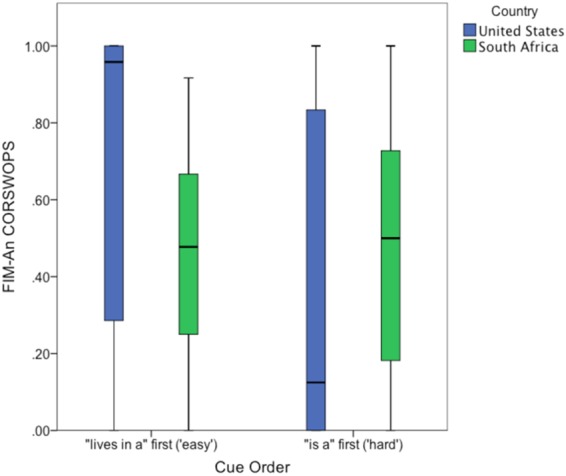
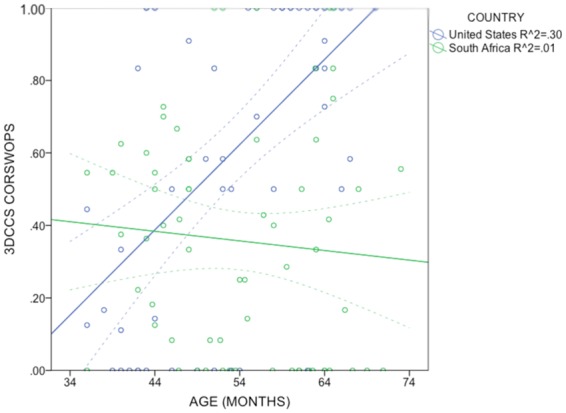
Cognitive flexibility, the adaptation of representations and responses to new task demands, improves dramatically in early childhood. It is unclear, however, whether flexibility is a coherent, unitary cognitive trait, or is an emergent dimension of task-specific performance that varies across populations with divergent experiences. Three- to 5-year-old English-speaking U.S. children and Tswana-speaking South African children completed two distinct language-processing cognitive flexibility tests: the FIM-Animates, a word-learning test, and the 3DCCS, a rule-switching test. U.S. and South African children did not differ in word-learning flexibility but showed similar age-related increases. In contrast, U.S. preschoolers showed an age-related increase in rule-switching flexibility but South African children did not. Verbal recall explained additional variance in both tests but did not modulate the interaction between population sample (i.e., country) and task. We hypothesize that rule-switching flexibility might be more dependent upon particular kinds of cultural experiences, whereas word-learning flexibility is less cross-culturally variable.
认知灵活性,即根据新任务需求调整表现和反应的能力,在儿童早期会显著提高。然而,目前尚不清楚灵活性是一种连贯的、单一的认知特征,还是一种特定任务表现的新兴维度,因具有不同经验的群体而异。3 至 5 岁的讲英语的美国儿童和讲茨瓦纳语的南非儿童完成了两项不同的语言处理认知灵活性测试:FIM-Animates,一项词汇学习测试,和 3DCCS,一项规则转换测试。美国和南非儿童在词汇学习灵活性方面没有差异,但都表现出与年龄相关的增长。相比之下,美国学龄前儿童的规则转换灵活性随着年龄的增长而提高,但南非儿童则没有。言语回忆在两项测试中都解释了额外的差异,但没有调节人口样本(即国家)和任务之间的相互作用。我们假设规则转换灵活性可能更依赖于特定类型的文化经验,而词汇学习灵活性在跨文化方面的变化较小。