Yamasaki Takeshi, Aoki Sou, Tokita Masayoshi
Division of Natural History Yamashina Institute for Ornithology Abiko Chiba Japan.
Department of Biology Faculty of Science Toho University Funabashi Chiba Japan.
Ecol Evol. 2018 Sep 21;8(20):10057-10066. doi: 10.1002/ece3.4440. eCollection 2018 Oct.
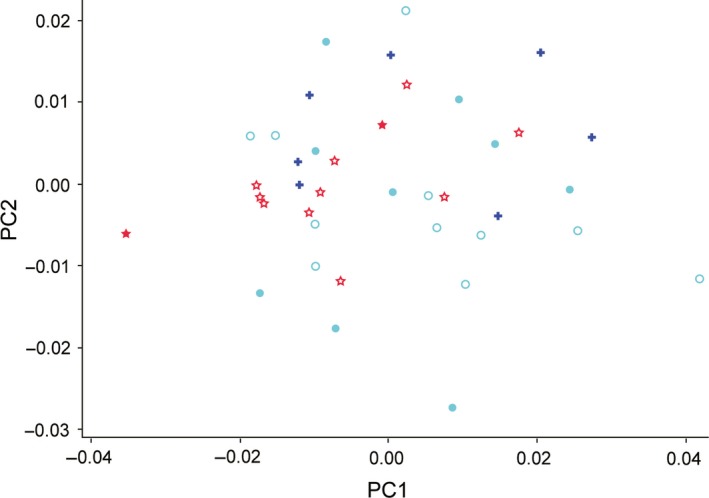
A recent geometric morphometric study on certain landbird lineages revealed that a major part of the variation in beak shape is accounted for by skull size and cranial shape. The study interpreted this result as evidence for the presence of strong evolutionary constraints that severely prevented beak shape from evolving substantially away from predictions of allometry and morphological integration. However, there is another overlooked but similarly plausible explanation for this result: The reason why beak shape does not depart much from predictions might simply be that selection pressures favoring such changes in shape are themselves rare. Here, to evaluate the intensity of evolutionary constraints on avian beak shape more appropriately, we selected large-billed () and carrion crows () as study objects. These landbird species seem to experience selection pressures favoring a departure from an allometric trajectory. A landmark-based geometric morphometric approach using three-dimensional reconstructions of CT scan images revealed that only 45.4% of the total shape variation was explained by allometry and beak-braincase integration. This suggests that when a selection pressure acts in a different direction to allometry and integration, avian beak shape can react to it and evolve flexibly. As traditionally considered, evolutionary constraints on avian beak shape might not be all that strong.
最近一项针对某些陆鸟谱系的几何形态测量研究表明,喙形状变化的主要部分可由头骨大小和颅骨形状来解释。该研究将这一结果解释为存在强烈进化限制的证据,这些限制严重阻碍了喙形状从异速生长和形态整合的预测中大幅进化。然而,对于这一结果还有另一个被忽视但同样合理的解释:喙形状与预测相差不大的原因可能仅仅是有利于这种形状变化的选择压力本身很少见。在此,为了更恰当地评估对鸟类喙形状的进化限制强度,我们选择了大嘴乌鸦( )和食腐鸦( )作为研究对象。这些陆鸟物种似乎经历了有利于偏离异速生长轨迹的选择压力。一种基于地标点的几何形态测量方法,利用CT扫描图像的三维重建显示,总形状变化中只有45.4%可由异速生长和喙-脑壳整合来解释。这表明,当选择压力朝着与异速生长和整合不同的方向作用时,鸟类喙形状能够对其做出反应并灵活进化。正如传统观点所认为的,对鸟类喙形状的进化限制可能并没有那么强烈。