School of Geosciences, University of South Florida, Tampa, FL, 33620, USA.
Unidad de Paleontologıa, Departamento Biologıa, Universidad Autonoma de Madrid, Cantoblanco, 28049, Madrid, Spain.
BMC Evol Biol. 2019 May 17;19(1):104. doi: 10.1186/s12862-019-1432-1.
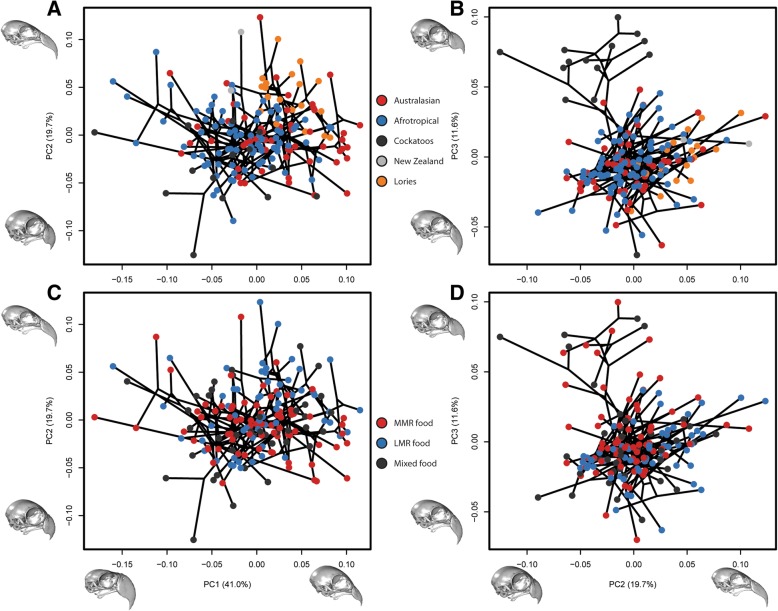
The Psittaciformes (parrots and cockatoos) are characterised by their large beaks, and are renowned for their ability to produce high bite forces. These birds also possess a suite of modifications to their cranial architecture interpreted to be adaptations for feeding on mechanically resistant foods, yet the relationship between cranial morphology and diet has never been explicitly tested. Here, we provide a three-dimensional geometric morphometric analysis of the developmental and biomechanical factors that may be influencing the evolution of psittaciformes' distinctive cranial morphologies.
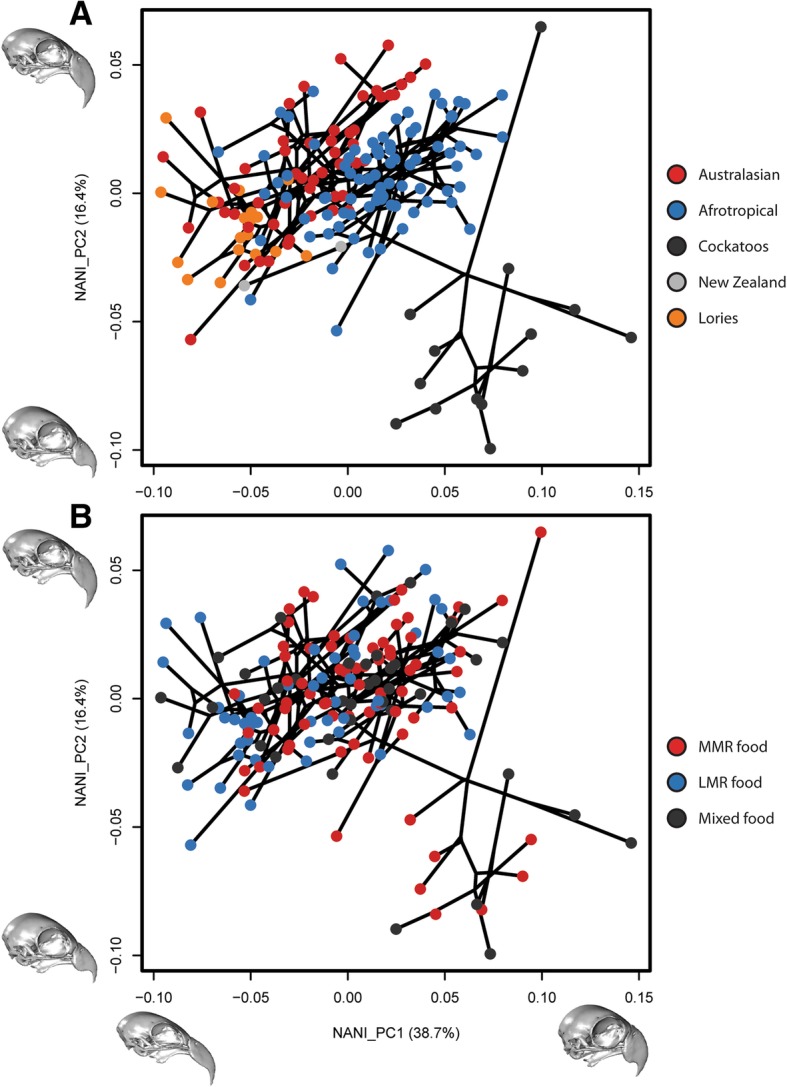
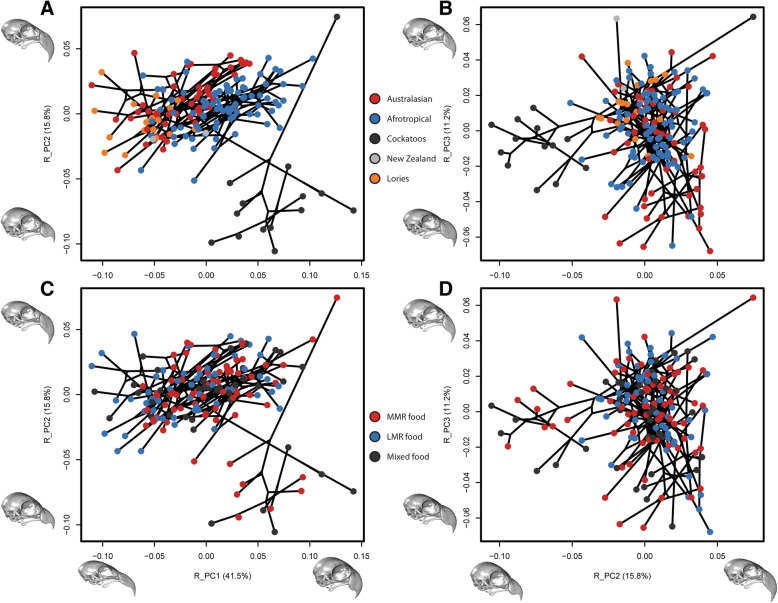
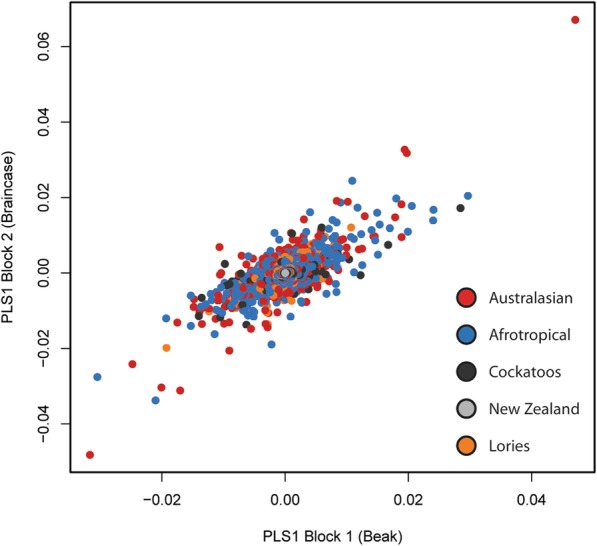
Contrary to our own predictions, we find that dietary preferences for more- or less- mechanically resistant foods have very little influence on beak and skull shape, and that diet predicts only 2.4% of the shape variation in psittaciform beaks and skulls. Conversely, evolutionary allometry and integration together predict almost half the observed shape variation, with phylogeny remaining an important factor in shape identity throughout our analyses, particularly in separating cockatoos (Cacatuoidea) from the true parrots (Psittacoidea).
Our results are similar to recent findings about the evolutionary trajectories of skull and beak shape in other avian families. We therefore propose that allometry and integration are important factors causing canalization of the avian head, and while diet clearly has an influence on beak shape between families, this may not be as important at driving evolvability within families as is commonly assumed.
凤头鹦鹉目(鹦鹉和凤头鹦鹉)的特征是其大喙,以能够产生高咬合力而闻名。这些鸟类的颅架构也有一系列的改变,被解释为适应于食用机械抗性食物,但颅形态和饮食之间的关系从未被明确测试过。在这里,我们提供了一个三维几何形态测量学分析,研究可能影响凤头鹦鹉独特颅形态进化的发育和生物力学因素。
与我们自己的预测相反,我们发现对更具或较少机械抗性食物的饮食偏好对喙和头骨形状的影响很小,饮食仅能预测凤头鹦鹉喙和头骨形状变化的 2.4%。相反,进化的异速生长和整合共同预测了近一半的观察到的形状变化,系统发育在整个分析中仍然是形状身份的一个重要因素,特别是在将凤头鹦鹉(Cacatuoidea)与真正的鹦鹉(Psittacoidea)分开时。
我们的结果与最近关于其他鸟类家族头骨和喙形状进化轨迹的发现相似。因此,我们提出异速生长和整合是导致鸟类头部管道化的重要因素,虽然饮食显然在家族之间对喙形状有影响,但这可能不如通常假设的那样,对家族内的可进化性有重要影响。