Wong Tzyy-Yue, Juang Wang-Chuan, Tsai Chia-Ti, Tseng Ching-Jiunn, Lee Wen-Hsien, Chang Sheng-Nan, Cheng Pei-Wen
Research Assistant Center, Show Chwan Memorial Hospital, Changhua 50000, Taiwan.
Department of Emergency, Kaohsiung Veterans General Hospital, Kaohsiung 81300, Taiwan.
J Clin Med. 2018 Nov 2;7(11):410. doi: 10.3390/jcm7110410.
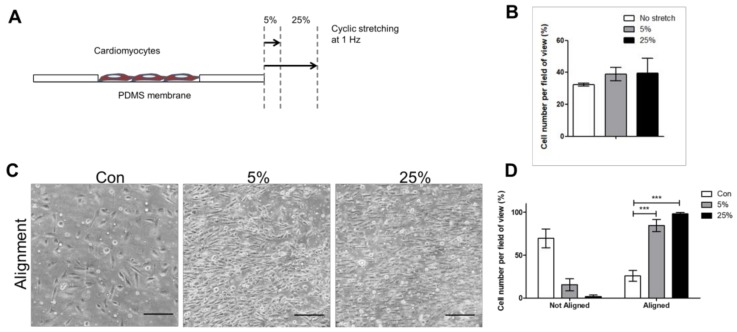
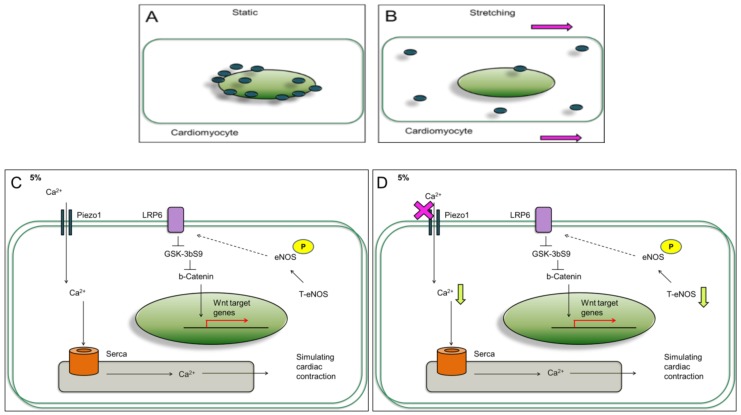
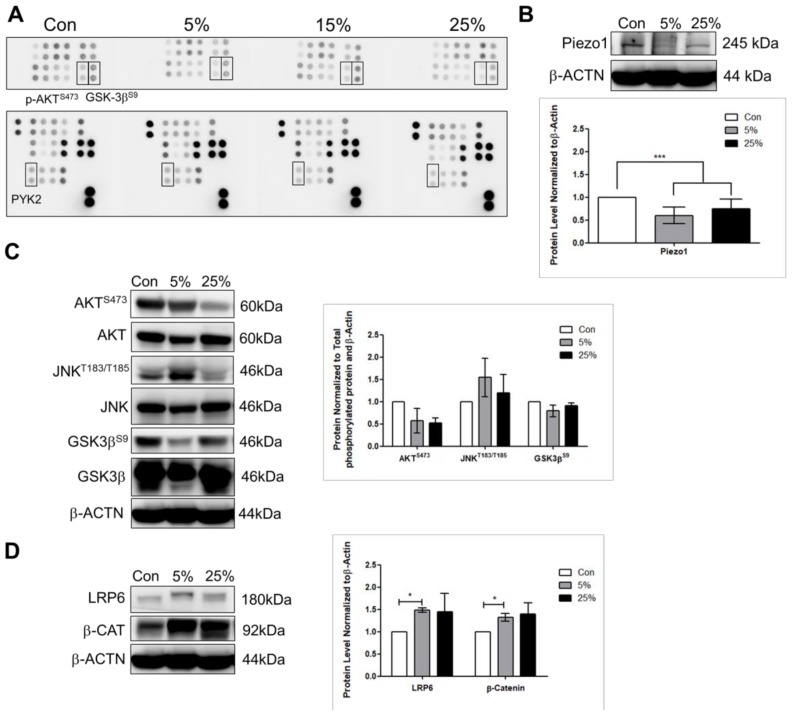
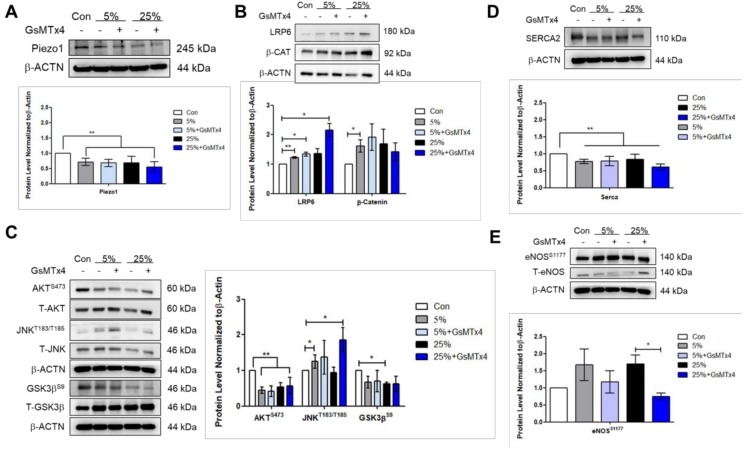
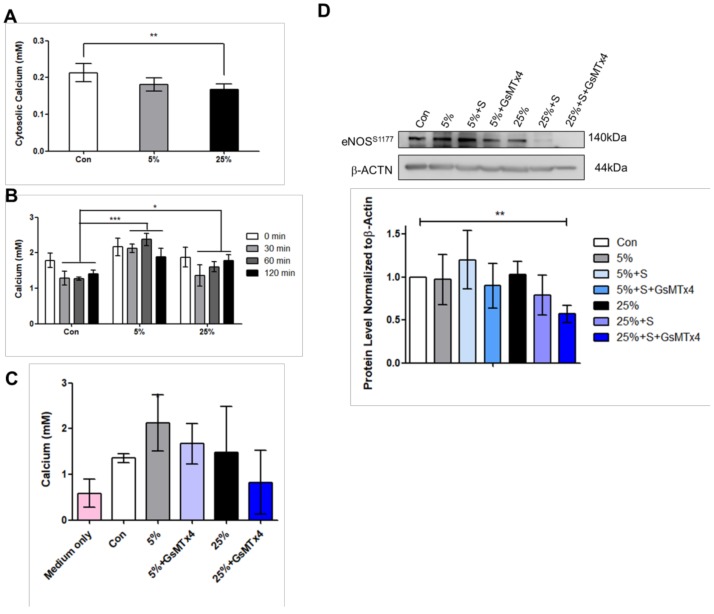
The dynamics of a living body enables organs to experience mechanical stimulation at cellular level. The human cardiomyocytes cell line provides a source for simulating heart dynamics; however, a limited understanding of the mechanical stimulation effect on them has restricted potential applications. Here, we investigated the effect of mechanical stimulation on the cardiac function-associated protein expressions in human cardiomyocytes. Human cardiomyocyte cell line AC16 was subjected to different stresses: 5% mild and 25% aggressive, at 1 Hz for 24 h. The stretched cardiomyocytes showed down-regulated Piezo1, phosphorylated-Ak transforming serine473 (P-AKT), and phosphorylated-glycogen synthase kinase-3 beta serine9 P-GSK3β compared to no stretch. In addition, the stretched cardiomyocytes showed increased low-density lipoprotein receptor-related protein 6 (LRP6), and phosphorylated-c-Jun N-terminal kinase threonine183/tyrosine185 (P-JNK). When Piezo inhibitor was added to the cells, the LRP6, and P-JNK were further increased under 25%, but not 5%, suggesting that higher mechanical stress further activated the wingless integrated-(Wnt)-related signaling pathway when Piezo1 was inhibited. Supporting this idea, when Piezo1 was inhibited, the expression of phosphorylated-endothelial nitric oxide synthase serine1177 (P-eNOS) and release of calcium ions were reduced under 25% compared to 5%. These studies demonstrate that cyclic mechanical stimulation affects cardiac function-associated protein expressions, and Piezo1 plays a role in the protein regulation.
活体的动力学特性使器官能够在细胞水平上经历机械刺激。人类心肌细胞系为模拟心脏动力学提供了一个来源;然而,对机械刺激对它们的影响了解有限,限制了其潜在应用。在此,我们研究了机械刺激对人类心肌细胞中心脏功能相关蛋白表达的影响。人类心肌细胞系AC16受到不同的应力:5%的轻度应力和25%的强烈应力,频率为1Hz,持续24小时。与未拉伸的心肌细胞相比,拉伸后的心肌细胞中Piezo1、磷酸化的Ak转化丝氨酸473(P-AKT)和磷酸化的糖原合酶激酶-3β丝氨酸9(P-GSK3β)表达下调。此外,拉伸后的心肌细胞中低密度脂蛋白受体相关蛋白6(LRP6)和磷酸化的c-Jun氨基末端激酶苏氨酸183/酪氨酸185(P-JNK)增加。当向细胞中添加Piezo抑制剂时,在25%的应力下,LRP6和P-JNK进一步增加,但在5%的应力下没有增加,这表明当Piezo1被抑制时,更高的机械应力进一步激活了无翅型整合(Wnt)相关信号通路。支持这一观点的是,当Piezo1被抑制时,与5%的应力相比,在25%的应力下,磷酸化的内皮型一氧化氮合酶丝氨酸1177(P-eNOS)的表达和钙离子的释放减少。这些研究表明,周期性机械刺激会影响心脏功能相关蛋白表达,并且Piezo1在蛋白调节中发挥作用。