Department of Public Health Sciences and Pediatrics, Università di Torino, Via Santena 5 bis, 10126, Turin, Italy.
Department of Biomedical and Neuromotor Sciences, Alma Mater Studiorum - Università di Bologna, Via Ugo Foscolo 7, 40123, Bologna, Italy.
BMC Public Health. 2018 Nov 6;18(1):1236. doi: 10.1186/s12889-018-6155-5.
The aim was to analyse participation trajectories in organised breast and cervical cancer screening programmes and the association between socioeconomic variables and participation.
A pooled, cross-sectional, time series analysis was used to evaluate secondary data from 17 European countries in 2004-2014.
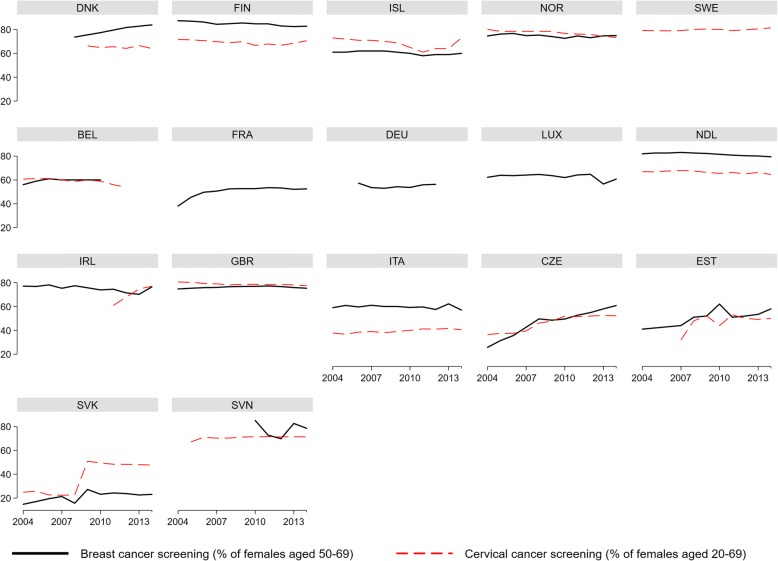
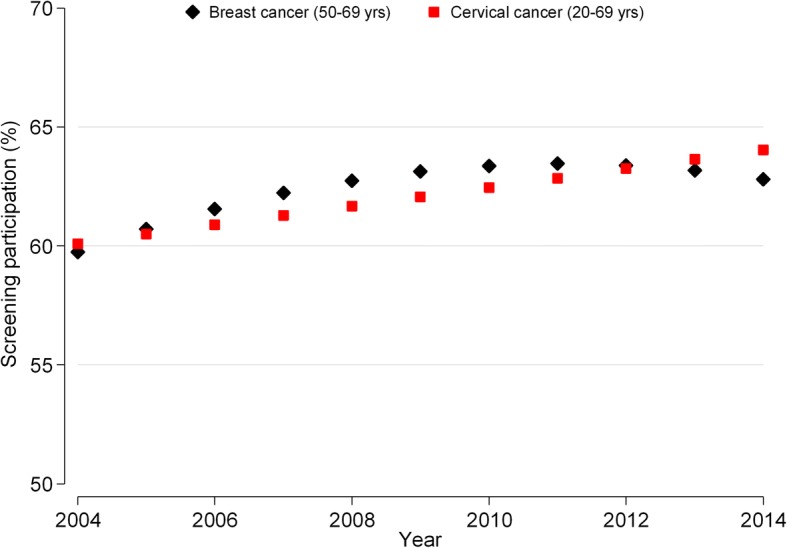
The results show that the mammographic screening trend decreases after an initial increase (coefficient for the linear term = 0.40; p = 0.210; 95% CI = - 0.25, 1.06; coefficient for the quadratic term = - 0.07; p = 0.027; 95% CI = - 0.14, - 0.01), while the cervical screening trend is essentially stable (coefficient for the linear term = 0.39, p = 0.312, 95% CI = - 0.42, 1.20; coefficient for the quadratic term = 0.02, p = 0.689, 95% CI = - 0.07, 0.10). There is a significant difference among the country-specific slopes for breast and cervical cancer screening (SD = 16.7, p < 0.001; SD = 14.4, p < 0.001, respectively). No association is found between participation rate and educational level, income, type of employment, unemployment and preventive expenditure. However, participation in cervical cancer screening is significantly associated with a higher proportion of younger women (≤ 49 years) and a higher Gini index (that is, higher income inequality).
In conclusion three messages: organized cancer screening programmes may reduce the socioeconomic inequalities in younger people's use of preventive services over time; socioeconomic variables are not related to participation rates; these rates do not reach a level of stability in several countries. Therefore, without effective recruitment strategies and tailored organizations, screening participation may not achieve additional gains.
本研究旨在分析参加有组织的乳腺癌和宫颈癌筛查计划的轨迹,并探讨社会经济变量与参与度之间的关系。
采用汇总、横截面、时间序列分析方法,对 2004 年至 2014 年来自 17 个欧洲国家的二级数据进行评估。
结果表明,乳腺 X 线筛查的趋势在最初增加后下降(线性项系数为 0.40;p=0.210;95%置信区间为-0.25 至 1.06;二次项系数为-0.07;p=0.027;95%置信区间为-0.14 至-0.01),而宫颈筛查的趋势基本稳定(线性项系数为 0.39,p=0.312,95%置信区间为-0.42 至 1.20;二次项系数为 0.02,p=0.689,95%置信区间为-0.07 至 0.10)。各国在乳腺癌和宫颈癌筛查方面的斜率存在显著差异(标准差分别为 16.7,p<0.001;14.4,p<0.001)。参与率与教育水平、收入、就业类型、失业和预防支出之间没有关联。然而,宫颈癌筛查的参与度与更年轻的女性(≤49 岁)比例较高和基尼指数(即较高的收入不平等)显著相关。
总之,有三个信息:有组织的癌症筛查计划可能会随着时间的推移减少年轻人在预防服务使用方面的社会经济不平等;社会经济变量与参与率无关;在一些国家,这些比率没有达到稳定水平。因此,如果没有有效的招募策略和量身定制的组织,筛查参与度可能不会带来额外的收益。