Radboud University, Donders Institute for Brain, Cognition and Behaviour, Department of Biophysics, Heyendaalseweg 135, 6525 AJ, Nijmegen, The Netherlands.
Sci Rep. 2018 Nov 6;8(1):16399. doi: 10.1038/s41598-018-34512-6.
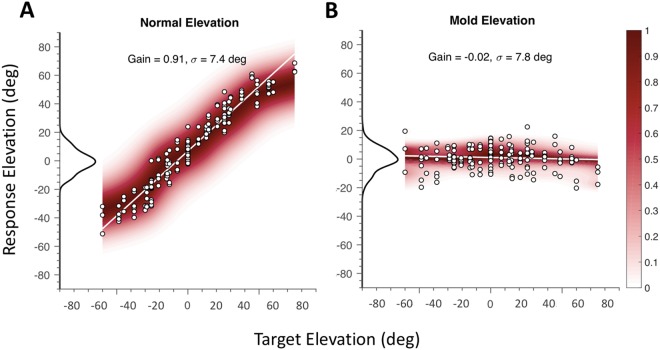
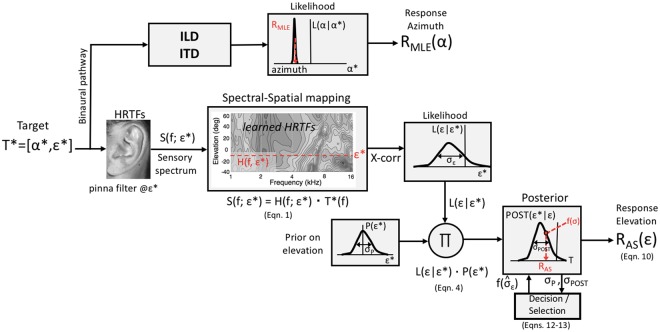
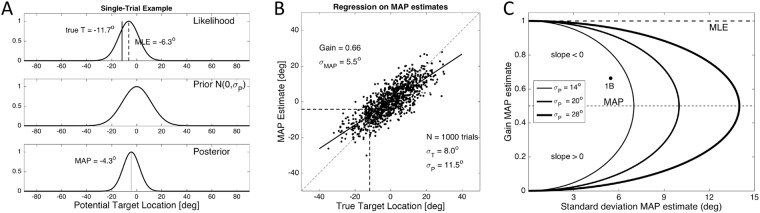
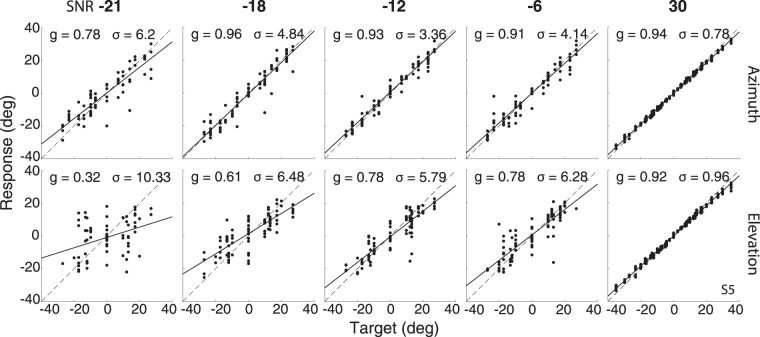
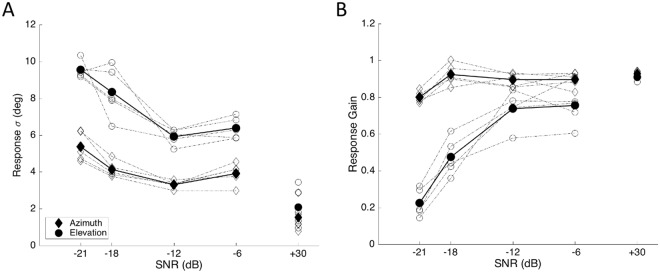
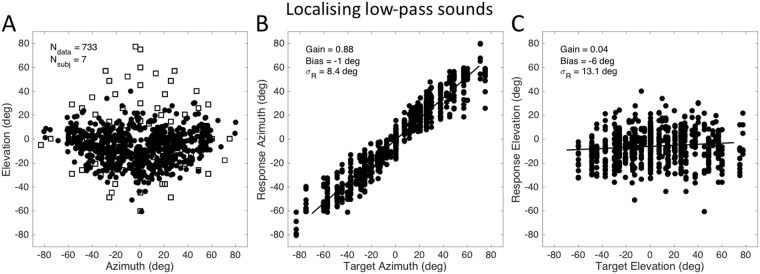
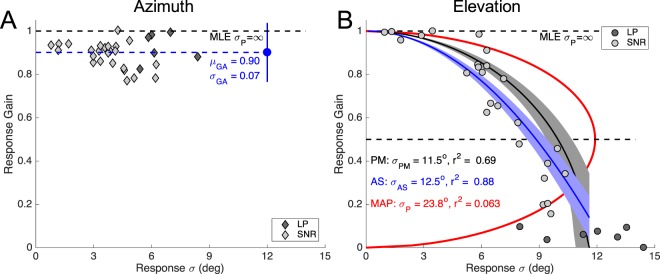
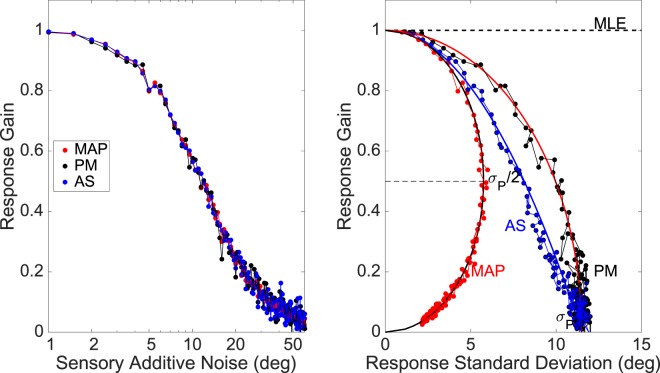
Sensory representations are typically endowed with intrinsic noise, leading to variability and inaccuracies in perceptual responses. The Bayesian framework accounts for an optimal strategy to deal with sensory-motor uncertainty, by combining the noisy sensory input with prior information regarding the distribution of stimulus properties. The maximum-a-posteriori (MAP) estimate selects the perceptual response from the peak (mode) of the resulting posterior distribution that ensure optimal accuracy-precision trade-off when the underlying distributions are Gaussians (minimal mean-squared error, with minimum response variability). We tested this model on human eye- movement responses toward broadband sounds, masked by various levels of background noise, and for head movements to sounds with poor spectral content. We report that the response gain (accuracy) and variability (precision) of the elevation response components changed systematically with the signal-to-noise ratio of the target sound: gains were high for high SNRs and decreased for low SNRs. In contrast, the azimuth response components maintained high gains for all conditions, as predicted by maximum-likelihood estimation. However, we found that the elevation data did not follow the MAP prediction. Instead, results were better described by an alternative decision strategy, in which the response results from taking a random sample from the posterior in each trial. We discuss two potential implementations of a simple posterior sampling scheme in the auditory system that account for the results and argue that although the observed response strategies for azimuth and elevation are sub-optimal with respect to their variability, it allows the auditory system to actively explore the environment in the absence of adequate sensory evidence.
感觉表示通常具有内在噪声,导致感知反应的可变性和不准确性。贝叶斯框架通过将噪声感觉输入与关于刺激属性分布的先验信息相结合,为处理感觉运动不确定性提供了一种最佳策略。最大后验(MAP)估计从产生的后验分布的峰值(模式)中选择感知反应,从而在基础分布为高斯分布时(最小均方误差,最小响应可变性)确保最佳准确性-精度折衷。我们在人类眼动反应中测试了该模型,这些反应针对宽带声音,被各种背景噪声水平掩盖,并且针对具有较差光谱内容的声音进行头部运动。我们报告说,抬头反应成分的响应增益(准确性)和可变性(精度)随目标声音的信噪比而系统变化:高 SNR 时增益高,低 SNR 时增益降低。相比之下,方位响应成分在所有条件下均保持高增益,这与最大似然估计一致。然而,我们发现高程数据不符合 MAP 预测。相反,结果由在每次试验中从后验中随机采样得到的替代决策策略更好地描述。我们讨论了听觉系统中简单后验抽样方案的两种潜在实现方式,这些方案解释了结果,并认为尽管对于方位和高程的观察到的响应策略相对于其可变性而言是次优的,但它允许听觉系统在缺乏足够的感官证据的情况下主动探索环境。