Group for Neural Theory, Département d'Etudes Cognitives, Ecole Normale Supérieure, Paris, France.
Nat Neurosci. 2011 Jul 3;14(8):1061-6. doi: 10.1038/nn.2872.
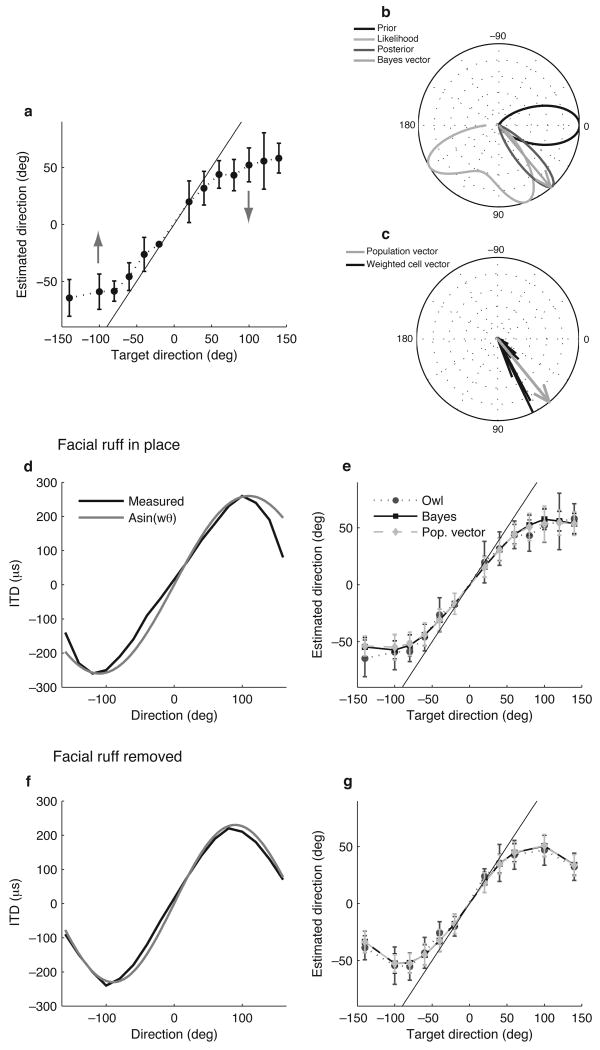
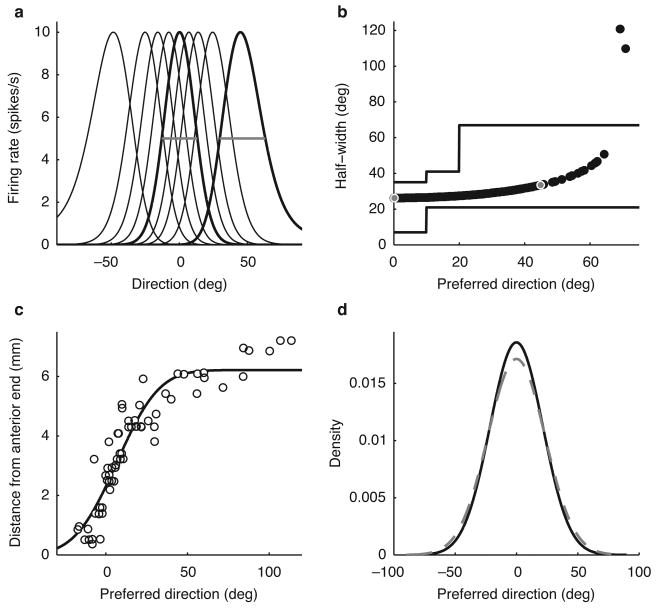
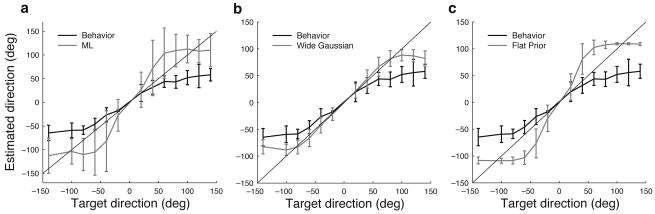
The owl captures prey using sound localization. In the classical model, the owl infers sound direction from the position of greatest activity in a brain map of auditory space. However, this model fails to describe the actual behavior. Although owls accurately localize sources near the center of gaze, they systematically underestimate peripheral source directions. We found that this behavior is predicted by statistical inference, formulated as a Bayesian model that emphasizes central directions. We propose that there is a bias in the neural coding of auditory space, which, at the expense of inducing errors in the periphery, achieves high behavioral accuracy at the ethologically relevant range. We found that the owl's map of auditory space decoded by a population vector is consistent with the behavioral model. Thus, a probabilistic model describes both how the map of auditory space supports behavior and why this representation is optimal.
猫头鹰利用声音定位来捕获猎物。在经典模型中,猫头鹰通过大脑中听觉空间图谱的最大活动位置来推断声音的方向。然而,这个模型无法描述实际的行为。尽管猫头鹰能够准确地定位注视中心附近的声源,但它们会系统地低估外围声源的方向。我们发现,这种行为可以通过统计推断来预测,其形式为一个强调中心方向的贝叶斯模型。我们提出,听觉空间的神经编码存在一种偏差,这种偏差以在外围产生误差为代价,在生态相关的范围内实现了高行为准确性。我们发现,通过群体矢量解码的猫头鹰听觉空间图谱与行为模型一致。因此,一个概率模型既描述了听觉空间图谱如何支持行为,也解释了为什么这种表示是最优的。