Department of Parasitology, Faculty of Medicine, University of Kelaniya, Ragama, Sri Lanka.
Department of Zoology and Environment Management, Faculty of Science, University of Kelaniya, Dalugama, Sri Lanka.
Biomed Res Int. 2018 Oct 9;2018:3048373. doi: 10.1155/2018/3048373. eCollection 2018.
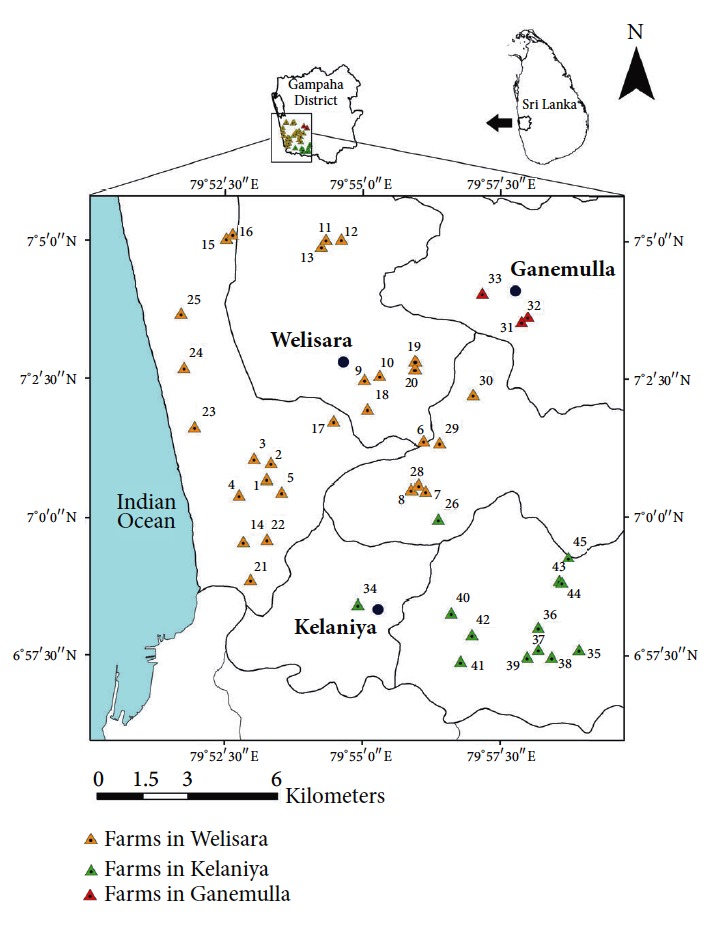
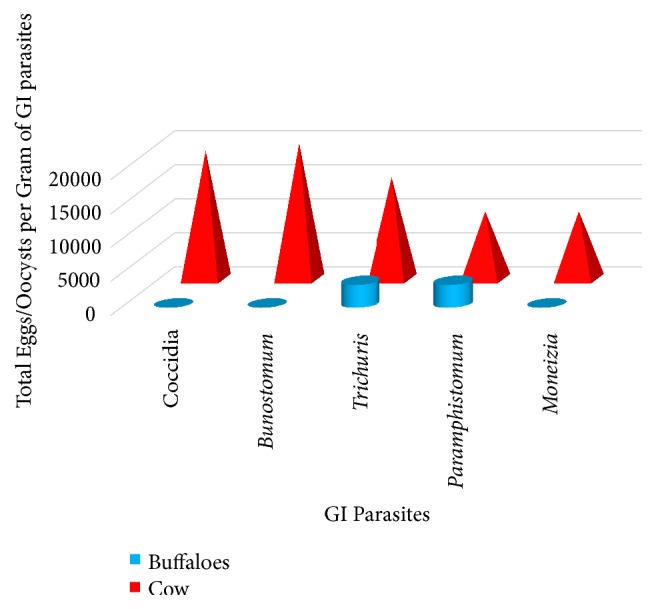
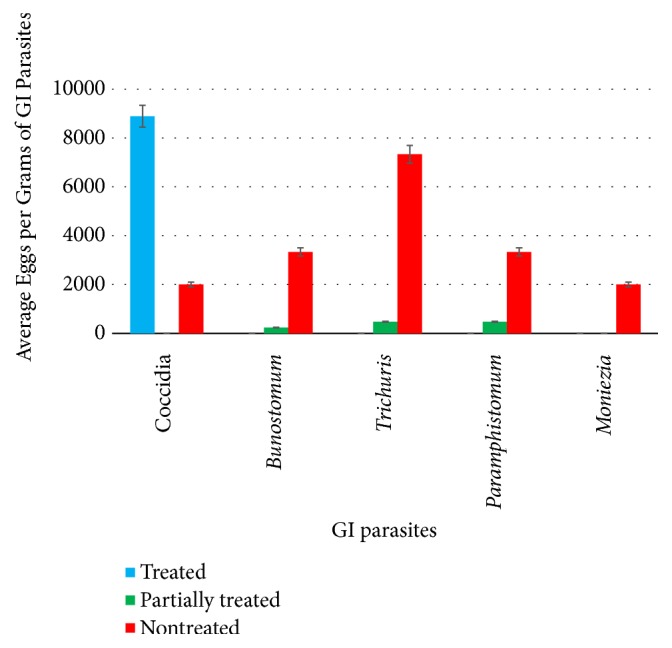
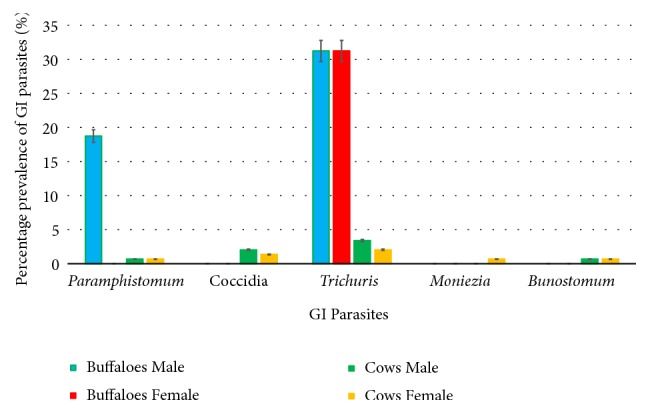
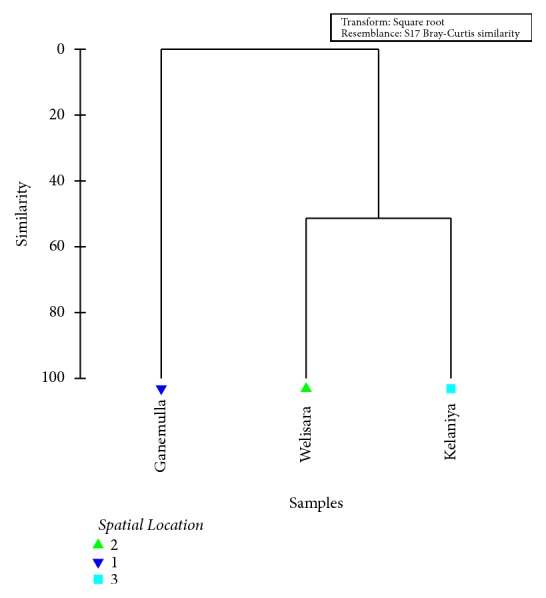
Gastrointestinal (GI) parasitic infection is a serious issue in cattle management. The effects of GI parasites may vary with age, sex of cattle, nutritional condition, and severity of infection. Prevalence of GI parasites among cattle population in Gampaha District has not been studied and there is no published study available. A total of 45 farms rearing cattle were selected randomly in three areas, namely, Kelaniya, Ganemulla, and Welisara, under three Veterinary Surgeon Divisions (VSD) in Gampaha District (Mahara, Gampaha, and Welisara). Freshly voided cattle fecal samples were collected randomly from the selected farms during March 2017-December 2017. Out of 163 cattle and buffaloes examined, 13.39% (n=22) were positive for eggs of one or more species of GI parasites. The prevalence of parasitic infection was higher in buffaloes (31.25%, 5/16) as compared to that of cows (11.56%, 21/147), but the difference was not significant ( >0.05). Hookworms ( spp.), whipworms ( spp.), digenetic trematodes ( spp.), cestodes ( spp.), and oocysts of protozoans (coccidians) were found during the study. The nontreated animals indicated the highest percentage of parasitic infections accounting for 46.67% (n= 14), followed by partially treated individuals (15.15%, n= 5). GI parasite prevalence in males was higher when compared to that of females, but the difference was nonsignificant ( >0.05). General Linear Modelling (GLM) revealed that the effect of treatment status was significantly associated with the prevalence of GI parasites. The calves and yearlings had the highest rate of GI parasitic infections. The highest infection rate was observed at Kelaniya, followed by Welisara. Future investigations are necessary to evaluate the economic impact of GI parasites in the study areas.
胃肠道寄生虫感染是牛管理中的一个严重问题。胃肠道寄生虫的影响可能因牛的年龄、性别、营养状况和感染严重程度而有所不同。在甘帕哈地区,尚未对牛群中的胃肠道寄生虫流行情况进行研究,也没有发表相关研究。在甘帕哈区的三个兽医分区(Mahara、Gampaha 和 Welisara)下,共从三个地区(Kelaniya、Ganemulla 和 Welisara)中随机选择了 45 个饲养牛的农场。在 2017 年 3 月至 2017 年 12 月期间,从选定的农场中随机采集新鲜排出的牛粪便样本。在检查的 163 头牛和水牛中,有 13.39%(n=22)的粪便样本中检测到一种或多种胃肠道寄生虫的卵。与奶牛(11.56%,21/147)相比,水牛的寄生虫感染率更高(31.25%,5/16),但差异无统计学意义(>0.05)。在研究期间发现了钩虫( spp.)、鞭虫( spp.)、复殖吸虫( spp.)、绦虫( spp.)和原生动物(球虫)的卵囊。未治疗的动物显示出最高的寄生虫感染率,占 46.67%(n=14),其次是部分治疗的个体(15.15%,n=5)。与雌性相比,雄性的胃肠道寄生虫感染率更高,但差异无统计学意义(>0.05)。一般线性模型(GLM)显示,治疗状况的影响与胃肠道寄生虫的流行情况显著相关。小牛和一岁牛的胃肠道寄生虫感染率最高。在 Kelaniya 观察到的感染率最高,其次是 Welisara。需要进一步的调查来评估胃肠道寄生虫在研究地区的经济影响。