Morrison Nick, Kolluri Raghu, Vasquez Michael, Madsen Monte, Jones Andrew, Gibson Kathleen
1 Center for Vein Restoration, Morrison Vein Institute, Scottsdale, AZ, USA.
2 OhioHealth, Riverside Methodist Hospital, Columbus, USA.
Phlebology. 2019 Jul;34(6):380-390. doi: 10.1177/0268355518810259. Epub 2018 Nov 7.
To evaluate the 36-month efficacy and safety of cyanoacrylate closure for the treatment of incompetent great saphenous veins in comparison with radiofrequency ablation.
In this multicenter, prospective, randomized controlled trial, 222 symptomatic subjects with incompetent great saphenous veins were assigned to either cyanoacrylate closure or radiofrequency ablation. The primary endpoint, complete closure of the target great saphenous vein, was determined using duplex ultrasound examination starting from three-month visit.
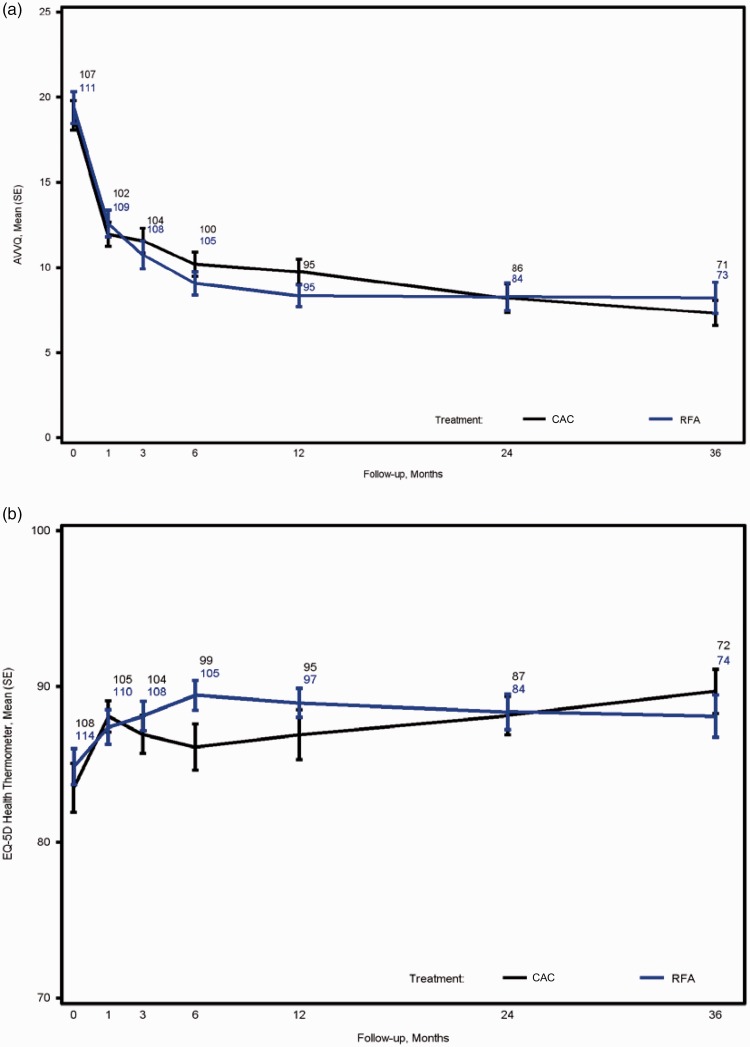
At month 36, the great saphenous vein closure rates were 94.4% for the cyanoacrylate closure group and 91.9% for the radiofrequency ablation group. Stable improvement in symptoms and quality of life was observed in both groups. Adverse event rates between the 24- and 36-month visits were similar between the groups as were serious adverse events which were infrequent and judged unrelated to either the device or the procedure in both groups.
This trial continues to demonstrate the safety and efficacy of cyanoacrylate closure for the treatment of great saphenous vein incompetence with great saphenous vein closure rate at 36 months similar to that of radiofrequency ablation, indicating non-inferiority of cyanoacrylate closure to radiofrequency ablation. The improvement in quality of life outcomes were also sustained and similar between the two treatment groups.
评估与射频消融术相比,氰基丙烯酸酯闭合术治疗大隐静脉功能不全的36个月疗效和安全性。
在这项多中心、前瞻性、随机对照试验中,222名有症状的大隐静脉功能不全受试者被分配接受氰基丙烯酸酯闭合术或射频消融术。从三个月随访开始,使用双功超声检查确定主要终点,即目标大隐静脉完全闭合。
在第36个月时,氰基丙烯酸酯闭合术组的大隐静脉闭合率为94.4%,射频消融术组为91.9%。两组均观察到症状和生活质量的持续改善。两组在24个月和36个月随访之间的不良事件发生率相似,严重不良事件也相似,且两组的严重不良事件均很少见,且判断与器械或手术无关。
本试验继续证明氰基丙烯酸酯闭合术治疗大隐静脉功能不全的安全性和有效性,36个月时大隐静脉闭合率与射频消融术相似,表明氰基丙烯酸酯闭合术不劣于射频消融术。两个治疗组的生活质量改善也持续且相似。