Department of Molecular Genetics and Infection Biology, Center for Functional Genomics of Microbes, Interfaculty Institute of Genetics and Functional Genomics, University of Greifswald, Greifswald, Germany.
Department of Functional Genomics, Center for Functional Genomics of Microbes, Interfaculty Institute of Genetics and Functional Genomics, University Medicine Greifswald, Greifswald, Germany.
Front Immunol. 2018 Oct 18;9:2405. doi: 10.3389/fimmu.2018.02405. eCollection 2018.
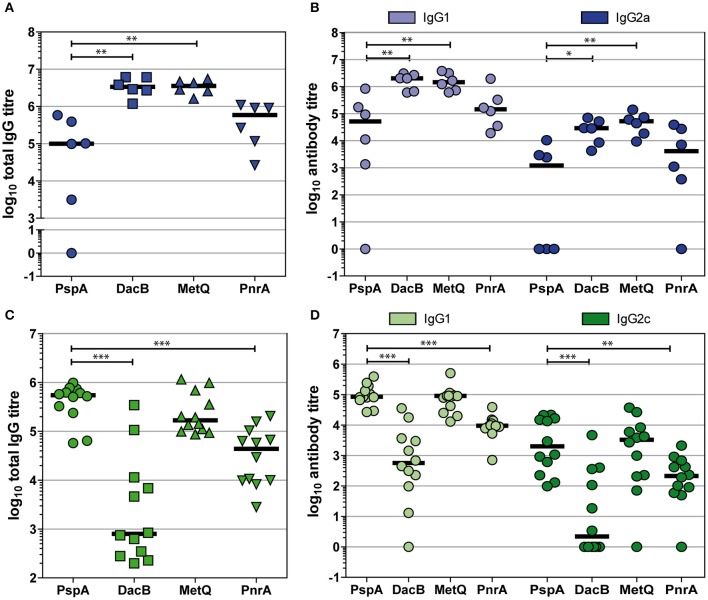
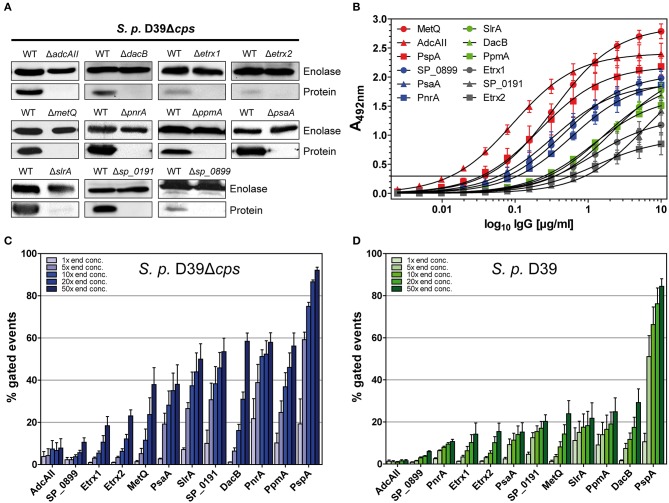
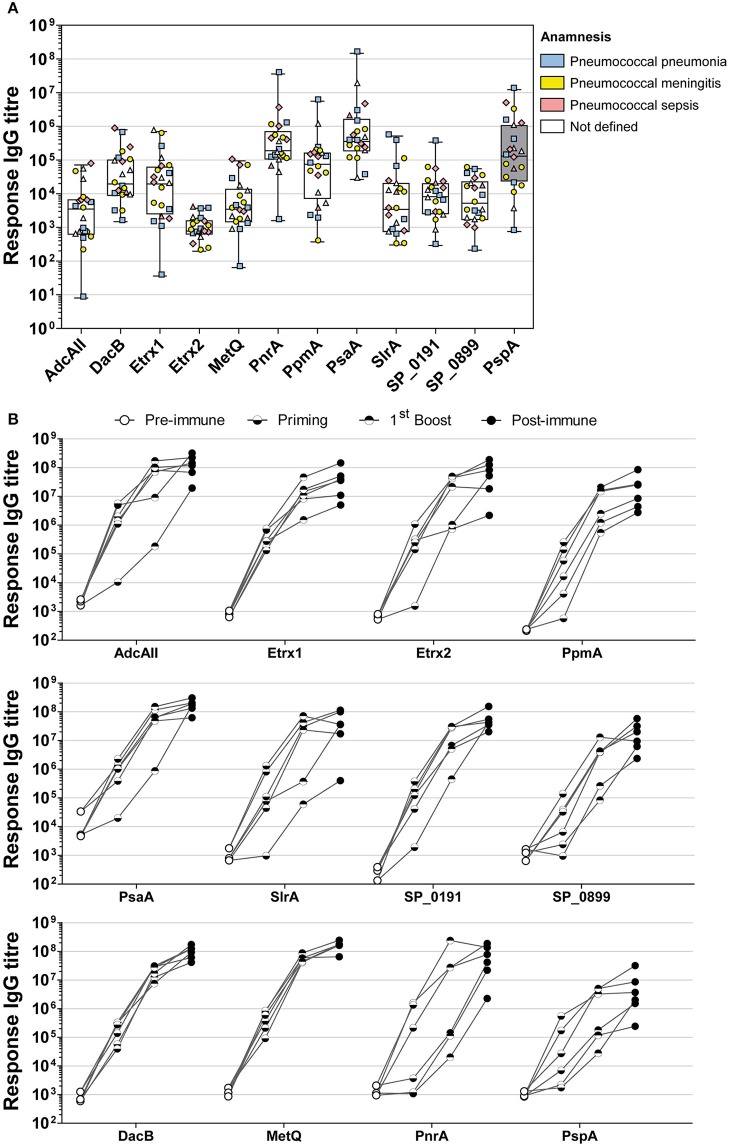
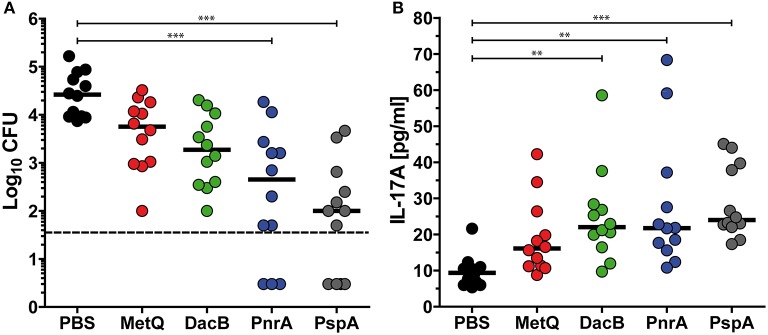
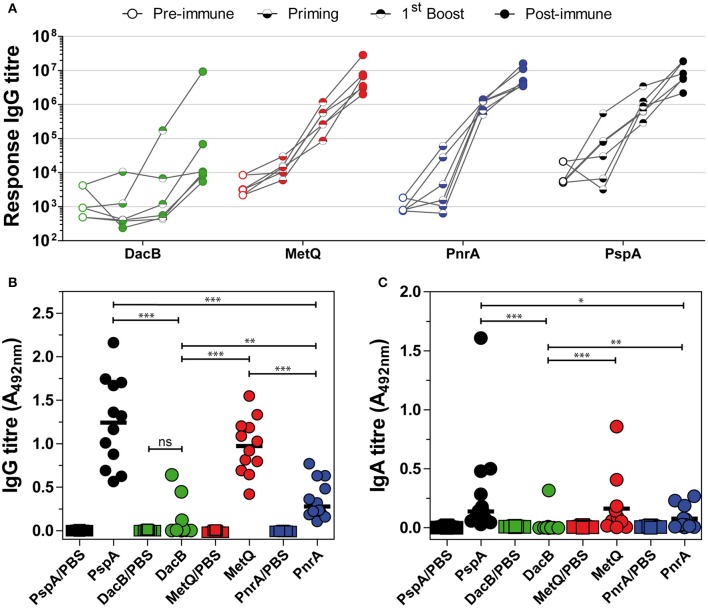
is endowed with a variety of surface-exposed proteins representing putative vaccine candidates. Lipoproteins are covalently anchored to the cell membrane and highly conserved among pneumococcal serotypes. Here, we evaluated these lipoproteins for their immunogenicity and protective potential against pneumococcal colonisation. A multiplex-based immunoproteomics approach revealed the immunogenicity of selected lipoproteins. High antibody titres were measured in sera from mice immunised with the lipoproteins MetQ, PnrA, PsaA, and DacB. An analysis of convalescent patient sera confirmed the immunogenicity of these lipoproteins. Examining the surface localisation and accessibility of the lipoproteins using flow cytometry indicated that PnrA and DacB were highly abundant on the surface of the bacteria. Mice were immunised intranasally with PnrA, DacB, and MetQ using cholera toxin subunit B (CTB) as an adjuvant, followed by an intranasal challenge with D39. PnrA protected the mice from pneumococcal colonisation. For the immunisation with DacB and MetQ, a trend in reducing the bacterial load could be observed, although this effect was not statistically significant. The reduction in bacterial colonisation was correlated with the increased production of antigen-specific IL-17A in the nasal cavity. Immunisation induced high systemic IgG levels with a predominance for the IgG1 isotype, except for DacB, where IgG levels were substantially lower compared to MetQ and PnrA. Our results indicate that lipoproteins are interesting targets for future vaccine strategies as they are highly conserved, abundant, and immunogenic.
该菌具有多种表面暴露蛋白,这些蛋白代表潜在的疫苗候选物。脂蛋白通过共价键锚定在细胞膜上,并且在不同肺炎球菌血清型之间高度保守。在这里,我们评估了这些脂蛋白的免疫原性及其对肺炎球菌定植的保护潜力。基于多重的免疫蛋白质组学方法揭示了选定脂蛋白的免疫原性。用脂蛋白 MetQ、PnrA、PsaA 和 DacB 免疫的小鼠血清中测量到高抗体滴度。对恢复期患者血清的分析证实了这些脂蛋白的免疫原性。使用流式细胞术分析脂蛋白的表面定位和可及性表明,PnrA 和 DacB 在细菌表面高度丰富。使用霍乱毒素亚单位 B (CTB) 作为佐剂,通过鼻腔内免疫 PnrA、DacB 和 MetQ,然后用 D39 进行鼻腔内攻击,对小鼠进行免疫。PnrA 可保护小鼠免受肺炎球菌定植。对于 DacB 和 MetQ 的免疫接种,观察到细菌负荷减少的趋势,尽管这种效果没有统计学意义。细菌定植的减少与鼻腔中抗原特异性 IL-17A 的增加有关。免疫接种诱导了高系统 IgG 水平,主要是 IgG1 同种型,除了 DacB,与 MetQ 和 PnrA 相比,DacB 的 IgG 水平要低得多。我们的结果表明,脂蛋白是未来疫苗策略的有前途的靶标,因为它们高度保守、丰富且具有免疫原性。