Scavone Giovanni, Caltabiano Daniele Carmelo, Raciti Maria Vittoria, Calcagno Maria Carla, Pennisi Monica, Musumeci Andrea Giovanni, Ettorre Giovanni Carlo
Department of diagnostic Radiology, Neuroradiology and interventional radiology, Hospital "Garibaldi", Piazza Santa Maria di Gesù, 5, Catania, CT 95124, Italy.
Radiodiagnostic and Radiotherapy Unit, University Hospital "Policlinico Vittorio-Emanuele", Via Santa Sofia, 78, Catania CT 95124, Italy.
Radiol Case Rep. 2018 Oct 30;14(2):141-145. doi: 10.1016/j.radcr.2018.10.008. eCollection 2019 Feb.
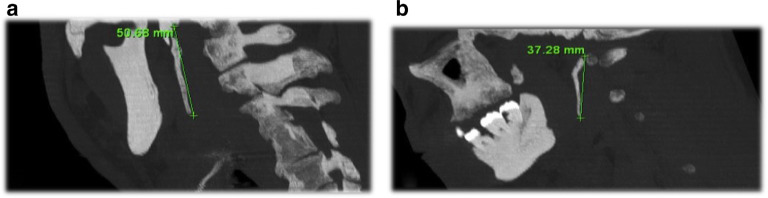
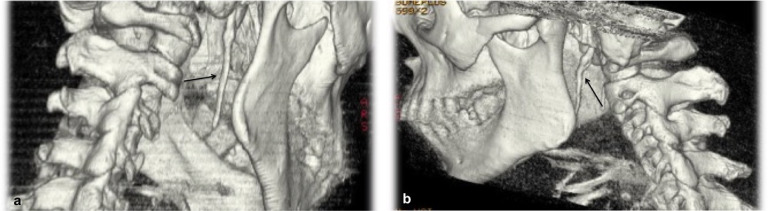
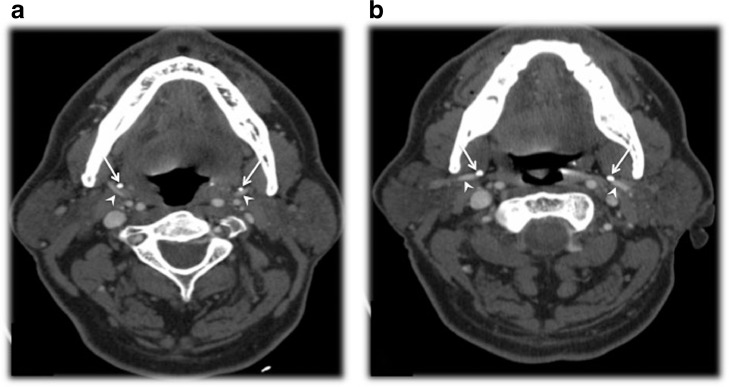
Eagle's syndrome (ES) refers to symptomatic elongation of the ossified styloid process. A styloid process greater than 2.5 cm in length should be considered abnormal; however, an elongated styloid process is not sufficient for a diagnosis of ES; only an abnormal styloid process in association with symptoms can confirm the syndrome. In this case report, we discuss a 54-year-old man who has come to our attention with various symptoms: dysphagia to both solids and liquids, difficulty swallowing, neck pain, and a foreign body sensation during bilateral neck rotation and mouth opening. The diagnosis is performed radiologically because conventional radiographs have many potential disadvantages, whereas, computed tomography (CT) scans and reconstructions allow the length and angulation of the styloid process to be measured and the relationship between the elongated styloid processes and adjacent anatomical structures to be evaluated. Moreover, CT allows for differential diagnosis and provides detailed information needed for surgical planning.
鹰综合征(ES)是指骨化的茎突出现症状性延长。茎突长度大于2.5厘米应被视为异常;然而,茎突延长并不足以诊断为鹰综合征;只有异常的茎突伴有症状才能确诊该综合征。在本病例报告中,我们讨论了一名54岁男性,他因多种症状引起我们的关注:固体和液体吞咽困难、吞咽困难、颈部疼痛以及双侧颈部旋转和张口时的异物感。诊断通过影像学检查进行,因为传统X线片有许多潜在缺点,而计算机断层扫描(CT)扫描及重建可以测量茎突的长度和角度,并评估延长的茎突与相邻解剖结构之间的关系。此外,CT有助于鉴别诊断,并为手术规划提供所需的详细信息。