Department of Global Public Health and Primary Care, Faculty of Medicine, University of Bergen, Bergen, Norway.
Department of Clinical Epidemiology, Aarhus University Hospital, Aarhus, Denmark.
Am J Epidemiol. 2019 Feb 1;188(2):398-407. doi: 10.1093/aje/kwy251.
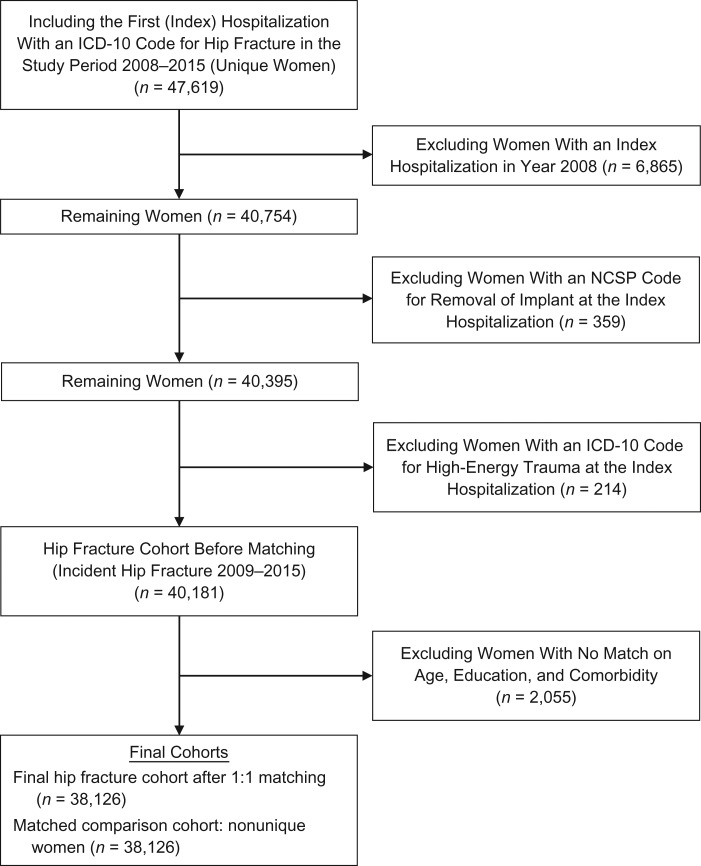
Hip fracture patients often have comorbid conditions. We investigated whether the combination of comorbidity and hip fracture could explain the previously observed excess mortality among hip fracture patients as compared with the general population. Using a population-based matched study design with 38,126 Norwegian women who suffered a hip fracture during the period 2009-2015 and the same number of women in a matched comparison cohort, we matched participants on prefracture comorbidity, age, and education. We estimated relative survival and additive and multiplicative comorbidity-hip fracture interactions. An additive comorbidity-hip fracture interaction of 4 or 9 additional deaths per 100 patients, depending on Charlson Comorbidity Index (CCI) score, was observed 1 year after hip fracture. Among women with a CCI score of ≥3, 15 additional deaths per 100 patients were observed; of these, 9 deaths could be attributed to the interaction and 6 to the hip fracture per se. On the relative scale, we observed increasing heterogeneity in survival by comorbidity over time; survival was reduced by 39% after 6 years among patients with a CCI score of ≥3, while among women with no comorbidity, survival was reduced by 17% (hip fracture vs. no hip fracture). In summary, prefracture comorbidity was associated with short-term absolute excess mortality and long-term relative excess mortality.
髋部骨折患者常伴有合并症。我们研究了合并症和髋部骨折的组合是否可以解释先前观察到的髋部骨折患者与普通人群相比死亡率过高的现象。我们采用基于人群的匹配研究设计,纳入了 2009 年至 2015 年期间挪威 38126 名髋部骨折女性患者和相同数量的匹配对照组女性,在骨折前合并症、年龄和教育程度方面对参与者进行匹配。我们估计了相对生存率以及合并症-髋部骨折的附加和乘法交互作用。髋部骨折后 1 年观察到,合并症-髋部骨折交互作用每 100 例患者增加 4 或 9 例额外死亡,具体取决于 Charlson 合并症指数(CCI)评分。CCI 评分≥3 的女性患者观察到每 100 例患者增加 15 例额外死亡;其中,9 例死亡可归因于交互作用,6 例归因于髋部骨折本身。在相对尺度上,我们观察到随着时间的推移,合并症对生存率的异质性逐渐增加;CCI 评分≥3 的患者在 6 年后生存率降低了 39%,而无合并症的女性患者生存率降低了 17%(髋部骨折与无髋部骨折)。总之,骨折前合并症与短期绝对超额死亡率和长期相对超额死亡率相关。