State Key Laboratory of Microbial Metabolism, Joint International Laboratory on Metabolic & Developmental Sciences, School of Life Sciences & Biotechnology, Shanghai Jiao Tong University, Shanghai 200030, China.
Shanghai Key Laboratory of Veterinary Biotechnology, Shanghai Jiao Tong University, Shanghai 200240, China.
Nucleic Acids Res. 2019 Jan 8;47(D1):D660-D665. doi: 10.1093/nar/gky1123.
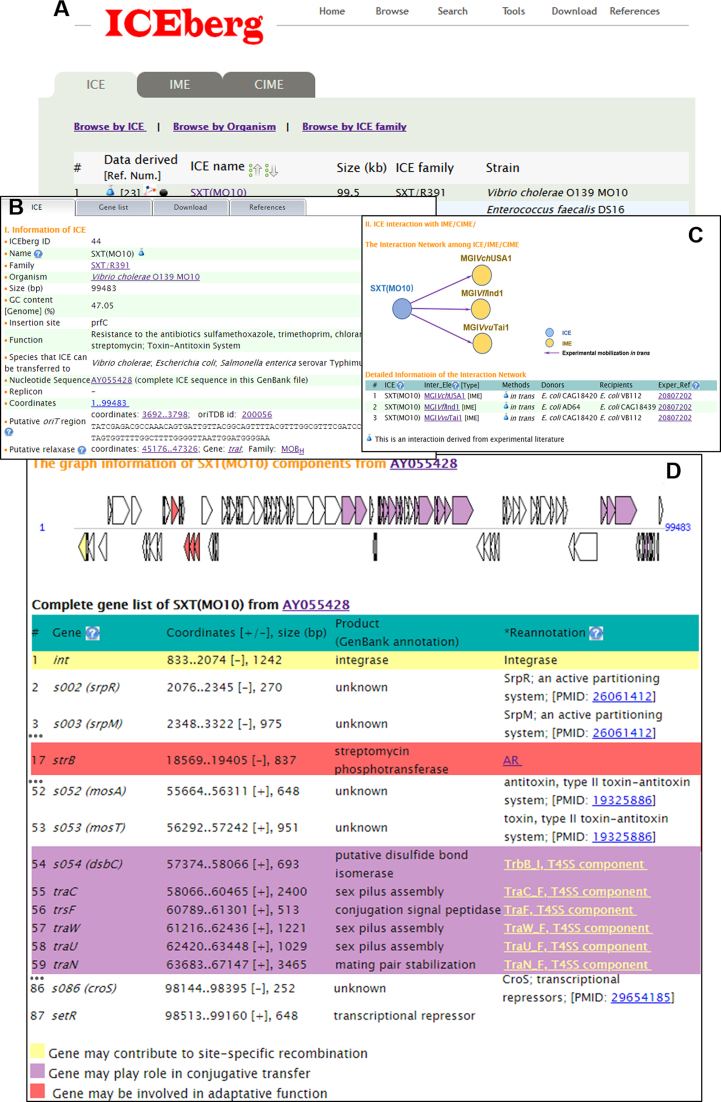
ICEberg 2.0 (http://db-mml.sjtu.edu.cn/ICEberg/) is an updated database that provides comprehensive information about bacterial integrative and conjugative elements (ICEs). Compared with the previous version, three major improvements were made. First, with the aid of text mining and manual curation, it now recorded the details of 1032 ICEs, including 270 with experimental supports and 762 from bioinformatics prediction. Second, as increasing evidence has shown that ICEs frequently mobilize the so-called 'hitchhikers', such as integrative and mobilizable elements (IMEs) and cis-mobilizable elements (CIMEs), 83 known transfer interactions between 49 IMEs and 7 CIMEs with 19 ICEs taken from the literature were included and illustrated with visually intuitive directed graphs. An expanded collection of 260 chromosome-borne IMEs and 235 CIMEs was also added. At last, ICEberg 2.0 provides an online tool ICEfinder to predict ICEs or IMEs in bacterial genome sequences. It combines a similarity search for the integrase, relaxase and/or type IV secretion system and the co-localization of these corresponding homologous genes. With the recent updates, ICEberg 2.0 might provide better support for understanding the biological traits of ICEs, especially as their interaction with cognate mobilizable elements may further promote horizontal gene flow.
ICEberg 2.0(http://db-mml.sjtu.edu.cn/ICEberg/)是一个更新的数据库,提供了关于细菌整合性和可转移性元件(ICEs)的综合信息。与前一版本相比,它有三个主要的改进。首先,借助文本挖掘和人工编辑,它现在记录了 1032 个 ICE 的详细信息,其中包括 270 个具有实验支持的 ICE 和 762 个来自生物信息学预测的 ICE。其次,越来越多的证据表明,ICE 经常会移动所谓的“搭便车者”,如整合性和可转移性元件(IMEs)和顺式可转移性元件(CIMEs),从文献中选取了 19 个 ICE,共涉及 49 个 IME 和 7 个 CIME 的 83 个已知转移相互作用,并通过直观的有向图进行了说明。还增加了一个扩展的 260 个染色体携带的 IME 和 235 个 CIME 集合。最后,ICEberg 2.0 提供了一个在线工具 ICEfinder,用于预测细菌基因组序列中的 ICE 或 IME。它结合了整合酶、松弛酶和/或 IV 型分泌系统的相似性搜索,以及这些对应同源基因的共定位。随着最近的更新,ICEberg 2.0 可能会更好地支持理解 ICE 的生物学特征,特别是因为它们与同源可转移性元件的相互作用可能会进一步促进水平基因流动。