MMWR Morb Mortal Wkly Rep. 2018 Nov 9;67(44):1225-1232. doi: 10.15585/mmwr.mm6744a2.
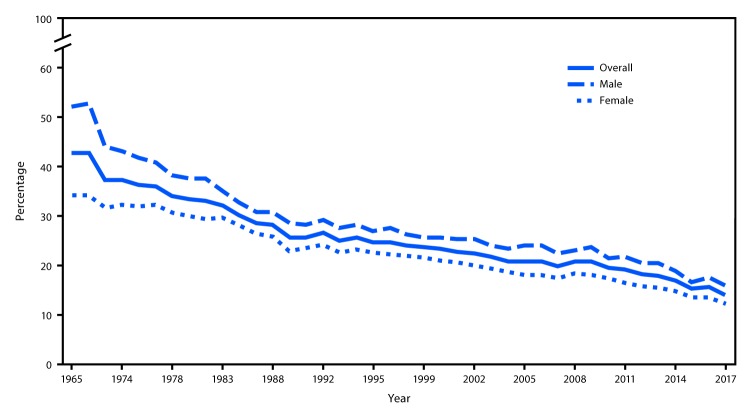
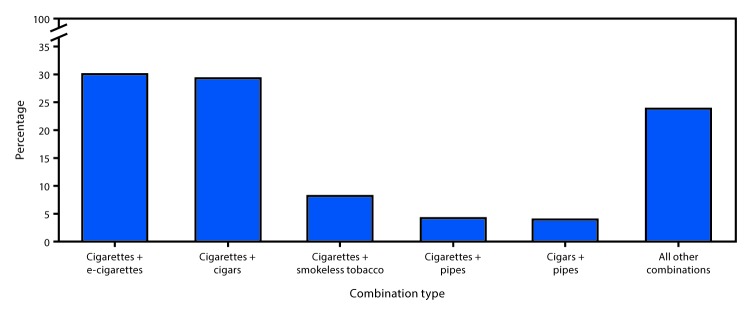
Cigarette smoking harms nearly every organ of the body and causes adverse health consequences, including heart disease, stroke, and multiple types of cancer (1). Although cigarette smoking among U.S. adults has declined considerably, tobacco products have evolved in recent years to include various combustible, noncombustible, and electronic products (1,2). To assess recent national estimates of tobacco product use among U.S. adults aged ≥18 years, CDC, the Food and Drug Administration (FDA), and the National Institutes of Health's National Cancer Institute analyzed data from the 2017 National Health Interview Survey (NHIS). In 2017, an estimated 47.4 million U.S. adults (19.3%) currently used any tobacco product, including cigarettes (14.0%; 34.3 million); cigars, cigarillos, or filtered little cigars (3.8%; 9.3 million); electronic cigarettes (e-cigarettes) (2.8%; 6.9 million); smokeless tobacco (2.1%; 5.1 million); and pipes, water pipes, or hookahs (1.0%; 2.6 million). Among current tobacco product users, 86.7% (41.1 million) smoked combustible tobacco products, and 19.0% (9.0 million) used ≥2 tobacco products. By univariate analyses, the prevalence of current use of any tobacco product was higher among males than among females; adults aged <65 years than among those aged ≥65 years; non-Hispanic American Indian/Alaska Natives, whites, blacks, or multiracial adults than among Hispanics or non-Hispanic Asians; adults who lived in the South or Midwest than among those in the West or Northeast; adults who had a general educational development certificate (GED) than among those with other levels of education; adults who earned an annual household income of <$35,000 than among those with those with higher income; lesbian, gay, or bisexual adults than among heterosexual/straight adults; and adults who were divorced/separated/widowed or single/never married/not living with a partner than among those who were married/living with a partner. Prevalence was also higher among those who were uninsured, insured by Medicaid, or had some other public insurance than among those with private insurance or Medicare only; those who had a disability/limitation than among those who did not; and those who had serious psychological distress than among those who did not. Full implementation of evidence-based tobacco control interventions that address the diversity of tobacco products used by U.S. adults, in coordination with regulation of tobacco product manufacturing, marketing, and sales, can reduce tobacco-related disease and death in the United States (1-3).
吸烟会损害身体的几乎每一个器官,并导致不良的健康后果,包括心脏病、中风和多种癌症(1)。尽管美国成年人的吸烟率大幅下降,但近年来烟草产品已经发展为包括各种可燃、不可燃和电子烟产品(1,2)。为了评估美国成年人使用烟草产品的最新国家估计,疾病预防控制中心、美国食品和药物管理局(FDA)和美国国立卫生研究院的国家癌症研究所分析了 2017 年全国健康访谈调查(NHIS)的数据。2017 年,估计有 4740 万美国成年人(19.3%)目前使用任何烟草产品,包括香烟(14.0%;3430 万人);雪茄、小雪茄或过滤小雪茄(3.8%;930 万人);电子烟(2.8%;690 万人);无烟烟草(2.1%;510 万人);以及烟斗、水烟袋或水烟管(1.0%;260 万人)。在目前使用烟草产品的人群中,86.7%(4110 万人)吸烟可燃烟草制品,19.0%(900 万人)使用≥2 种烟草制品。通过单变量分析,目前使用任何烟草制品的流行率在男性中高于女性;<65 岁的成年人高于≥65 岁的成年人;非西班牙裔美洲印第安人/阿拉斯加原住民、白种人、黑种人或多种族成年人高于西班牙裔或非西班牙裔亚洲人;生活在南部或中西部的成年人高于生活在西部或东北部的成年人;拥有普通教育发展证书(GED)的成年人高于其他教育程度的成年人;年收入<35000 美元的成年人高于收入较高的成年人;同性恋、双性恋或双性恋成年人高于异性恋/异性恋成年人;离异/分居/丧偶或单身/未婚/未与伴侣同住的成年人高于已婚/与伴侣同住的成年人。那些没有保险、由医疗补助保险覆盖或拥有其他公共保险的成年人的流行率高于那些有私人保险或仅医疗保险的成年人;那些有残疾/限制的成年人高于那些没有残疾/限制的成年人;以及那些有严重心理困扰的成年人高于那些没有严重心理困扰的成年人。全面实施针对美国成年人使用的各种烟草产品的循证烟草控制干预措施,并与烟草产品制造、营销和销售的监管相协调,可以减少美国的与烟草相关的疾病和死亡(1-3)。