Hematology and Oncology, New York University, Perlmutter Cancer Center, New York, New York, United States of America.
Center for Observational and Real-world Evidence (CORE), Merck & Co., Inc., Kenilworth, New Jersey, United States of America.
PLoS One. 2018 Nov 8;13(11):e0206370. doi: 10.1371/journal.pone.0206370. eCollection 2018.
The anti-programmed death receptor-1 (anti-PD-1) pembrolizumab is approved as first-line monotherapy for metastatic non-small cell lung cancer (mNSCLC) with PD-ligand 1 (PD-L1) tumor expression ≥50%. Most studies comparing PD-L1 results by immunohistochemistry (IHC) assay type have been conducted by prespecified and, in most cases, highly experienced, trained pathologists; however, knowledge is limited regarding the current use and concordance of PD-L1 assays in the real-world clinical setting. Our aim was to study the distribution of PD-L1 tumor expression by IHC assay type among patients with mNSCLC in US oncology practices.
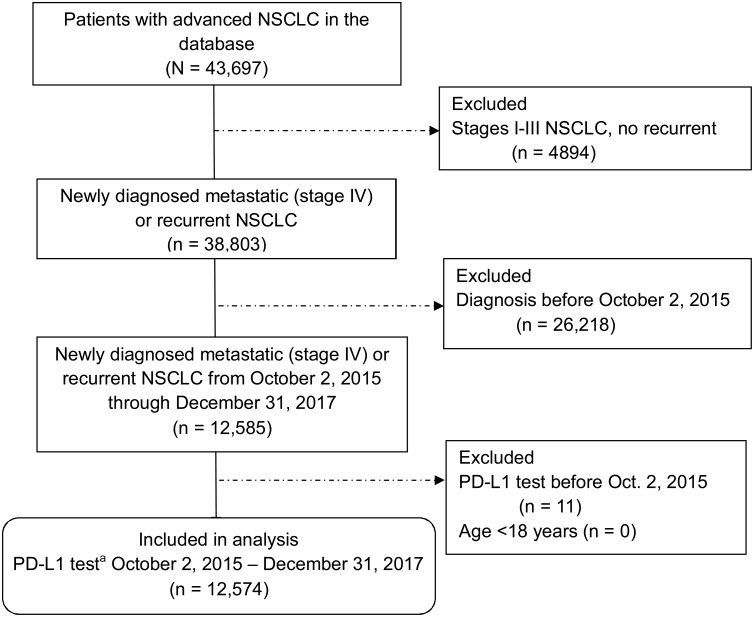
This retrospective observational study utilized de-identified, longitudinal data from a large US electronic medical record database. Eligible patients were adults (≥18 years) with histologically/cytologically confirmed initial diagnosis of metastatic or recurrent NSCLC from October 2015 through December 2017. We determined PD-L1 testing trends and distribution of PD-L1 tumor expression (percentage of tumor cells staining for PD-L1) by IHC assay type.
The 12,574 eligible patients (mean age, 69 years) included 6,620 (53%) men and 86% with positive smoking history. Of 4,868 evaluable tests, 3,799 (78%), 195 (4%), 165 (3%), and 709 (15%) used the Agilent 22C3 pharmDx, Agilent 28-8 pharmDx, Ventana PD-L1 (SP142) Assay, and laboratory-developed tests (LDTs, including SP263), respectively. The percentages of tests scoring PD-L1 tumor expression of ≥50% were 33%, 32%, 10%, and 23%, respectively. Measured PD-L1 tumor expression varied across the four assay types (χ2 p < 0.001) and across three assay types excluding SP142 (p < 0.001), with no significant difference between 22C3 and 28-8 assays (p = 0.96). The PD-L1 testing rate increased from 18% in the fourth quarter of 2015 to 71% in the fourth quarter of 2017.
In the real-world clinical setting, we observed that measured PD-L1 tumor expression is concordant using the 22C3 and 28-8 assays; however, the SP142 assay and LDTs appear discordant and could underestimate high PD-L1 positivity. Further study is needed to evaluate the association between PD-L1 tumor expression and response to therapy.
抗程序性死亡受体-1(抗 PD-1)的 pembrolizumab 被批准为 PD-配体 1(PD-L1)肿瘤表达≥50%的转移性非小细胞肺癌(mNSCLC)的一线单药治疗。大多数比较免疫组织化学(IHC)检测类型的 PD-L1 结果的研究都是由预设的、且在大多数情况下是经验丰富的、训练有素的病理学家进行的;然而,对于 PD-L1 检测在真实临床环境中的当前使用和一致性,我们的了解是有限的。我们的目的是研究在美国肿瘤学实践中 mNSCLC 患者的 PD-L1 肿瘤表达的 IHC 检测类型分布。
这项回顾性观察性研究利用了来自美国大型电子病历数据库的去识别、纵向数据。合格的患者为 2015 年 10 月至 2017 年 12 月期间经组织学/细胞学确诊为转移性或复发性非小细胞肺癌的初诊成年患者(≥18 岁)。我们确定了 PD-L1 检测趋势和 PD-L1 肿瘤表达(PD-L1 染色的肿瘤细胞百分比)的 IHC 检测类型分布。
在 12574 名合格患者(平均年龄 69 岁)中,包括 6620 名(53%)男性和 86%有阳性吸烟史。在 4868 项可评估的检测中,分别有 3799 项(78%)、195 项(4%)、165 项(3%)和 709 项(15%)使用了 Agilent 22C3 pharmDx、Agilent 28-8 pharmDx、Ventana PD-L1(SP142)检测和实验室开发的检测(LDTs,包括 SP263)。PD-L1 肿瘤表达≥50%的检测百分比分别为 33%、32%、10%和 23%。四种检测类型的 PD-L1 肿瘤表达存在差异(χ2 p < 0.001),三种不包括 SP142 的检测类型也存在差异(p < 0.001),但 22C3 和 28-8 检测类型之间无显著差异(p = 0.96)。PD-L1 检测率从 2015 年第四季度的 18%增加到 2017 年第四季度的 71%。
在真实的临床环境中,我们观察到使用 22C3 和 28-8 检测时,PD-L1 肿瘤表达的测定结果是一致的;然而,SP142 检测和 LDTs 似乎不一致,可能会低估高 PD-L1 阳性率。需要进一步研究以评估 PD-L1 肿瘤表达与治疗反应之间的关系。