Schraag Stefan, Pradelli Lorenzo, Alsaleh Abdul Jabbar Omar, Bellone Marco, Ghetti Gianni, Chung Tje Lin, Westphal Martin, Rehberg Sebastian
Department of Perioperative Medicine, Golden Jubilee National Hospital, Clydebank, G81 4DY, Scotland, UK.
AdRes-Health Economics and Outcome Research, Torino, Italy.
BMC Anesthesiol. 2018 Nov 8;18(1):162. doi: 10.1186/s12871-018-0632-3.
It is unclear if anaesthesia maintenance with propofol is advantageous or beneficial over inhalational agents. This study is intended to compare the effects of propofol vs. inhalational agents in maintaining general anaesthesia on patient-relevant outcomes and patient satisfaction.
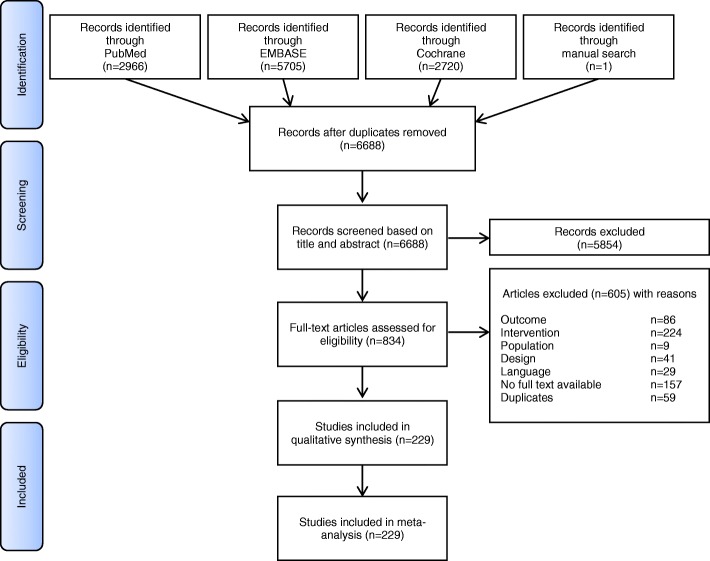
Studies were identified by electronic database searches in PubMed™, EMBASE™ and the Cochrane™ library between 01/01/1985 and 01/08/2016. Randomized controlled trials (RCTs) of peer-reviewed journals were studied. Of 6688 studies identified, 229 RCTs were included with a total of 20,991 patients. Quality control, assessment of risk of bias, meta-bias, meta-regression and certainty in evidence were performed according to Cochrane. Common estimates were derived from fixed or random-effects models depending on the presence of heterogeneity. Post-operative nausea and vomiting (PONV) was the primary outcome. Post-operative pain, emergence agitation, time to recovery, hospital length of stay, post-anaesthetic shivering and haemodynamic instability were considered key secondary outcomes.
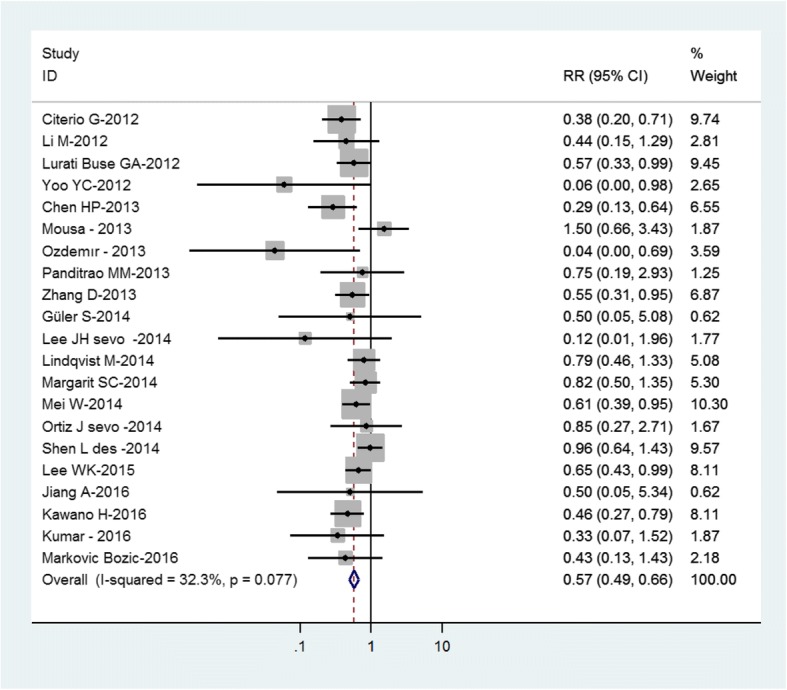
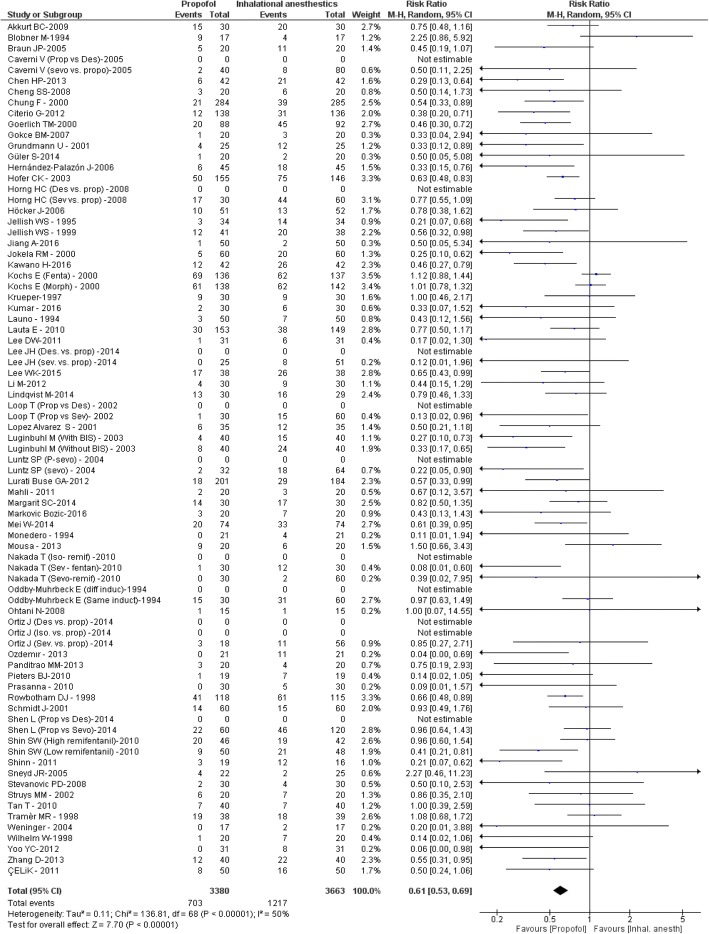
The risk for PONV was lower with propofol than with inhalational agents (relative risk (RR) 0.61 [0.53, 0.69], p < 0.00001). Additionally, pain score after extubation and time in the post-operative anaesthesia care unit (PACU) were reduced with propofol (mean difference (MD) - 0.51 [- 0.81, - 0.20], p = 0.001; MD - 2.91 min [- 5.47, - 0.35], p = 0.03). In turn, time to respiratory recovery and tracheal extubation were longer with propofol than with inhalational agents (MD 0.82 min [0.20, 1.45], p = 0.01; MD 0.70 min [0.03, 1.38], p = 0.04, respectively). Notably, patient satisfaction, as reported by the number of satisfied patients and scores, was higher with propofol (RR 1.06 [1.01, 1.10], p = 0.02; MD 0.13 [0.00, 0.26], p = 0.05). Secondary analyses supported the primary results.
Based on the present meta-analysis there are several advantages of anaesthesia maintenance with propofol over inhalational agents. While these benefits result in an increased patient satisfaction, the clinical and economic relevance of these findings still need to be addressed in adequately powered prospective clinical trials.
目前尚不清楚丙泊酚维持麻醉是否优于吸入性麻醉剂。本研究旨在比较丙泊酚与吸入性麻醉剂在维持全身麻醉时对患者相关结局和患者满意度的影响。
通过在PubMed™、EMBASE™和Cochrane™图书馆中进行电子数据库检索,确定1985年1月1日至2016年8月1日期间的研究。对同行评审期刊的随机对照试验(RCT)进行研究。在检索到的6688项研究中,纳入了229项RCT,共20991例患者。根据Cochrane方法进行质量控制、偏倚风险评估、元偏倚、元回归和证据确定性分析。根据异质性情况,采用固定效应模型或随机效应模型得出常见估计值。术后恶心呕吐(PONV)是主要结局。术后疼痛、苏醒期躁动、恢复时间、住院时间、麻醉后寒战和血流动力学不稳定被视为关键次要结局。
丙泊酚组PONV风险低于吸入性麻醉剂组(相对风险(RR)0.61 [0.53, 0.69],p < 0.00001)。此外,丙泊酚组拔管后疼痛评分及在术后麻醉恢复室(PACU)的停留时间降低(平均差(MD)-0.51 [-0.81, -0.20],p = 0.001;MD -2.91分钟 [-5.47, -0.35],p = 0.03)。反过来,丙泊酚组呼吸恢复和气管拔管时间比吸入性麻醉剂组长(MD 0.82分钟 [0.20, 1.45],p = 0.01;MD 0.70分钟 [0.03, 1.38],p = 0.04)。值得注意的是,从满意患者数量和评分来看,丙泊酚组患者满意度更高(RR 1.06 [1.01, 1.10],p = 0.02;MD 0.13 [0.00, 0.26],p = 0.05)。次要分析支持主要结果。
基于目前的荟萃分析,丙泊酚维持麻醉比吸入性麻醉剂有几个优势。虽然这些益处提高了患者满意度,但这些发现的临床和经济相关性仍需在有足够样本量的前瞻性临床试验中加以探讨。