Wake Forest Institute for Regenerative Medicine, Wake Forest School of Medicine, Winston-Salem, NC, USA.
State Key Laboratory of Ophthalmology, Zhongshan Ophthalmic Center, Sun Yat-Sen University, Guangzhou, China.
Stem Cell Res Ther. 2018 Nov 8;9(1):304. doi: 10.1186/s13287-018-1035-6.
Autologous urothelial cells are often obtained via bladder biopsy to generate the bio-engineered urethra or bladder, while urine-derived stem cells (USC) can be obtained by a non-invasive approach. The objective of this study is to develop an optimal strategy for urothelium with permeability barrier properties using human USC which could be used for tissue repair in the urinary tract system.
USC were harvested from six healthy adult individuals. To optimize urothelial differentiation, five different differentiation methods were studied. The induced cells were assessed for gene and protein expression markers of urothelial cells via RT-PCR, Western blotting, and immunofluorescent staining. Barrier function and ultrastructure of the tight junction were assessed with permeability assays and transmission electron microscopy (TEM). Induced cells were both cultured on trans-well membranes and small intestinal submucosa, then investigated under histology analysis.
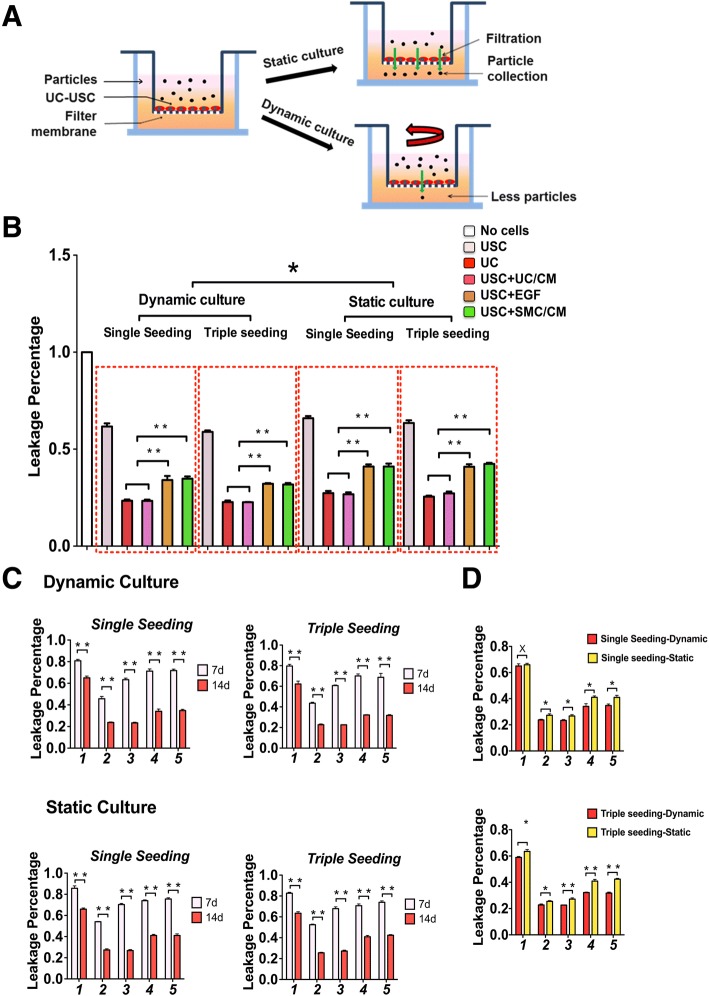
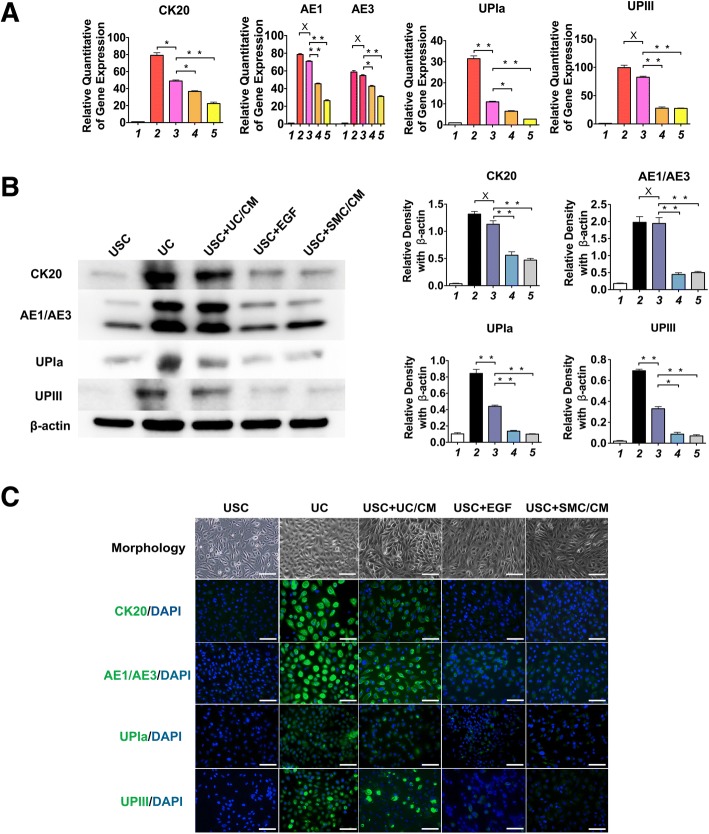
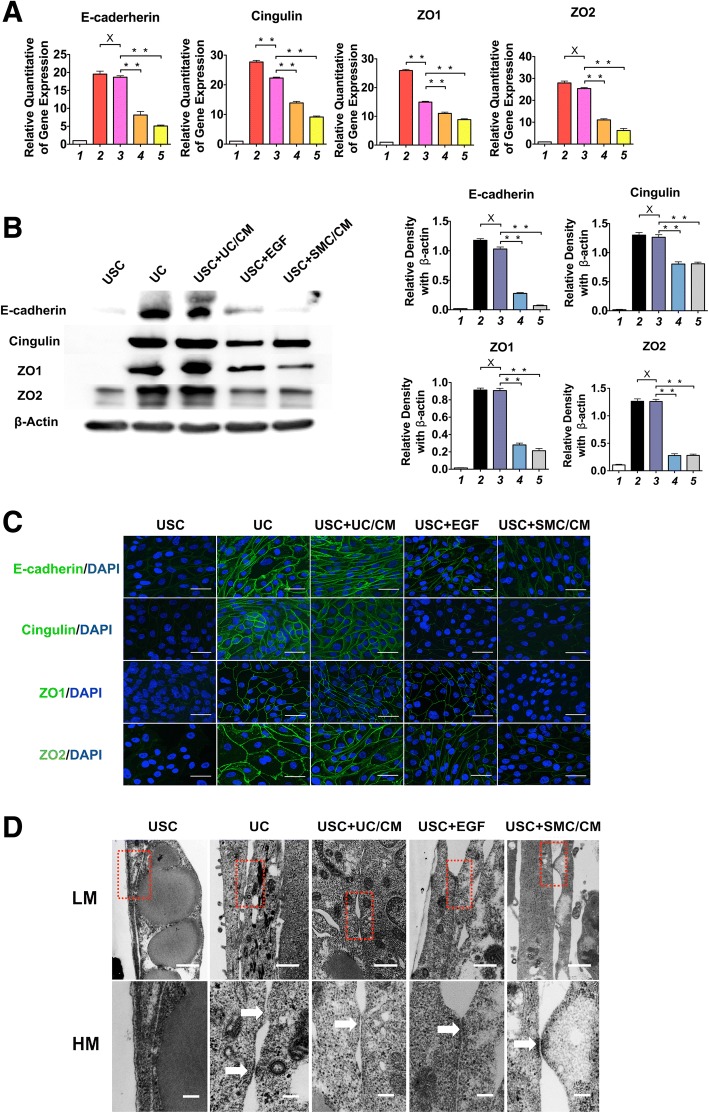
Differentiated USC expressed significantly higher levels of urothelial-specific transcripts and proteins (Uroplakin III and Ia), epithelial cell markers (CK20 and AE1/AE3), and tight junction markers (ZO-1, ZO-2, E-cadherin, and Cingulin) in a time-dependent manner, compared to non-induced USC. In vitro assays using fluorescent dye demonstrated a significant reduction in permeability of differentiated USC. In addition, transmission electron microscopy confirmed appropriate ultrastructure of urothelium differentiated from USC, including tight junction formation between neighboring cells, which was similar to positive controls. Furthermore, multilayered urothelial tissues formed 2 weeks after USC were differentiated on intestine submucosal matrix.
The present study illustrates an optimal strategy for the generation of differentiated urothelium from stem cells isolated from the urine. The induced urothelium is phenotypically and functionally like native urothelium and has proposed uses in in vivo urological tissue repair or in vitro urethra or bladder modeling.
自体尿路上皮细胞通常通过膀胱活检获得,以生成生物工程尿道或膀胱,而尿液来源的干细胞(USC)可以通过非侵入性方法获得。本研究的目的是开发一种使用人 USC 获得具有渗透屏障特性的尿路上皮的最佳策略,该策略可用于泌尿系统的组织修复。
从六名健康成年个体中采集 USC。为了优化尿路上皮分化,研究了五种不同的分化方法。通过 RT-PCR、Western blot 和免疫荧光染色评估诱导细胞的尿路上皮细胞基因和蛋白表达标志物。通过渗透测定法和透射电子显微镜(TEM)评估紧密连接的屏障功能和超微结构。将诱导细胞分别培养在 Transwell 膜和小肠黏膜下层上,然后在组织学分析下进行研究。
与未诱导的 USC 相比,分化的 USC 表达明显更高水平的尿路上皮特异性转录本和蛋白质(Uroplakin III 和 Ia)、上皮细胞标志物(CK20 和 AE1/AE3)和紧密连接标志物(ZO-1、ZO-2、E-cadherin 和 Cingulin),呈时间依赖性。体外荧光染料测定表明,分化的 USC 的渗透能力显著降低。此外,透射电子显微镜证实了从 USC 分化而来的尿路上皮具有适当的超微结构,包括相邻细胞之间紧密连接的形成,与阳性对照相似。此外,在 USC 分化在肠黏膜下层基质上 2 周后,形成了多层尿路上皮组织。
本研究说明了一种从尿液中分离的干细胞生成分化尿路上皮的最佳策略。诱导的尿路上皮在表型和功能上与天然尿路上皮相似,并已被提议用于体内泌尿科组织修复或体外尿道或膀胱建模。