Centre for Genomic and Experimental Medicine, Institute of Genetics and Molecular Medicine, University of Edinburgh, Edinburgh, EH4 2XU, UK.
Centre for Cognitive Ageing and Cognitive Epidemiology, University of Edinburgh, Edinburgh, EH8 9JZ, UK.
Clin Epigenetics. 2018 Nov 8;10(1):140. doi: 10.1186/s13148-018-0572-2.
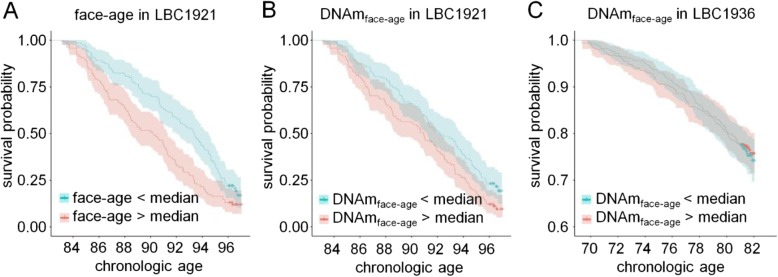
Evaluation of biological age, as opposed to chronological age, is of high relevance for interventions to increase healthy ageing. Highly reproducible age-associated DNA methylation (DNAm) changes can be integrated into algorithms for epigenetic age predictions. These predictors have mostly been trained to correlate with chronological age, but they are also indicative for biological ageing. For example, accelerated epigenetic age of blood is associated with higher risk of all-cause mortality in later life. The perceived age of facial images (face-age) is also associated with all-cause mortality and other ageing-associated traits. In this study, we therefore tested the hypothesis that an epigenetic predictor for biological age might be trained on face-age as a surrogate for biological age rather than on chronological age. Our data demonstrate that facial ageing does not correlate with either the epigenetic clock or blood-based DNAm measures.
评估生物年龄(相对于实际年龄)对于增加健康老龄化的干预措施具有重要意义。高度可重复的与年龄相关的 DNA 甲基化(DNAm)变化可以整合到表观遗传年龄预测算法中。这些预测因子主要是为了与实际年龄相关联而进行训练,但它们也可以反映生物年龄。例如,血液中加速的表观遗传年龄与晚年全因死亡率的风险增加有关。面部图像的感知年龄(face-age)也与全因死亡率和其他与衰老相关的特征有关。因此,在这项研究中,我们测试了这样一个假设,即生物年龄的表观遗传预测因子可以基于 face-age 进行训练,而不是基于实际年龄,作为生物年龄的替代指标。我们的数据表明,面部衰老与表观遗传时钟或基于血液的 DNAm 测量均无相关性。