Kuroda Makoto, Sekizuka Tsuyoshi, Matsui Hidehito, Suzuki Katsunori, Seki Hiroyuki, Saito Mitsumasa, Hanaki Hideaki
Pathogen Genomics Center, National Institute of Infectious Diseases, Tokyo, Japan.
Infection Control Research Center, Kitasato University, Tokyo, Japan.
Front Microbiol. 2018 Oct 25;9:2576. doi: 10.3389/fmicb.2018.02576. eCollection 2018.
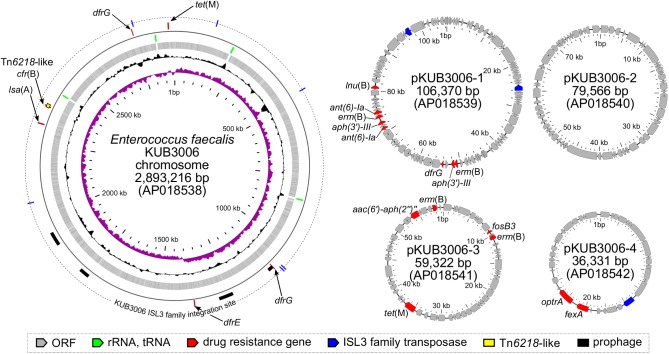
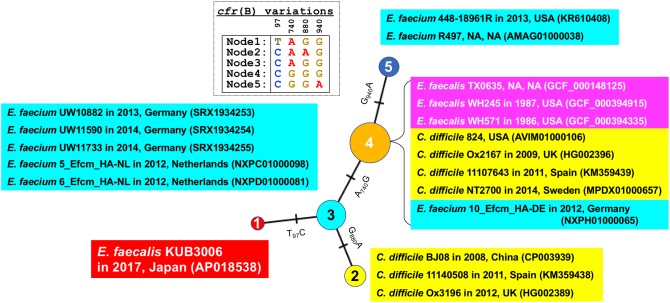
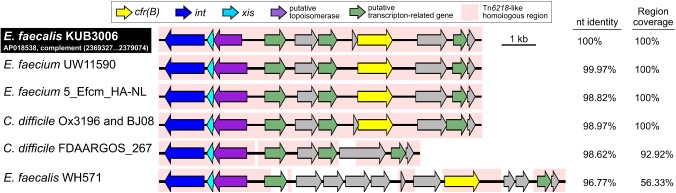
Linezolid (LZD) has become one of the most important antimicrobial agents for infections caused by gram-positive bacteria, including those caused by species. LZD-resistant (LR) genetic features include mutations in 23S rRNA/ribosomal proteins, a plasmid-borne 23S rRNA methyltransferase gene , and ribosomal protection genes ( and ). Recently, a gene variant, (B), was identified in a Tn-like transposon (Tn) in a isolate. Here, we isolated an LR clinical isolate, KUB3006, from a urine specimen of a patient with urinary tract infection during hospitalization in 2017. Comparative and whole-genome analyses were performed to characterize the genetic features and overall antimicrobial resistance genes in isolate KUB3006. Complete genome sequencing of KUB3006 revealed that it carried (B) on a chromosomal Tn-like element. Surprisingly, this Tn-like element was almost (99%) identical to that of Ox3196, which was isolated from a human in the UK in 2012, and to that of 5_Efcm_HA-NL, which was isolated from a human in the Netherlands in 2012. An additional oxazolidinone and phenicol resistance gene, , was also identified on a plasmid. KUB3006 is sequence type (ST) 729, suggesting that it is a minor ST that has not been reported previously and is unlikely to be a high-risk lineage. In summary, LR KUB3006 possesses a notable Tn-like-borne (B) and a plasmid-borne . This finding raises further concerns regarding the potential declining effectiveness of LZD treatment in the future.
利奈唑胺(LZD)已成为治疗革兰氏阳性菌感染最重要的抗菌药物之一,包括由某些菌种引起的感染。耐利奈唑胺(LR)的遗传特征包括23S rRNA/核糖体蛋白突变、质粒携带的23S rRNA甲基转移酶基因以及核糖体保护基因(和)。最近,在一株分离菌的类转座子(Tn)中鉴定出一种基因变体(B)。在此,我们从一名2017年住院期间患有尿路感染的患者的尿液标本中分离出一株LR临床分离株KUB3006。进行了比较分析和全基因组分析,以表征分离株KUB3006的遗传特征和整体抗菌耐药基因。KUB3006的全基因组测序显示,它在一个染色体类转座元件上携带(B)。令人惊讶的是,这个类转座元件与2012年从英国一名人类身上分离出的Ox3196以及2012年从荷兰一名人类身上分离出的5_Efcm_HA-NL的类转座元件几乎(99%)相同。在一个质粒上还鉴定出另一个恶唑烷酮和氯霉素耐药基因。KUB3006是序列型(ST)729,表明它是一个此前未报道过的次要ST,不太可能是高风险谱系。总之,LR分离株KUB3006拥有一个显著的类转座子携带的(B)和一个质粒携带的。这一发现进一步引发了对未来利奈唑胺治疗效果可能下降的担忧。