Dempsey-Jones Harriet, Kritikos Ada
University College London, London, UK.
University of Oxford, Oxford, UK.
Exp Brain Res. 2019 Feb;237(2):351-361. doi: 10.1007/s00221-018-5391-3. Epub 2018 Nov 8.
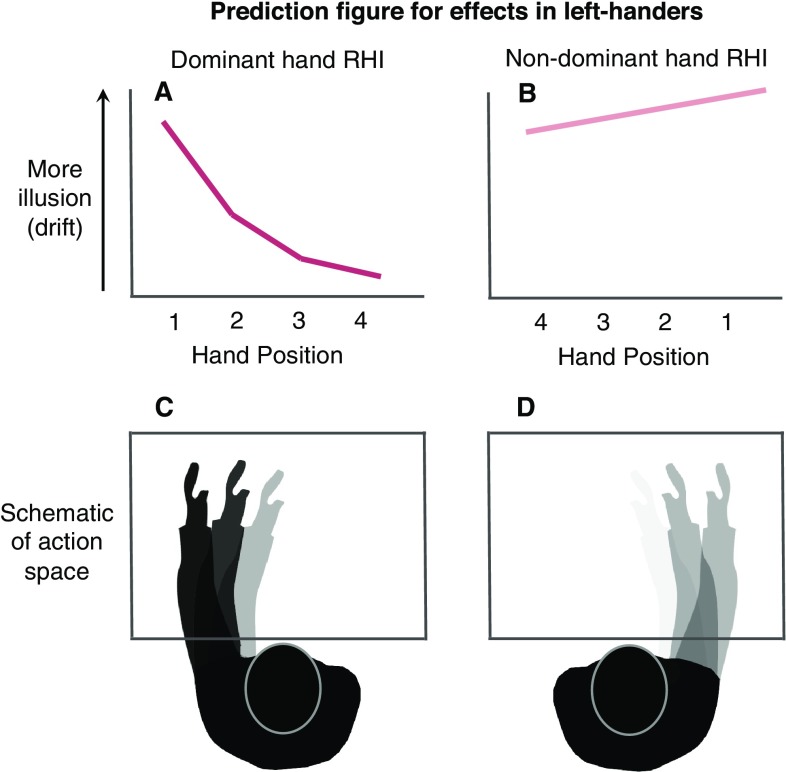
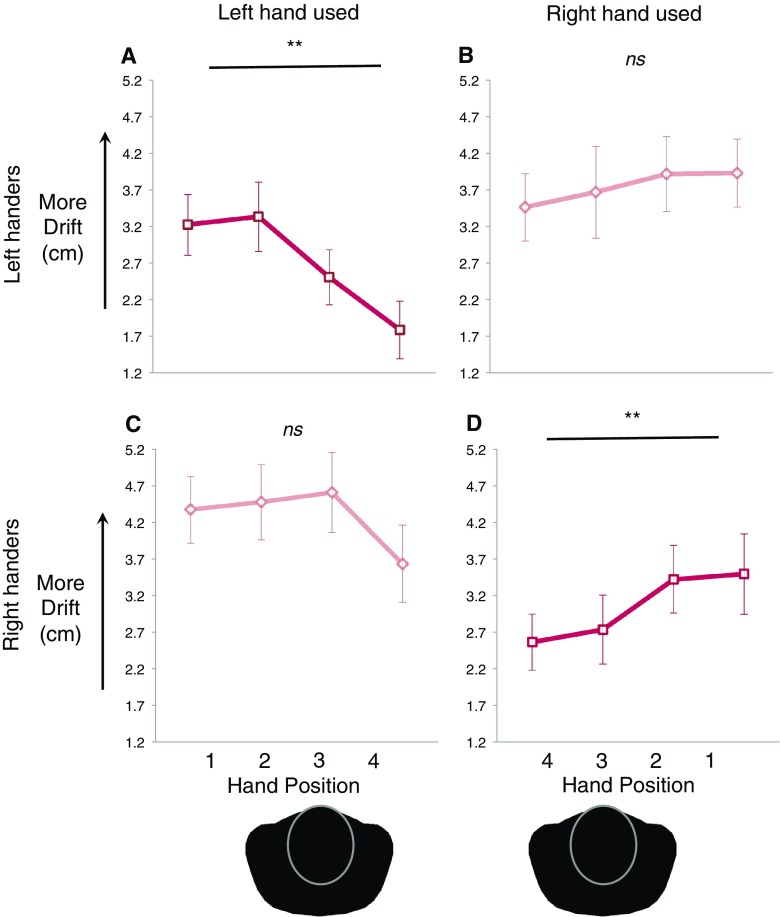
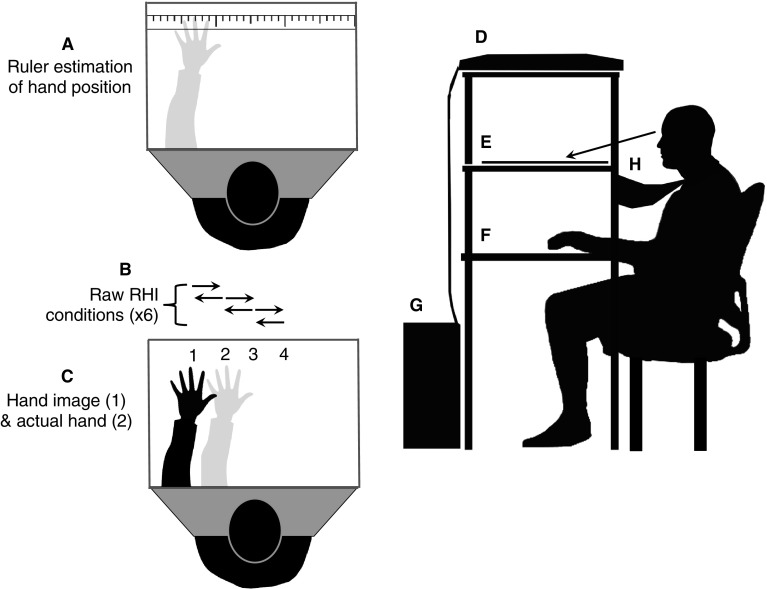
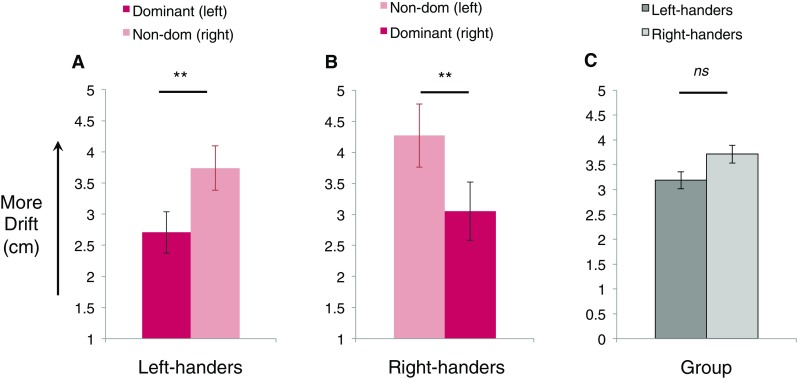
Preference for use of either the left or right hand ('handedness') has been linked with modulations of perception and sensory processing-both of space and the body. Here we ask whether multisensory integration of bodily information also varies as a function of handedness. We created a spatial disparity between visual and somatosensory hand position information using the rubber hand illusion, and use the magnitude of illusory shifts in hand position (proprioceptive 'drift') as a tool to probe the weighted integration of multisensory information. First, we found drift was significantly reduced when the illusion was performed on the dominant vs. non-dominant hand. We suggest increased manual dexterity of the dominant hand causes greater representational stability and thus an increased resistance to bias by the illusion induction. Second, drift was generally greatest when the hand was in its habitual action space (i.e., near the shoulder of origin), compared to when it laterally displaced towards, or across the midline. This linear effect, however, was only significant for the dominant hand-in both left- and right-handed groups. Thus, our results reveal patterns of habitual hand action modulate drift both within a hand (drift varies with proximity to action space), and between hands (differences in drift between the dominant and non-dominant hands). In contrast, we were unable to find conclusive evidence to support, or contradict, an overall difference between left- and right-handers in susceptibility to RHI drift (i.e., total drift, collapsed across hand positions). In sum, our results provide evidence that patterns of daily activity-and the subsequent patterns of sensory input-shape multisensory integration across space.
对使用左手或右手(“用手习惯”)的偏好与空间和身体的感知及感觉加工的调节有关。在此,我们探讨身体信息的多感官整合是否也会因用手习惯而有所不同。我们利用橡胶手错觉在视觉和体感手部位置信息之间制造空间差异,并将手部位置的错觉性偏移幅度(本体感觉“漂移”)作为一种工具来探究多感官信息的加权整合。首先,我们发现当错觉在优势手与非优势手上进行时,漂移显著减少。我们认为优势手手动灵活性的提高会带来更高的表征稳定性,并因此增加对错觉诱导偏差的抵抗力。其次,与手部向中线横向移动或越过中线时相比,当手处于其习惯动作空间(即靠近起始肩部)时,漂移通常最大。然而,这种线性效应仅在优势手上显著——在左利手和右利手群体中均如此。因此,我们的结果揭示了习惯手部动作模式在一只手内部(漂移随与动作空间的接近程度而变化)以及两只手之间(优势手和非优势手之间的漂移差异)调节漂移。相比之下,我们无法找到确凿证据来支持或反驳左利手和右利手在橡胶手错觉漂移易感性方面的总体差异(即总漂移,涵盖所有手部位置)。总之,我们的结果提供了证据,表明日常活动模式以及随后的感觉输入模式塑造了跨空间的多感官整合。