Faculty of Psychology, University of Warsaw, Warsaw, Poland.
Polish Academy of Sciences, Institute of Philosophy and Sociology, Warsaw, Poland.
PLoS One. 2020 Dec 30;15(12):e0244594. doi: 10.1371/journal.pone.0244594. eCollection 2020.
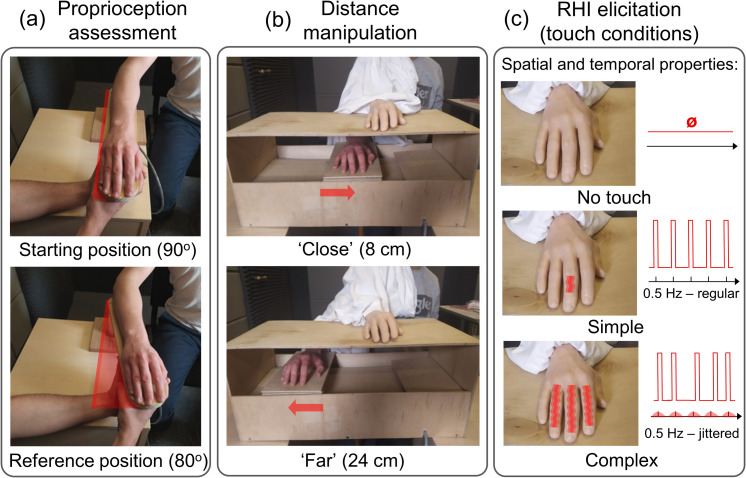
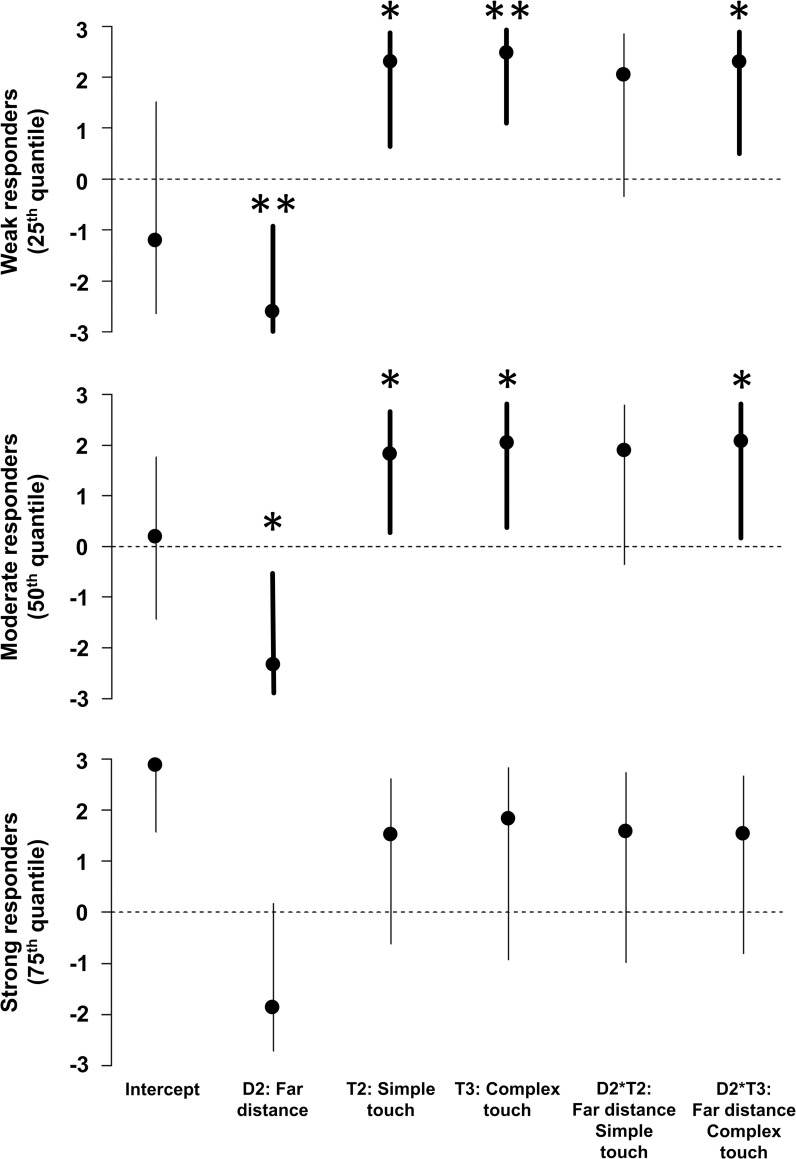
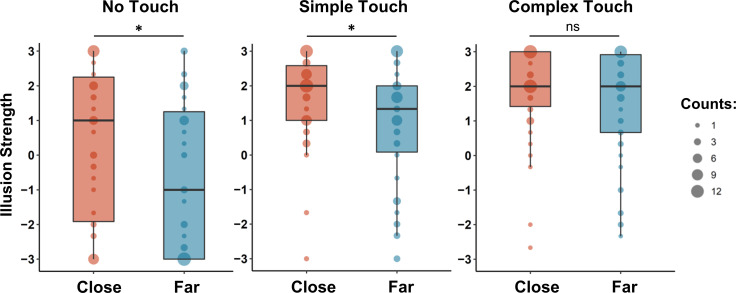
Sense of body ownership is an immediate and distinct experience of one's body as belonging to oneself. While it is well-recognized that ownership feelings emerge from the integration of visual and somatosensory signals, the principles upon which they are integrated are still intensely debated. Here, we used the rubber hand illusion (RHI) to examine how the interplay of visual, tactile, and proprioceptive signals is governed depending on their spatiotemporal properties. For this purpose, the RHI was elicited in different conditions varying with respect to the extent of visuo-proprioceptive divergence (i.e., the distance between the real and fake hands) and differing in terms of the availability and spatiotemporal complexity of tactile stimulation (none, simple, or complex). We expected that the attenuating effect of distance on illusion strength will be more pronounced in the absence of touch (when proprioception gains relatively higher importance) and absent in the presence of complex tactile signals. Additionally, we hypothesized that participants with greater proprioceptive acuity-assessed using an elbow joint position discrimination task-will be less susceptible to the illusion, but only under the conditions of limited tactile stimulation. In line with our prediction, RHI was attenuated at the farthest distance only when tactile information was absent or simplified, but the attenuation was effectively prevented by the use of complex tactile stimulation-in this case, RHI was comparably vivid at both distances. However, passive proprioceptive acuity was not related to RHI strength in either of the conditions. The results indicate that complex-structured tactile signals can override the influence of proprioceptive signals in body attribution processes. These findings extend our understanding of body ownership by showing that it is primarily determined by informative cues from the most relevant sensory domains, rather than mere accumulation of multisensory evidence.
身体所有权是一种即时而鲜明的自我身体归属感体验。虽然人们普遍认为,所有权的感觉来自于视觉和体感信号的整合,但它们是如何整合的原则仍在激烈争论中。在这里,我们使用橡胶手错觉(RHI)来研究视觉、触觉和本体感觉信号的相互作用是如何根据它们的时空特性来控制的。为此,我们在不同的条件下诱发了 RHI,这些条件在视动感知差异的程度上有所不同(即真实手和假手之间的距离),并且在触觉刺激的可用性和时空复杂性上也有所不同(没有、简单或复杂)。我们预计,在没有触觉的情况下(当本体感觉获得相对较高的重要性时),距离对错觉强度的衰减作用将更加明显,而在存在复杂触觉信号的情况下则不会出现这种情况。此外,我们假设使用肘关节位置辨别任务评估的本体感觉敏锐度较高的参与者,在触觉刺激有限的情况下,将不太容易受到错觉的影响。与我们的预测一致,只有在没有触觉信息或触觉信息简化的情况下,RHI 才会在最远的距离上减弱,但复杂触觉刺激的使用有效地阻止了这种减弱——在这种情况下,RHI 在两个距离上都同样生动。然而,被动本体感觉敏锐度与两种情况下的 RHI 强度都没有关系。研究结果表明,复杂结构的触觉信号可以覆盖本体感觉信号在身体归属过程中的影响。这些发现通过表明身体所有权主要取决于最相关的感觉领域的信息性线索,而不是单纯的多感觉证据积累,扩展了我们对身体所有权的理解。