Department of Public Health, Osaka City University Graduate School of Medicine.
Research Center for Infectious Disease Sciences, Osaka City University Graduate School of Medicine.
J Epidemiol. 2019 Sep 5;29(9):354-362. doi: 10.2188/jea.JE20180060. Epub 2018 Nov 10.
Severe pediatric cases of hand, foot, and mouth disease (HFMD), herpangina (HA), and associated complications caused by enterovirus 71 (EV71) infection have brought substantial public health impact in Asia. This study aimed to elucidate the epidemiology of these pediatric cases in Japan.
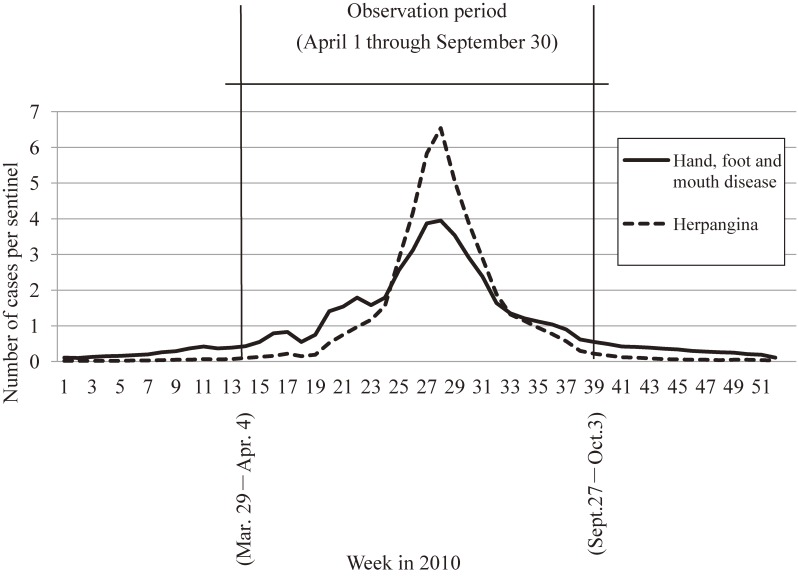
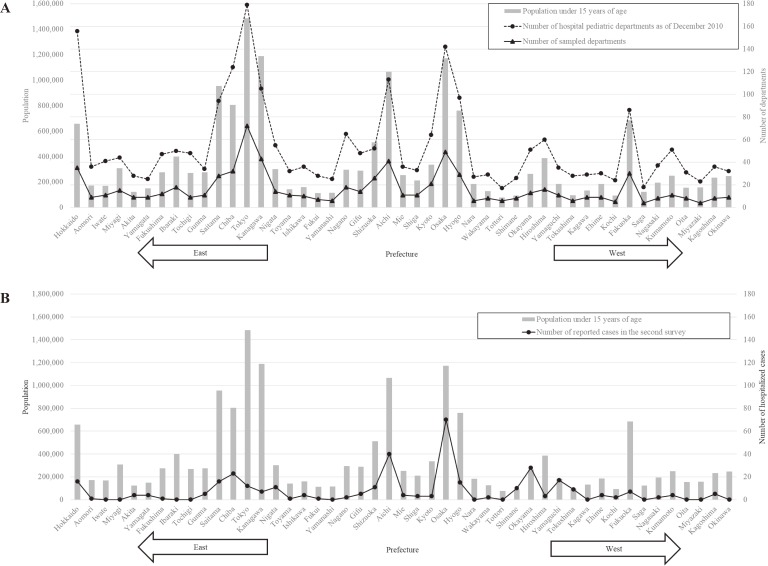
A nationwide survey was conducted using stratified random sampling of hospital pediatric departments. We estimated the number of inpatients with HFMD, HA, and associated complications between April 1 and September 30, 2010, during which EV71 was circulating predominantly. Factors associated with severe cases with ≥7 days of admission, sequelae, or outcome of death were analyzed using multivariate logistic regression.
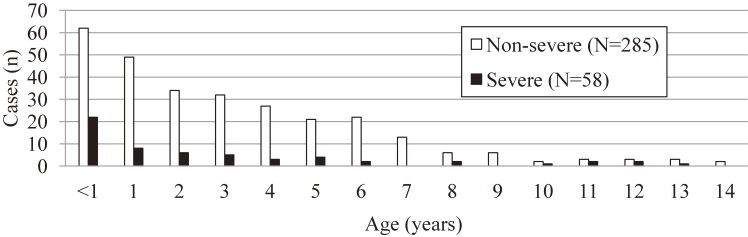
During the 6-month epidemic period, the number of pediatric inpatients aged <15 years was about 2,900 (estimated cumulative incidence of hospitalized cases: 17.0 per 100,000 population). Severe cases were significantly associated with younger age. Compared to patients ≥5 years of age, the odds ratios (ORs) for <1 year of age and 1 to <3 years of age were 5.74 (95% confidence interval [CI], 2.14-15.4) and 2.94 (95% CI, 1.02-8.51), respectively. Elevated ORs for hyperglycemia (plasma glucose level of ≥8.3 mmol/L) on admission (OR 3.60; 95% CI, 0.94-13.8) were also observed.
Disease burden of pediatric inpatients with HFMD, HA, and associated complications in Japan was described for the first time. During an EV71 epidemic, younger age and, suggestively, hyperglycemia may have been critical factors requiring more careful treatment.
手足口病(HFMD)、疱疹性咽峡炎(HA)和肠道病毒 71 型(EV71)感染引起的严重儿科病例及其相关并发症给亚洲的公共卫生带来了重大影响。本研究旨在阐明日本这些儿科病例的流行病学情况。
采用医院儿科部门分层随机抽样的方法进行了一项全国性调查。我们估计了 2010 年 4 月 1 日至 9 月 30 日期间 EV71 主要流行期间住院的 HFMD、HA 和相关并发症患儿的人数。使用多变量逻辑回归分析与住院时间≥7 天、后遗症或死亡结局相关的严重病例的相关因素。
在 6 个月的流行期间,年龄<15 岁的儿科住院患者人数约为 2900 人(估计住院病例累计发病率为每 100000 人 17.0 例)。严重病例与年龄较小显著相关。与≥5 岁的患者相比,<1 岁和 1-<3 岁患者的比值比(OR)分别为 5.74(95%置信区间[CI],2.14-15.4)和 2.94(95% CI,1.02-8.51)。入院时高血糖(血糖水平≥8.3mmol/L)的 OR 也升高(OR 3.60;95% CI,0.94-13.8)。
日本首次描述了 HFMD、HA 和相关并发症的儿科住院患者的疾病负担。在 EV71 流行期间,年龄较小,推测高血糖可能是需要更仔细治疗的关键因素。