Wang Alice S, Jamshidi Ali O, Oh Nathan, Sahyouni Ronald, Nowroozizadeh Behdokht, Kim Ronald, Hsu Frank P K, Bota Daniela
Department of Neurological Surgery, University of California-Irvine Medical Center, Orange, CA, United States.
Department of Pathology and Laboratory Medicine, University of California-Irvine Medical Center, Orange, CA, United States.
Front Neurol. 2018 Oct 26;9:919. doi: 10.3389/fneur.2018.00919. eCollection 2018.
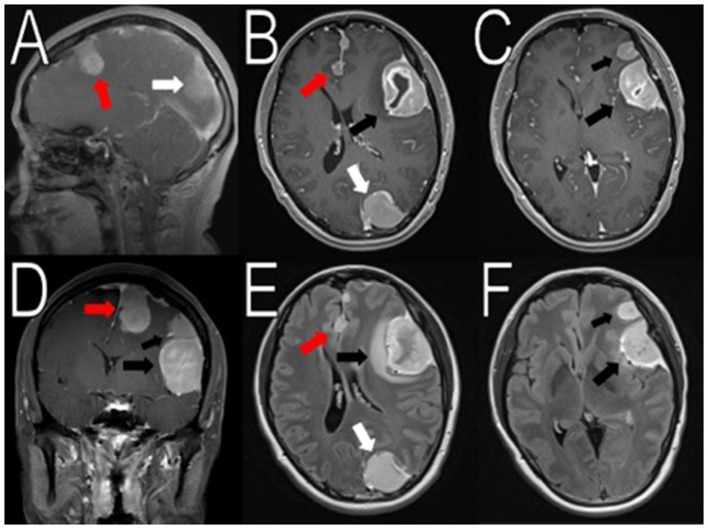
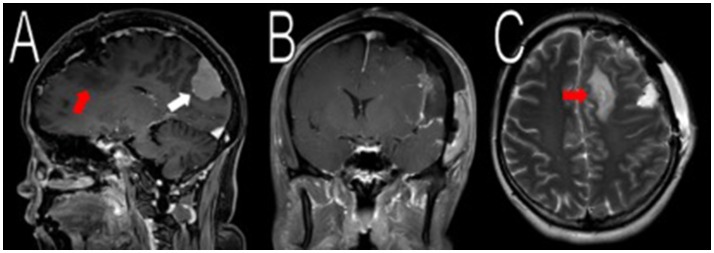
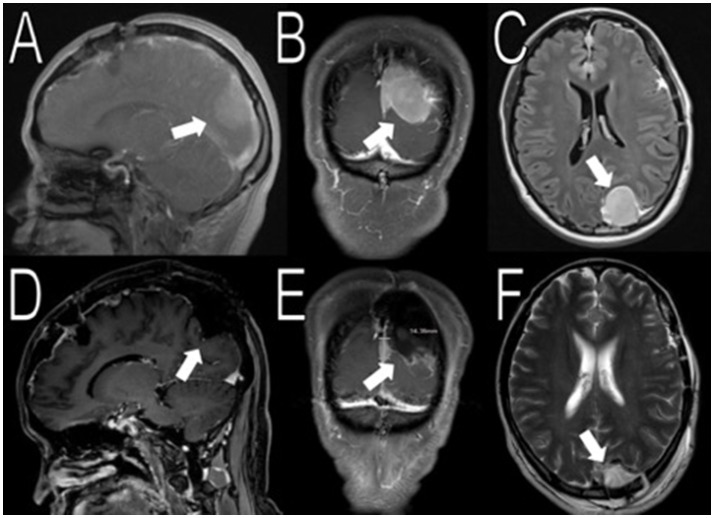
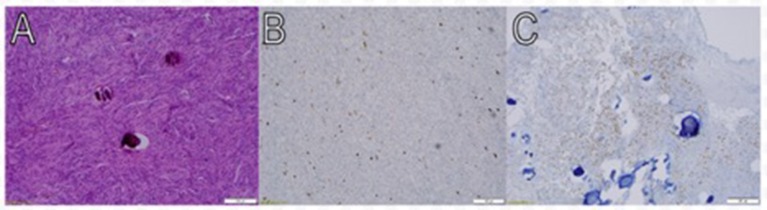
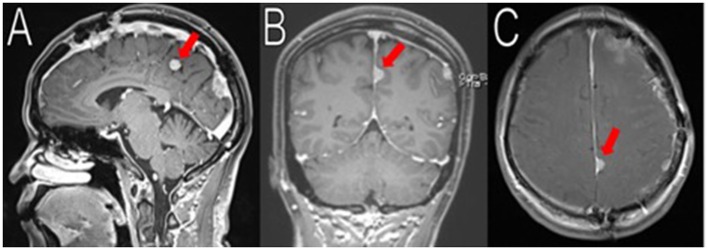
Multiple intracranial meningiomas account for <10% of all meningiomas. Familial multiple meningiomas have been linked to germline mutations in two genes: (NF2) and (SMARCB1). Sporadic multiple meningiomas have been associated with somatic NF2 mutations and, to date, there has been no case related to somatic SMARCB1 mutations. Here, we describe the first case. A 45-year-old female suffered a head trauma while snowboarding. Subsequent to her injury, she experienced persistent headache, nausea, vomiting, dizziness, and flashing lights in the right eye. Magnetic resonance imaging (MRI) of her brain revealed multiple intracranial meningiomas. She underwent a two-staged craniotomy to remove frontal/parietal/temporal and occipital extra-axial tumors. Pathology confirmed the masses as meningiomas, WHO Grade I. Tumor genetic testing was positive for SMARCB1 mutation but blood genetic testing was negative for SMARCB1 mutation. In sporadic multiple meningiomas, somatic NF2 mutations are usually the suspected genetic alternations. Our case illustrates that somatic SMARCB1 mutation is another genetic risk factor for sporadic multiple meningiomas, albeit rare.
多发性颅内脑膜瘤占所有脑膜瘤的比例不到10%。家族性多发性脑膜瘤与两个基因的种系突变有关:神经纤维瘤病2型(NF2)基因和SWI/SNF相关、基质相关、肌动蛋白依赖的染色质调节因子亚基1(SMARCB1)基因。散发性多发性脑膜瘤与体细胞NF2突变有关,迄今为止,尚无与体细胞SMARCB1突变相关的病例。在此,我们描述首例此类病例。一名45岁女性在单板滑雪时头部受伤。受伤后,她持续出现头痛、恶心、呕吐、头晕,右眼有闪光感。脑部磁共振成像(MRI)显示有多发性颅内脑膜瘤。她接受了分两阶段的开颅手术,以切除额/顶/颞叶和枕叶的轴外肿瘤。病理检查证实肿块为WHO I级脑膜瘤。肿瘤基因检测显示SMARCB1突变呈阳性,但血液基因检测显示SMARCB1突变呈阴性。在散发性多发性脑膜瘤中,体细胞NF2突变通常是可疑的基因改变。我们的病例表明,体细胞SMARCB1突变是散发性多发性脑膜瘤的另一个遗传危险因素,尽管很罕见。