Tang Chufei, Davis Katie E, Delmer Cyrille, Yang Ding, Wills Matthew A
Department of Entomology, College of Plant Protection, China Agricultural University, 100193, Beijing, China.
The Milner Centre for Evolution, Department of Biology & Biochemistry, University of Bath, Claverton Down, Bath, BA27AY, UK.
Commun Biol. 2018 Nov 5;1:182. doi: 10.1038/s42003-018-0191-7. eCollection 2018.
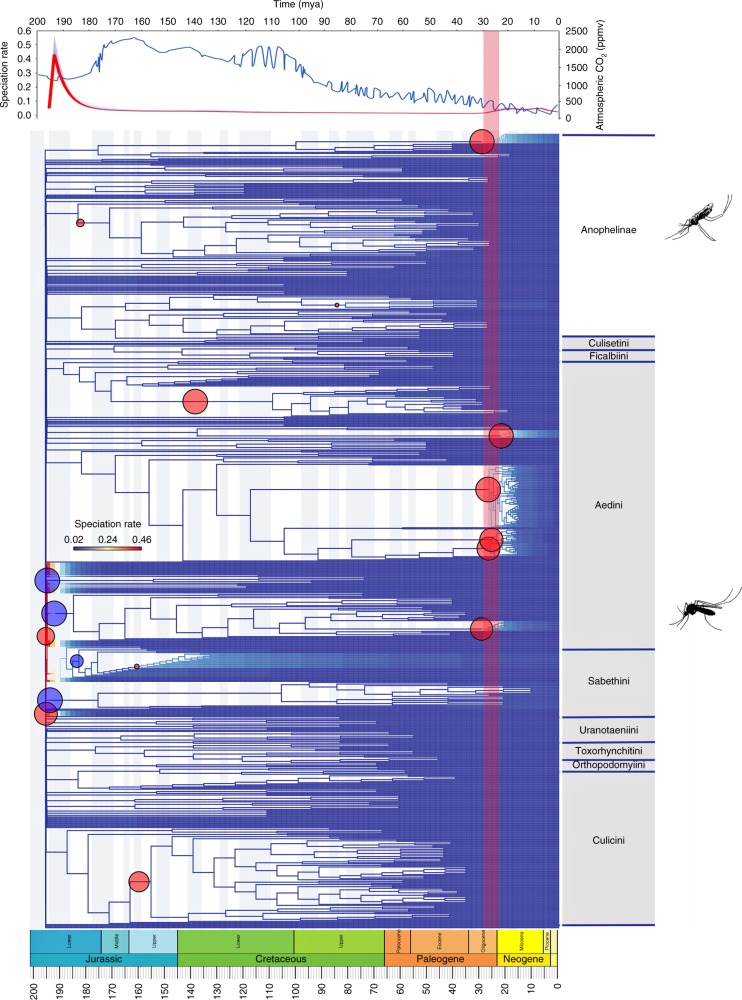
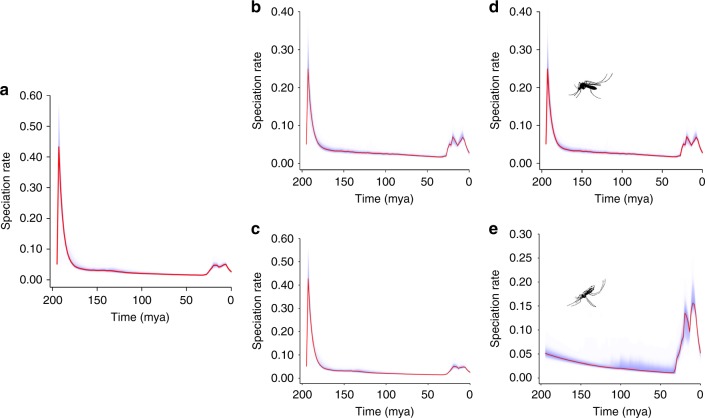
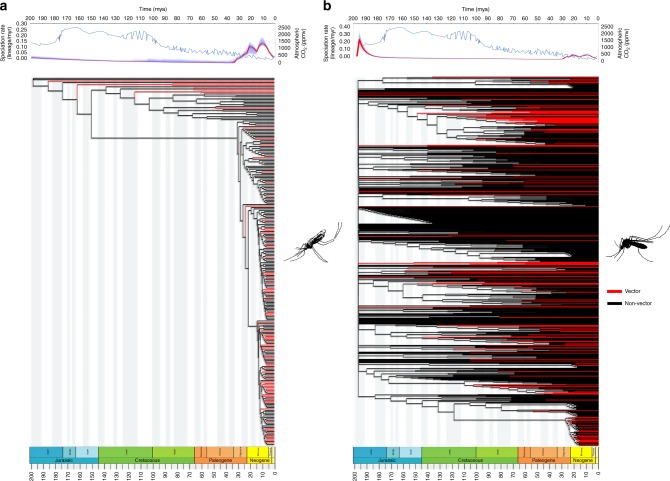
Mosquitoes are of great medical significance as vectors of deadly diseases. Despite this, little is known about their evolutionary history or how their present day diversity has been shaped. Within a phylogenetic framework, here we show a strong correlation between climate change and mosquito speciation rates: the first time to our knowledge such an effect has been demonstrated for insects. Information theory reveals that although climate change is correlated with mosquito evolution there are other important factors at play. We identify one such driver to be the rise of mammals, which are predominant hosts of Culicidae. Regardless of the precise mechanism, we demonstrate a strong historical association. This finding, taken in combination with projected rises in atmospheric CO from anthropogenic activity, has important implications for culicid vector distributions and abundance, and consequently for human health.
蚊子作为致命疾病的传播媒介具有重大医学意义。尽管如此,人们对它们的进化史或当今多样性的形成方式知之甚少。在系统发育框架内,我们在此表明气候变化与蚊子物种形成速率之间存在强烈关联:据我们所知,这是首次针对昆虫证明这种效应。信息论表明,虽然气候变化与蚊子进化相关,但还有其他重要因素在起作用。我们确定其中一个驱动因素是哺乳动物的兴起,哺乳动物是蚊科的主要宿主。无论确切机制如何,我们都证明了一种强烈的历史关联。这一发现,结合人为活动导致的大气二氧化碳预计上升,对蚊科传播媒介的分布和数量具有重要影响,进而对人类健康产生重要影响。