Li Xiao, Chan King Yuk, Ramer Rodica
School of Electrical Engineering and Telecommunications, University of New South Wales, Sydney, NSW 2052, Australia.
Micromachines (Basel). 2018 Mar 20;9(3):138. doi: 10.3390/mi9030138.
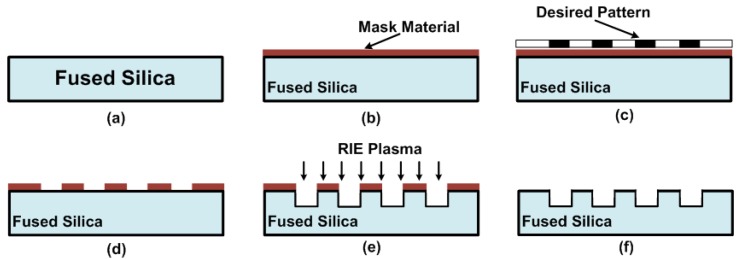
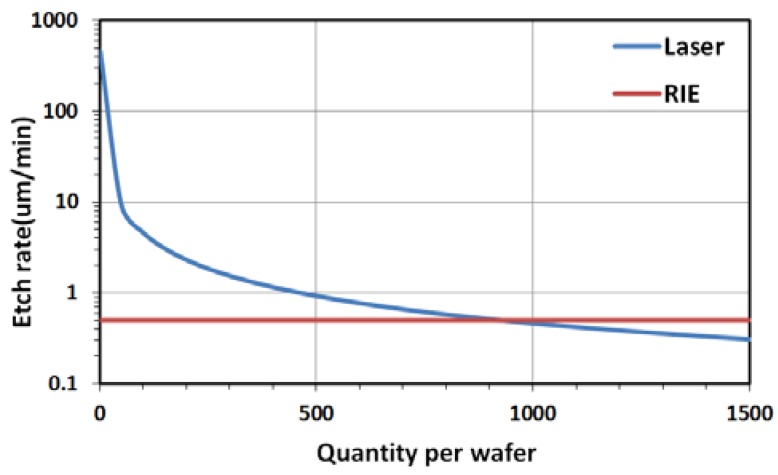
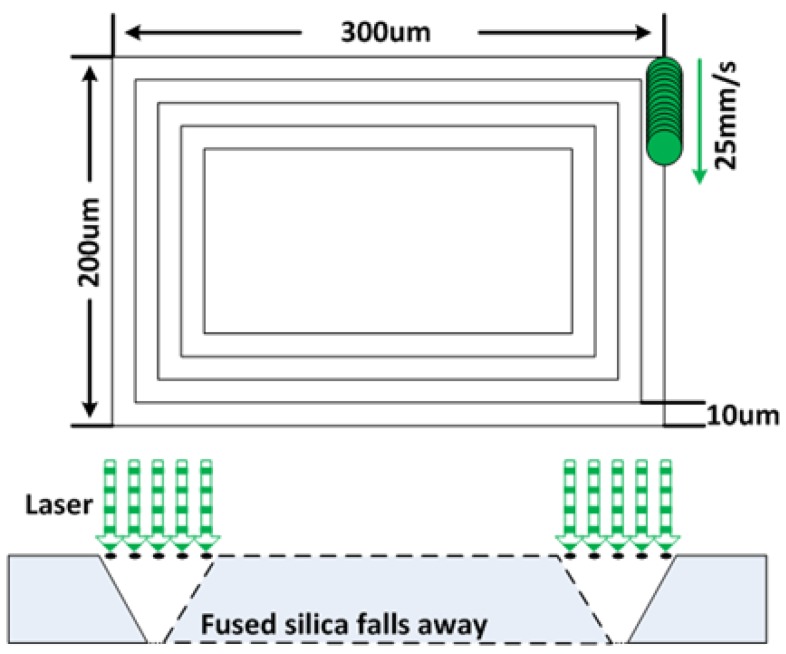
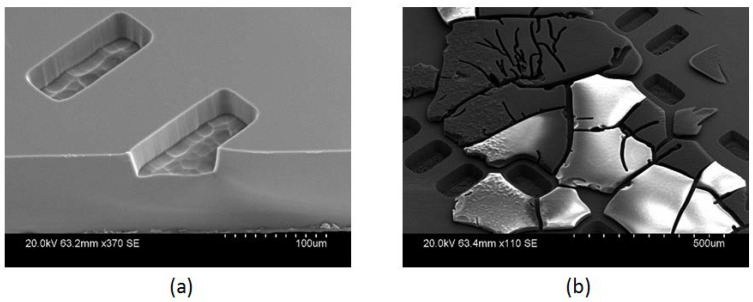
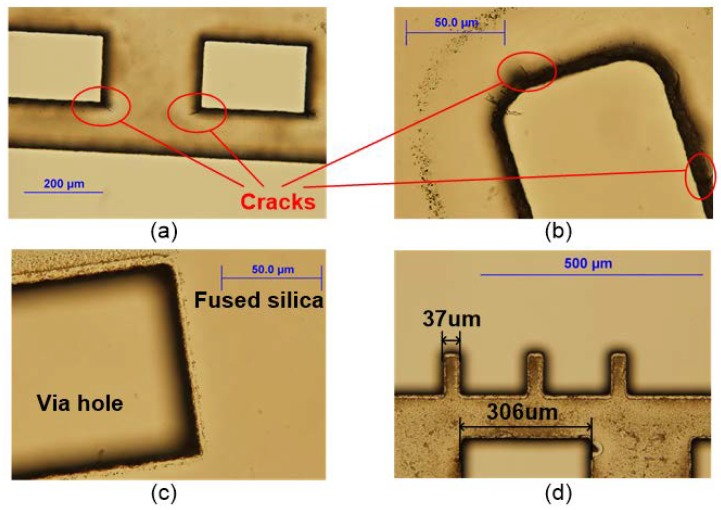
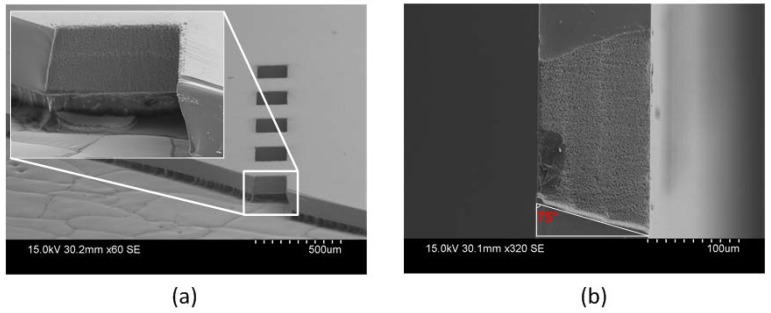
Through via holes in fused silica are a key infrastructure element of microwave and millimeter-wave circuits and 3D integration. In this work, etching through via holes in ultra-thin fused silica wafers using deep reactive-ion etching (DRIE) and laser ablation was developed and analyzed. The experimental setup and process parameters for both methods are presented and compared. For DRIE, three types of mask materials including KMPR 1035 (Nippon Kayaku, Tokyo, Japan) photoresist, amorphous silicon and chromium-with their corresponding optimized processing recipes-were tested, aiming at etching through a 100 μm fused silica wafer. From the experiments, we concluded that using chromium as the masking material is the best choice when using DRIE. However, we found that the laser ablation method with a laser pulse fluence of 2.89 J/cm² and a pulse overlap of 91% has advantages over DRIE. The laser ablation method has a simpler process complexity, while offering a fair etching result. In particular, the sidewall profile angle is measured to be 75° to the bottom surface of the wafer, which is ideal for the subsequent metallization process. As a demonstration, a two-inch wafer with 624 via holes was processed using both technologies, and the laser ablation method showed better efficiency compared to DRIE.
贯穿熔融石英的通孔是微波和毫米波电路以及3D集成的关键基础设施元件。在这项工作中,开发并分析了使用深反应离子刻蚀(DRIE)和激光烧蚀在超薄熔融石英晶圆上刻蚀通孔的方法。介绍并比较了这两种方法的实验装置和工艺参数。对于DRIE,测试了三种掩膜材料,包括KMPR 1035(日本东京日东化成)光刻胶、非晶硅和铬以及它们相应的优化工艺配方,目标是刻蚀穿透100μm厚的熔融石英晶圆。通过实验,我们得出结论,在使用DRIE时,使用铬作为掩膜材料是最佳选择。然而,我们发现激光脉冲能量密度为2.89J/cm²且脉冲重叠率为91%的激光烧蚀方法比DRIE具有优势。激光烧蚀方法的工艺复杂度更低,同时蚀刻效果良好。特别是,测量到侧壁轮廓与晶圆底面的夹角为75°,这对于后续的金属化工艺来说是理想的。作为演示,使用这两种技术对一个带有624个通孔的两英寸晶圆进行了加工,结果表明激光烧蚀方法比DRIE具有更高的效率。