Ren Yi, Liu Jing
Department of Biomedical Engineering, Tsinghua University, Beijing 100084, China.
Technical Institute of Physics and Chemistry, Chinese Academy of Sciences, Beijing 100190, China.
Micromachines (Basel). 2018 May 5;9(5):218. doi: 10.3390/mi9050218.
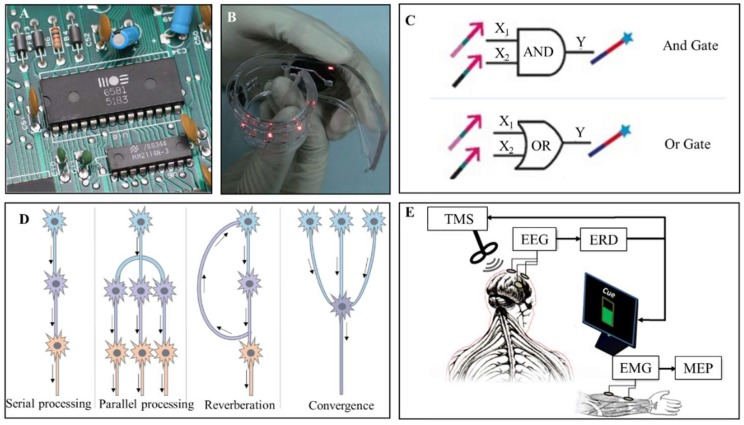
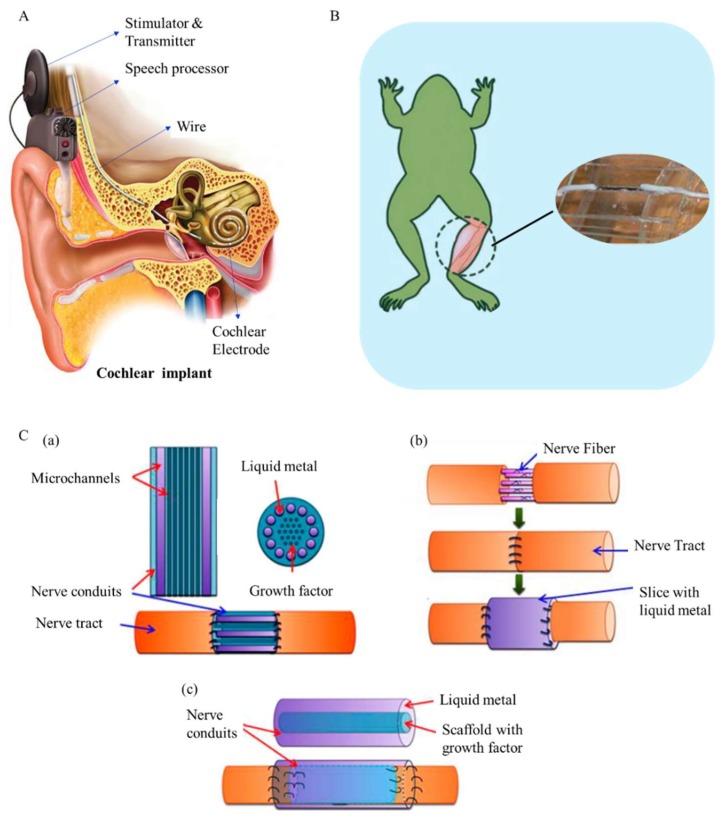
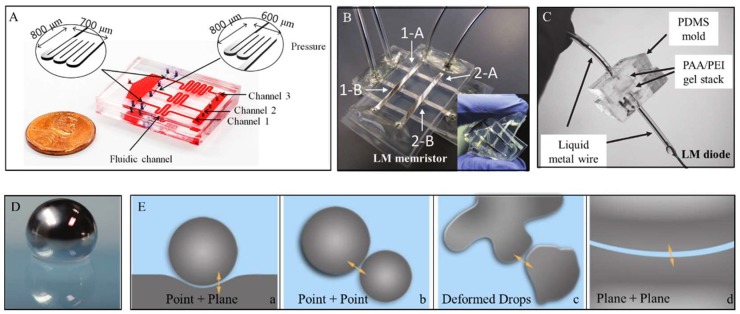
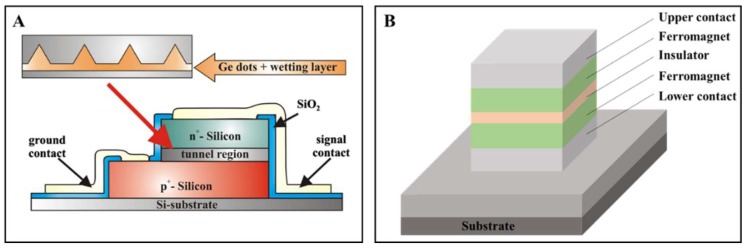
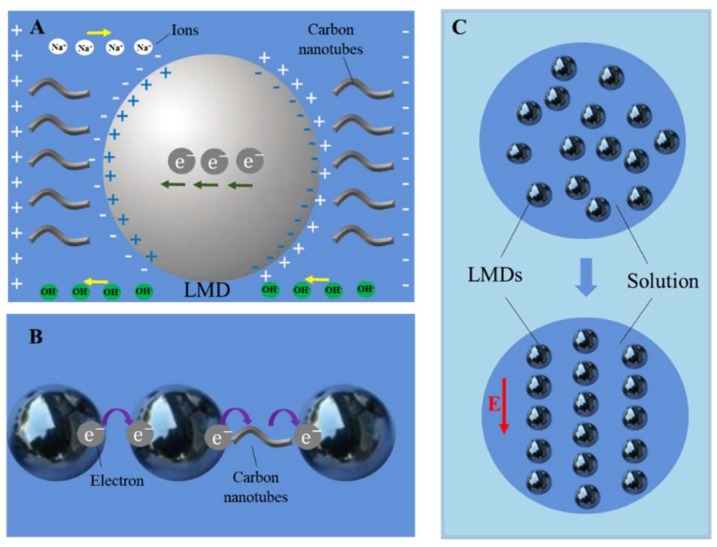
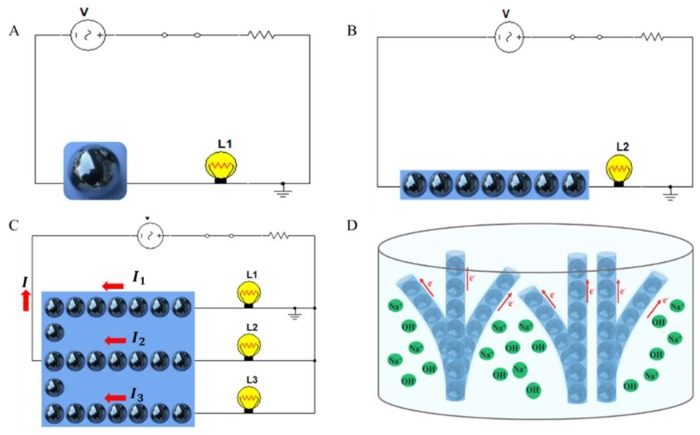
Conventional electrical circuits are generally rigid in their components and working styles, which are not flexible and stretchable. As an alternative, liquid-metal-based soft electronics offer important opportunities for innovation in modern bioelectronics and electrical engineering. However, their operation in wet environments such as aqueous solution, biological tissue or allied subjects still encounters many technical challenges. Here, we propose a new conceptual electrical circuit, termed as droplet circuit, to fulfill the special needs described above. Such unconventional circuits are immersed in a solution and composed of liquid metal droplets, conductive ions or wires, such as carbon nanotubes. With specifically-designed topological or directional structures/patterns, the liquid-metal droplets composing the circuit can be discrete and disconnected from each other, while achieving the function of electron transport through conductive routes or the quantum tunneling effect. The conductive wires serve as electron transfer stations when the distance between two separate liquid-metal droplets is far beyond that which quantum tunneling effects can support. The unique advantage of the current droplet circuit lies in the fact that it allows parallel electron transport, high flexibility, self-healing, regulation and multi-point connectivity without needing to worry about the circuit break. This would extend the category of classical electrical circuits into newly emerging areas like realizing room temperature quantum computing, making brain-like intelligence or nerve⁻machine interface electronics, etc. The mechanisms and potential scientific issues of the droplet circuits are interpreted and future prospects in this direction are outlined.
传统电路的组件和工作方式通常较为固定,缺乏灵活性和可拉伸性。作为替代方案,基于液态金属的柔性电子学为现代生物电子学和电气工程的创新提供了重要机遇。然而,它们在诸如水溶液、生物组织或相关环境等潮湿环境中的运行仍面临许多技术挑战。在此,我们提出一种新的概念性电路,称为液滴电路,以满足上述特殊需求。这种非常规电路浸没在溶液中,由液态金属液滴、导电离子或导线(如碳纳米管)组成。通过专门设计的拓扑或定向结构/图案,构成电路的液态金属液滴可以相互离散且断开连接,同时通过导电路径或量子隧穿效应实现电子传输功能。当两个分离的液态金属液滴之间的距离远超过量子隧穿效应所能支持的范围时,导线充当电子传输站。当前液滴电路的独特优势在于它允许并行电子传输、具有高灵活性、自我修复、可调节性和多点连接性,而无需担心电路中断。这将把经典电路的范畴扩展到新兴领域,如实现室温量子计算、制造类脑智能或神经-机器接口电子器件等。本文解释了液滴电路的机制和潜在科学问题,并概述了该方向的未来前景。