Schneider Johannes, Djamiykov Vergil, Greiner Christian
Institute for Applied Materials (IAM), Karlsruhe Institute of Technology (KIT), Kaiserstrasse 12, 76131 Karlsruhe, Germany.
KIT IAM-CMS MikroTribologie Centrum µTC, Strasse am Forum 5, 76131 Karlsruhe, Germany.
Beilstein J Nanotechnol. 2018 Sep 26;9:2561-2572. doi: 10.3762/bjnano.9.238. eCollection 2018.
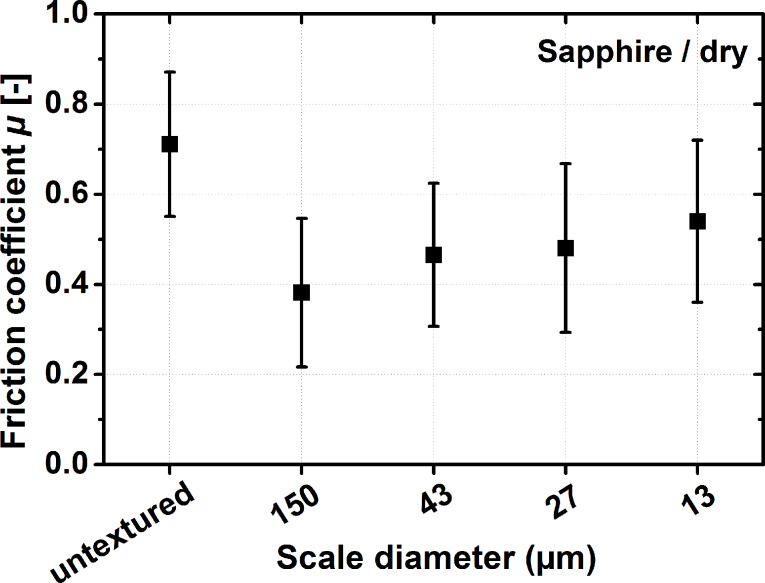
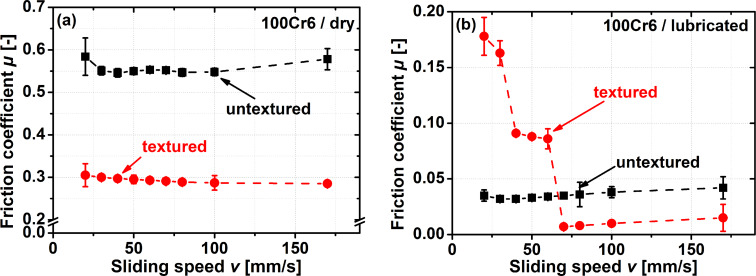
Reducing friction forces is a major challenge in many engineering applications involving moving parts. For the past 50 years, the morphological texturing of surfaces for improving tribological properties has been investigated. Only recently, the application of biologically inspired surface features, like scales found on lizards and snakes, has come to the attention of tribologists. Here, we present results of the lubricated and unlubricated performance of biologically inspired scale-like textures applied with laser light to the surface of bearing steel pins. These were paired in unidirectional sliding against metallic (100Cr6), polymeric (PEEK) and ceramic (AlO) counter bodies. Additionally, a possible size effect was investigated by changing the scale diameter between 13 and 150 µm under dry sliding contact against sapphire. Our results demonstrate that depending on the contact conditions a biologically inspired surface morphology has the potential to reduce friction forces by more than 80%. However, under certain conditions, especially for slow-moving lubricated steel-on-steel and steel-on-ceramic contacts, these surface morphologies may increase friction as well. Similar to classical laser surface textures, such as round dimples, these biologically inspired morphologies need to be carefully optimized for each tribological system in which they are intended to be applied. There is no standard solution for all sliding conditions. The results presented here demonstrate that such efforts have the potential to yield significant reduction in friction forces and are expected to spark future research in the field of biologically inspired surface morphologies applied to tribological contacts.
在许多涉及运动部件的工程应用中,降低摩擦力是一项重大挑战。在过去的50年里,人们一直在研究通过表面形态纹理化来改善摩擦学性能。直到最近,受生物启发的表面特征(如蜥蜴和蛇身上的鳞片)的应用才引起摩擦学家的关注。在此,我们展示了用激光在轴承钢销表面加工出的受生物启发的鳞片样纹理在润滑和未润滑状态下的性能结果。这些纹理与金属(100Cr6)、聚合物(PEEK)和陶瓷(AlO)对磨副进行单向滑动配对。此外,还研究了在与蓝宝石的干滑动接触中,通过将鳞片直径在13至150微米之间变化可能产生的尺寸效应。我们的结果表明,根据接触条件,受生物启发的表面形态有可能将摩擦力降低80%以上。然而,在某些条件下,特别是对于缓慢移动的润滑钢对钢和钢对陶瓷接触,这些表面形态也可能增加摩擦力。与经典的激光表面纹理(如圆形凹坑)类似,这些受生物启发的形态需要针对其打算应用的每个摩擦学系统进行仔细优化。对于所有滑动条件,不存在标准解决方案。此处展示的结果表明,此类努力有可能显著降低摩擦力,并有望激发未来在应用于摩擦学接触的受生物启发表面形态领域的研究。