Xiong Yuan, Wu Qipeng, Mi Bobin, Zhou Wu, Liu Yi, Liu Jing, Xue Hang, Hu Liangcong, Panayi Adriana C, Liu Guohui
Department of Orthopedics, Union Hospital, Tongji Medical College, Huazhong University of Science and Technology, Wuhan, 430022, China.
Department of Orthopedics, Pu'ai Hospital, Tongji Medical College, Huazhong University of Science and Technology, Wuhan, 430022, China.
Arch Orthop Trauma Surg. 2019 Apr;139(4):529-536. doi: 10.1007/s00402-018-3071-1. Epub 2018 Nov 13.
Corticosteroid (CS) injections have been proven to be effective in ameliorating symptoms of plantar fasciitis. Shock-wave (SW) therapy is another common treatment of plantar fasciitis, and several meta-analyses have documented its advantages when compared to placebo treatment. Despite this, few studies have focused on comparing the use of CS and SW in the treatment of plantar fasciitis. The purpose of this meta-analysis is to assess whether SW is superior to CS in managing plantar fasciitis, both in terms of ameliorating pain as well as improving functionality.
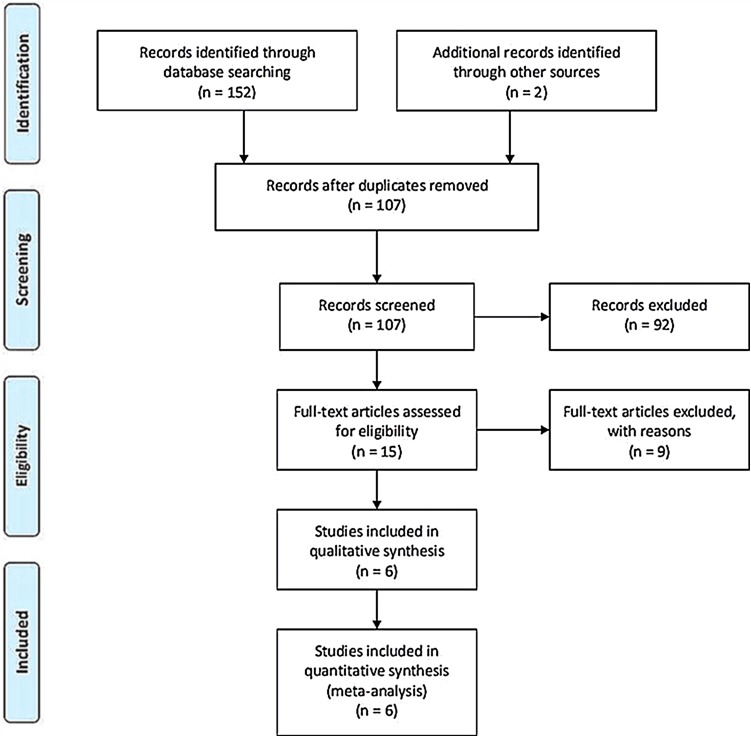
A systematic search of the literature was conducted to identify relevant articles that were published in Pubmed, Medline, Embase, the Cochrane Library, SpringerLink, Clinical Trials.gov and OVID from the databases' inception to July 2018. All studies comparing the efficacy of SW and CS in terms of pain levels and functionality improvement were included. Data on the two primary outcomes were collected and analyzed using the Review Manager 5.3.
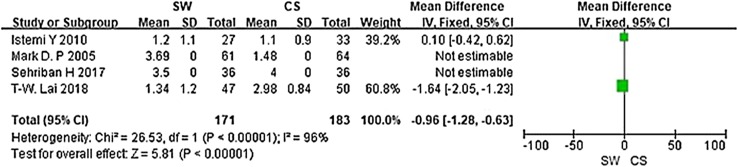
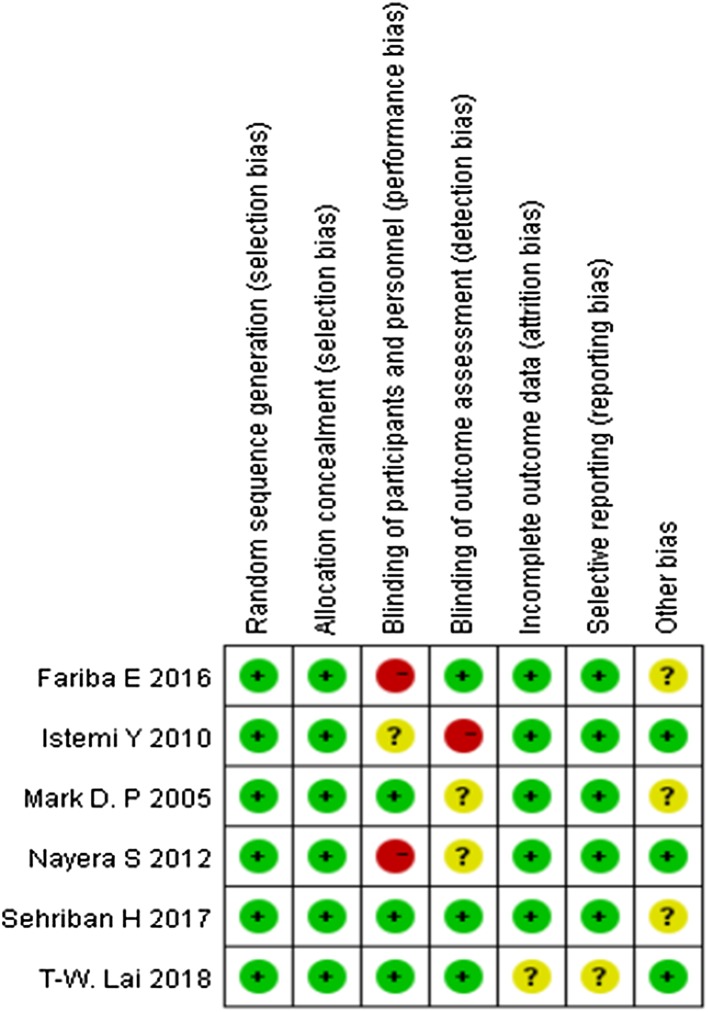
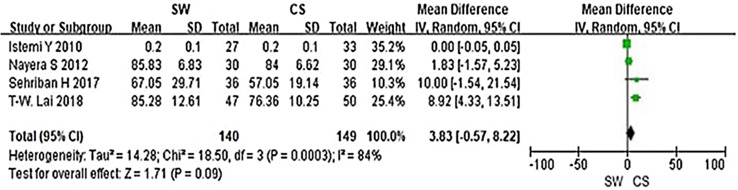
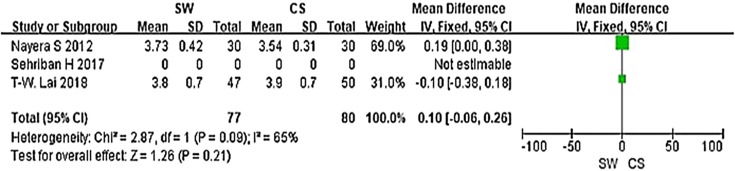
Six studies were included in the current meta-analysis. A significant difference in VAS score (MD = - 0.96, Cl - 1.28 to - 0.63, P < 0.00001, I = 96%) was noted between the SW group and the CS group. No significant difference was seen in the Mayo CSS or FFI or HFI or 100 Scoring System score at the 3 months follow-up (Chi = 0.62, I = 0%, P > 0.05).
The clinical relevance of the present study is that both SW and CS were effective and successful in relieving pain and improving self-reported function in the treatment of plantar fasciitis at 3 months. Although inter-group differences were not significant, the VAS score was better improved in the SW group, highlighting that shock-wave therapy may be a better alternative for the management of chronic plantar fasciitis.
皮质类固醇(CS)注射已被证明可有效改善足底筋膜炎症状。冲击波(SW)疗法是足底筋膜炎的另一种常见治疗方法,多项荟萃分析已证明其与安慰剂治疗相比的优势。尽管如此,很少有研究关注比较CS和SW在治疗足底筋膜炎中的应用。本荟萃分析的目的是评估SW在治疗足底筋膜炎方面是否优于CS,包括缓解疼痛和改善功能。
对文献进行系统检索,以识别从数据库创建至2018年7月在PubMed、Medline、Embase、Cochrane图书馆、SpringerLink、ClinicalTrials.gov和OVID上发表的相关文章。纳入所有比较SW和CS在疼痛水平和功能改善方面疗效的研究。使用Review Manager 5.3收集并分析关于两个主要结局的数据。
本荟萃分析纳入了六项研究。SW组和CS组之间的视觉模拟评分(VAS)得分存在显著差异(MD = -0.96,CI -1.28至-0.63,P < 0.00001,I = 96%)。在3个月随访时,梅奥临床症状评分(CSS)、足部功能指数(FFI)、健康足部指数(HFI)或100分评分系统得分无显著差异(Chi = 0.62,I = 0%,P > 0.05)。
本研究的临床意义在于,SW和CS在治疗足底筋膜炎3个月时均能有效缓解疼痛并改善自我报告的功能。尽管组间差异不显著,但SW组的VAS得分改善更好,这表明冲击波疗法可能是治疗慢性足底筋膜炎的更好选择。