Parkin Ashleigh, Man Jennifer, Chou Angela, Nagrial Adnan M, Samra Jaswinder, Gill Anthony J, Timpson Paul, Pajic Marina
The Kinghorn Cancer Centre, The Garvan Institute of Medical Research, 384 Victoria St, Darlinghurst, Sydney, NSW 2010, Australia.
University of Sydney, Sydney, NSW 2006, Australia.
Diseases. 2018 Nov 13;6(4):103. doi: 10.3390/diseases6040103.
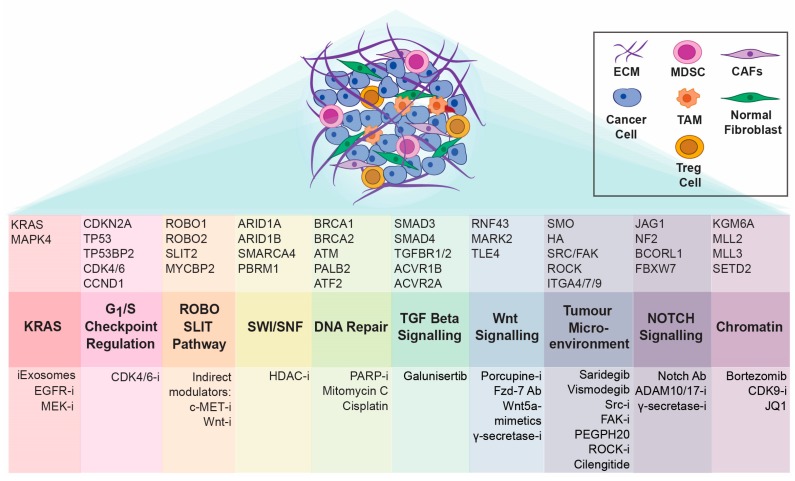
Pancreatic cancer is the third leading cause of cancer-related deaths, characterised by poor survival, marked molecular heterogeneity and high intrinsic and acquired chemoresistance. Only 10⁻20% of pancreatic cancer patients present with surgically resectable disease and even then, 80% die within 5 years. Our increasing understanding of the genomic heterogeneity of cancer suggests that the failure of definitive clinical trials to demonstrate efficacy in the majority of cases is likely due to the low proportion of responsive molecular subtypes. As a consequence, novel treatment strategies to approach this disease are urgently needed. Significant developments in the field of precision oncology have led to increasing molecular stratification of cancers into subtypes, where individual cancers are selected for optimal therapy depending on their molecular or genomic fingerprint. This review provides an overview of the current status of clinically used and emerging treatment strategies, and discusses the advances in and the potential for the implementation of precision medicine in this highly lethal malignancy, for which there are currently no curative systemic therapies.
胰腺癌是癌症相关死亡的第三大主要原因,其特点是生存率低、分子异质性显著以及固有的和获得性的高化疗耐药性。只有10%-20%的胰腺癌患者存在可手术切除的疾病,即便如此,80%的患者会在5年内死亡。我们对癌症基因组异质性的认识不断加深,这表明大多数确定性临床试验未能证明疗效,可能是由于反应性分子亚型的比例较低。因此,迫切需要针对这种疾病的新治疗策略。精准肿瘤学领域的重大进展导致癌症越来越多地被分子分层为亚型,根据个体癌症的分子或基因组特征选择最佳治疗方案。本综述概述了临床应用和新兴治疗策略的现状,并讨论了在这种高度致命的恶性肿瘤中实施精准医学的进展和潜力,目前尚无治愈性的全身治疗方法。