Division of Pharmacy and Optometry, School of Health Sciences, University of Manchester, Manchester, UK.
Institute of Pathophysiology, University Medical Centre of the Johannes Gutenberg University Mainz, Mainz, Germany.
Sci Rep. 2018 Nov 14;8(1):16804. doi: 10.1038/s41598-018-35103-1.
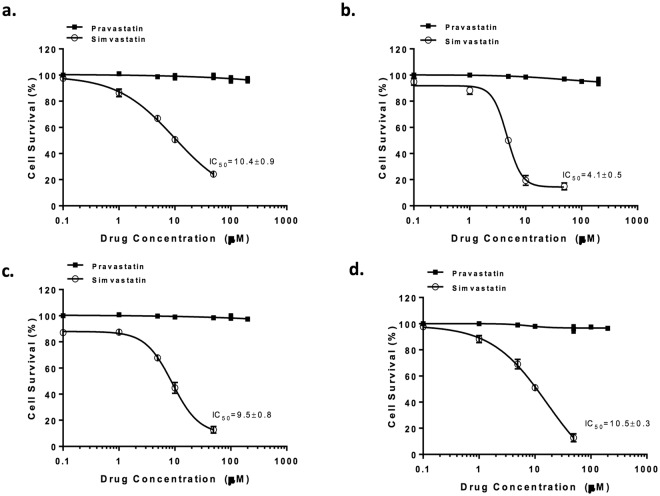
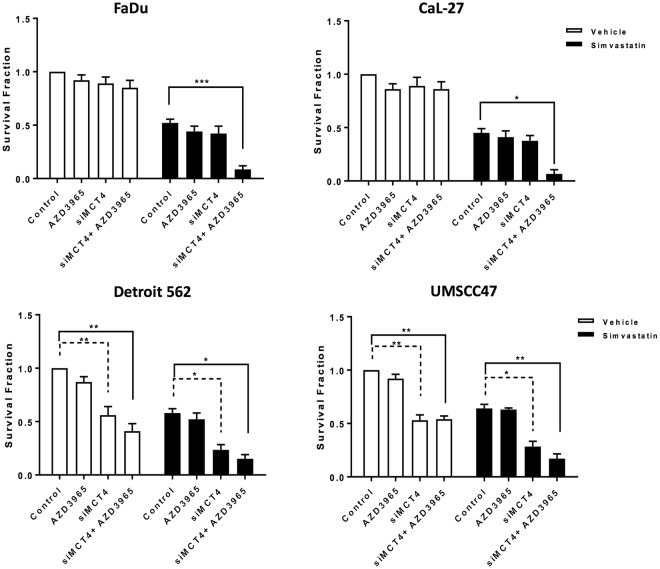
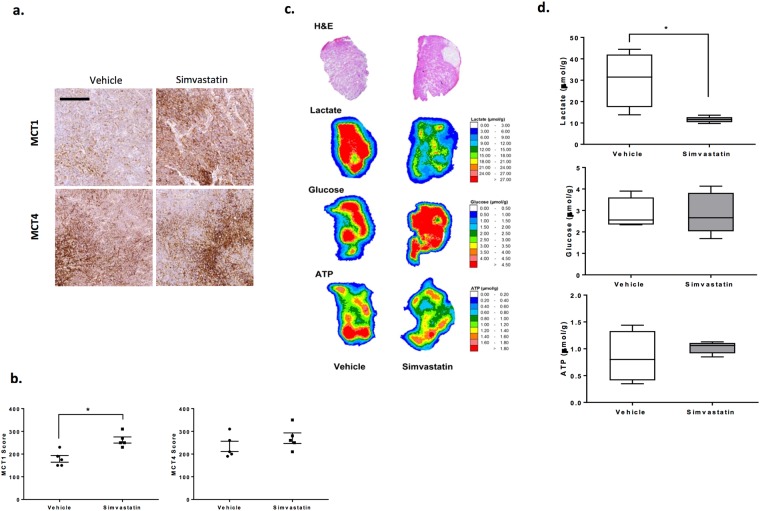
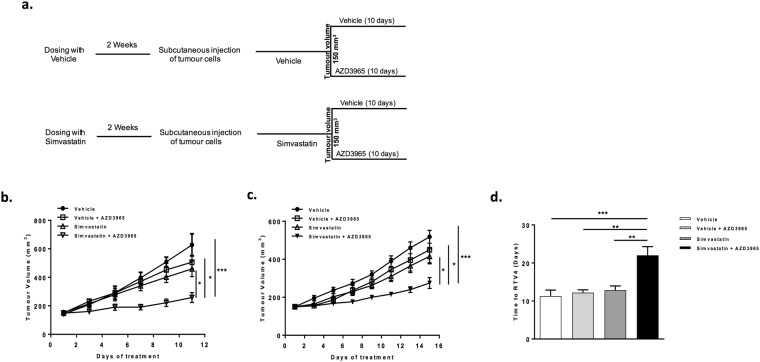
Prognosis of HPV negative head and neck squamous cell carcinoma (HNSCC) patients remains poor despite surgical and medical advances and inadequacy of predictive and prognostic biomarkers in this type of cancer highlights one of the challenges to successful therapy. Statins, widely used for the treatment of hyperlipidaemia, have been shown to possess anti-tumour effects which were partly attributed to their ability to interfere with metabolic pathways essential in the survival of cancer cells. Here, we have investigated the effect of statins on the metabolic modulation of HNSCC cancers with a vision to predict a personalised anticancer therapy. Although, treatment of tumour-bearing mice with simvastatin did not affect tumour growth, pre-treatment for 2 weeks prior to tumour injection, inhibited tumour growth resulting in strongly increased survival. This was associated with increased expression of the monocarboxylate transporter 1 (MCT1) and a significant reduction in tumour lactate content, suggesting a possible reliance of these tumours on oxidative phosphorylation for survival. Since MCT1 is responsible for the uptake of mitochondrial fuels into the cells, we reasoned that inhibiting it would be beneficial. Interestingly, combination of simvastatin with AZD3965 (MCT1 inhibitor) led to further tumour growth delay as compared to monotherapies, without signs of toxicity. In clinical biopsies, prediagnostic statin therapy was associated with a significantly higher MCT1 expression and was not of prognostic value following conventional chemo-radiotherapy. These findings provide a rationale to investigate the clinical effectiveness of MCT1 inhibition in patients with HNSCC who have been taking lipophilic statins prior to diagnosis.
HPV 阴性头颈部鳞状细胞癌 (HNSCC) 患者的预后仍然很差,尽管手术和医学取得了进步,但这种癌症的预测和预后生物标志物仍然不足,这凸显了成功治疗的挑战之一。他汀类药物被广泛用于治疗高脂血症,已被证明具有抗肿瘤作用,部分原因是它们能够干扰癌细胞生存所必需的代谢途径。在这里,我们研究了他汀类药物对 HNSCC 癌症代谢调节的影响,以期预测个性化的抗癌治疗。尽管辛伐他汀治疗荷瘤小鼠并不影响肿瘤生长,但在肿瘤注射前预处理 2 周可抑制肿瘤生长,从而显著提高生存率。这与单羧酸转运蛋白 1 (MCT1) 的表达增加和肿瘤乳酸含量的显著降低有关,表明这些肿瘤可能依赖氧化磷酸化来生存。由于 MCT1 负责将线粒体燃料摄取到细胞中,我们推断抑制它将是有益的。有趣的是,与单药治疗相比,辛伐他汀与 AZD3965(MCT1 抑制剂)联合使用导致肿瘤生长进一步延迟,而没有毒性迹象。在临床活检中,与常规放化疗后相比,预测性他汀类药物治疗与 MCT1 表达显著升高相关,而与预后无关。这些发现为在接受诊断前使用亲脂性他汀类药物的 HNSCC 患者中研究 MCT1 抑制的临床效果提供了依据。